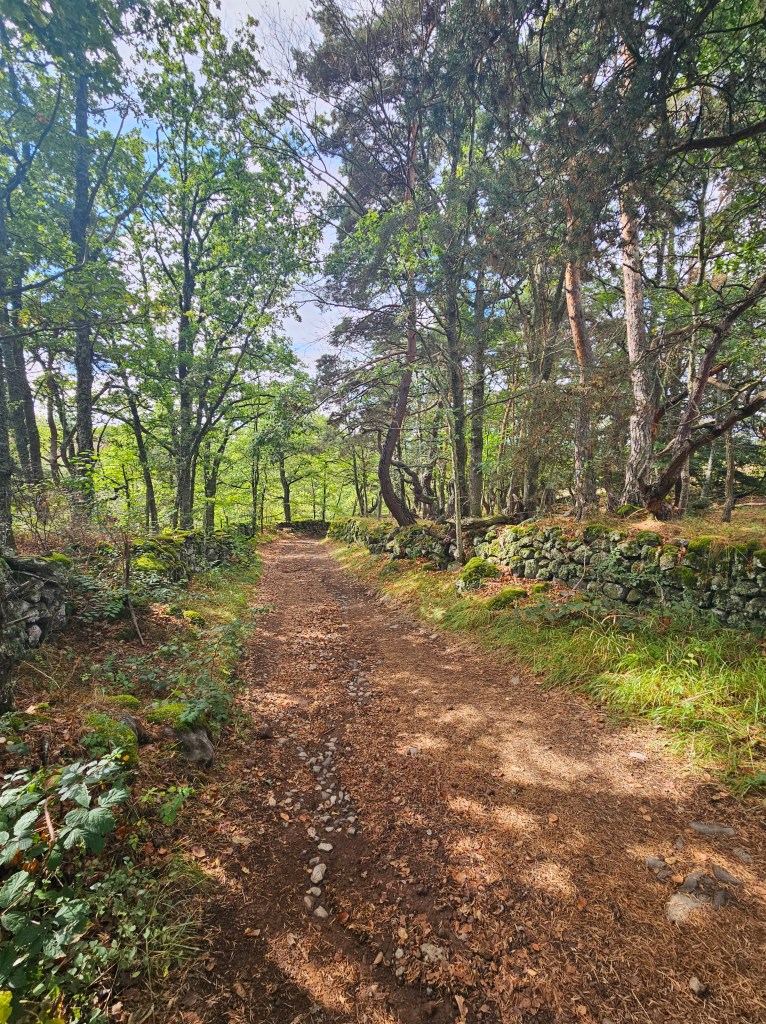
A very fine beginning on Le Chemin. Cool and overcast, no rain, we had an easy day: just 16.9 km/10.35 miles. The pack feels fine now that I received some tips on packing, where to settle the main weight, and how to use the load straps. The Caminho Portugues could have been so much more comfortable.
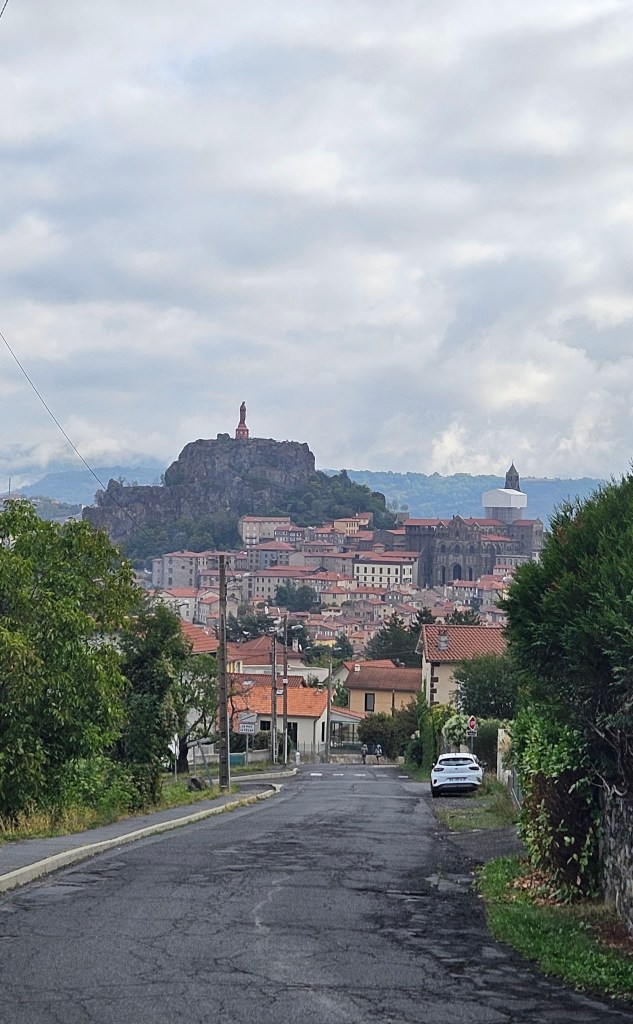
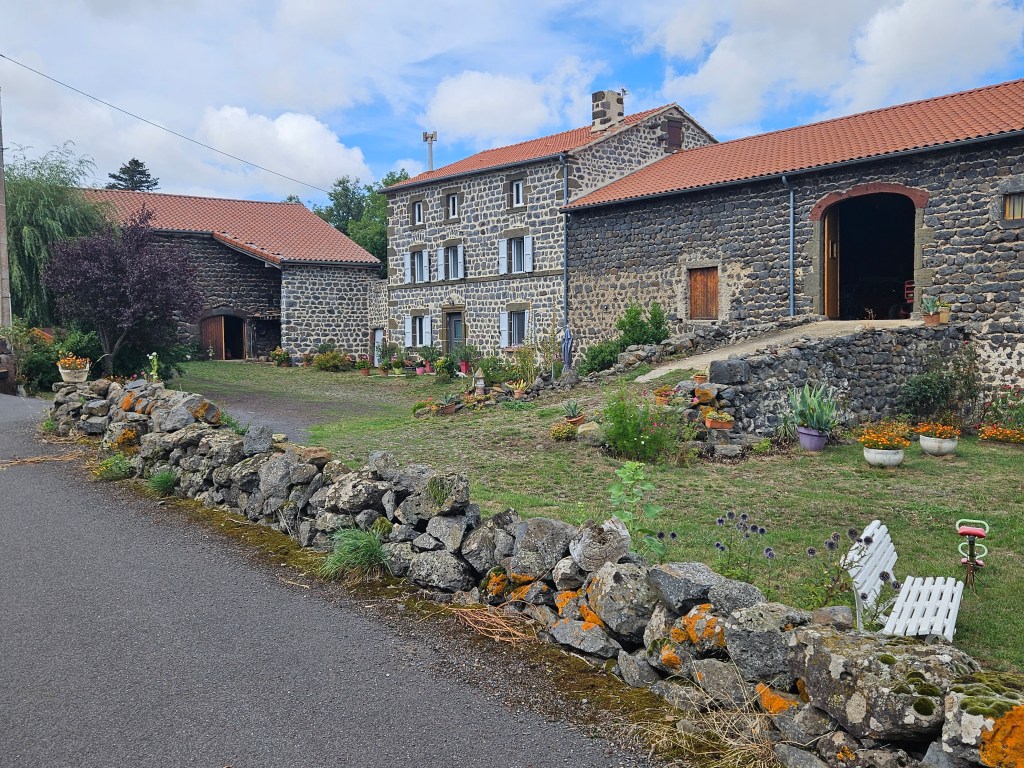
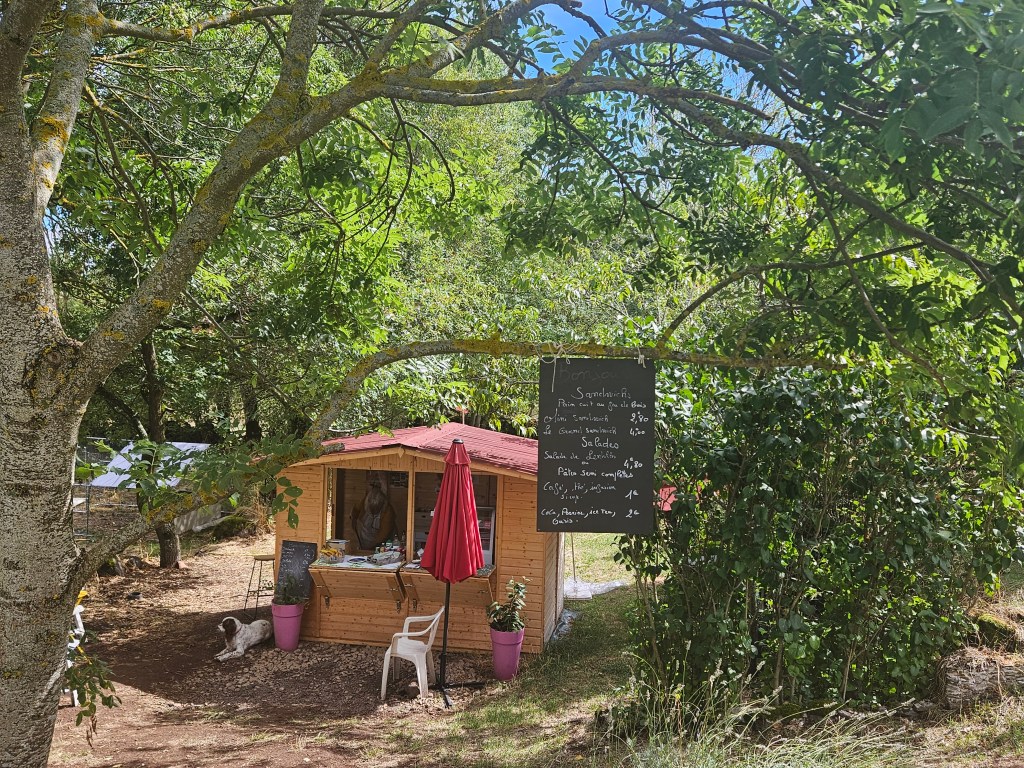
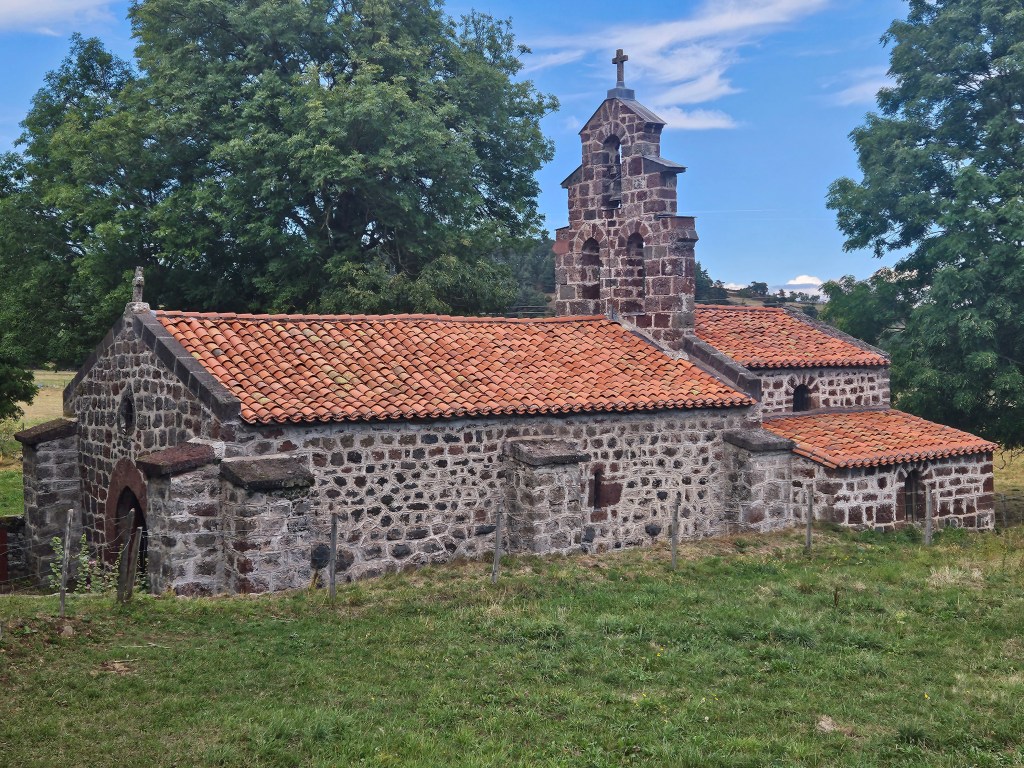
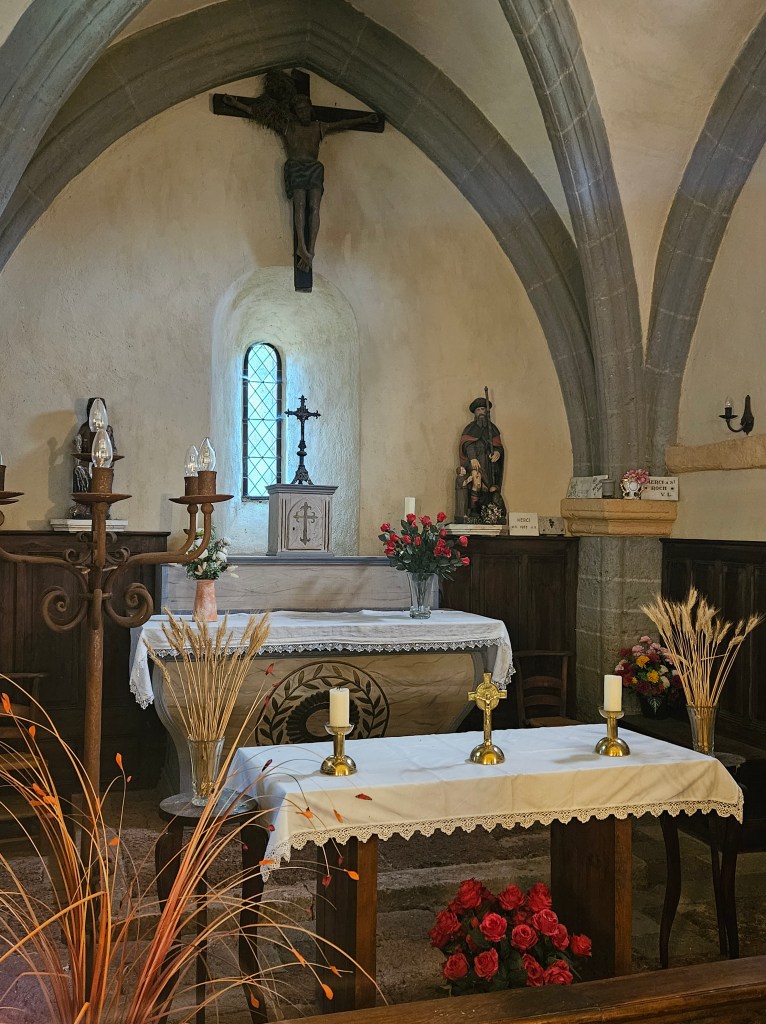
Au revoir à Le Puy St. CristopheThe first place I left some of mom’s and dad’s ashes.A ferme-bloc – house and barn are attached. Snack house along the way La Chapelle de St. Roch, circa 1321Inside La Chapelle de St. Roch – he’s in back on the right.
St. Roch was a healer back during the plague. After his pilgrimage to Compostella, he traveled around providing healing to those who contracted the plague. Until, that is, he came down with the plague himself. Then he was shunned and lived alone, only squeaking by due to a dog that would bring him bread. This is why he is always depicted with a dog by his side, and his robe lifted to show his plague wound. A Pilgrim shell and gourd are also included, so don’t confuse him with St. Jacques!
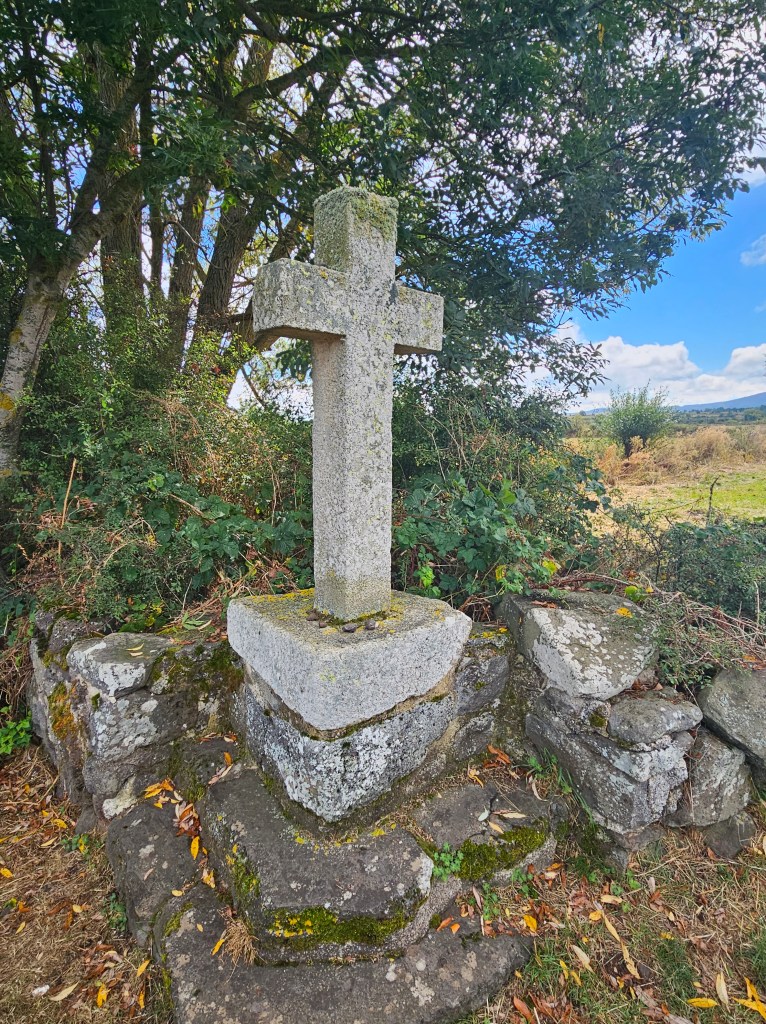
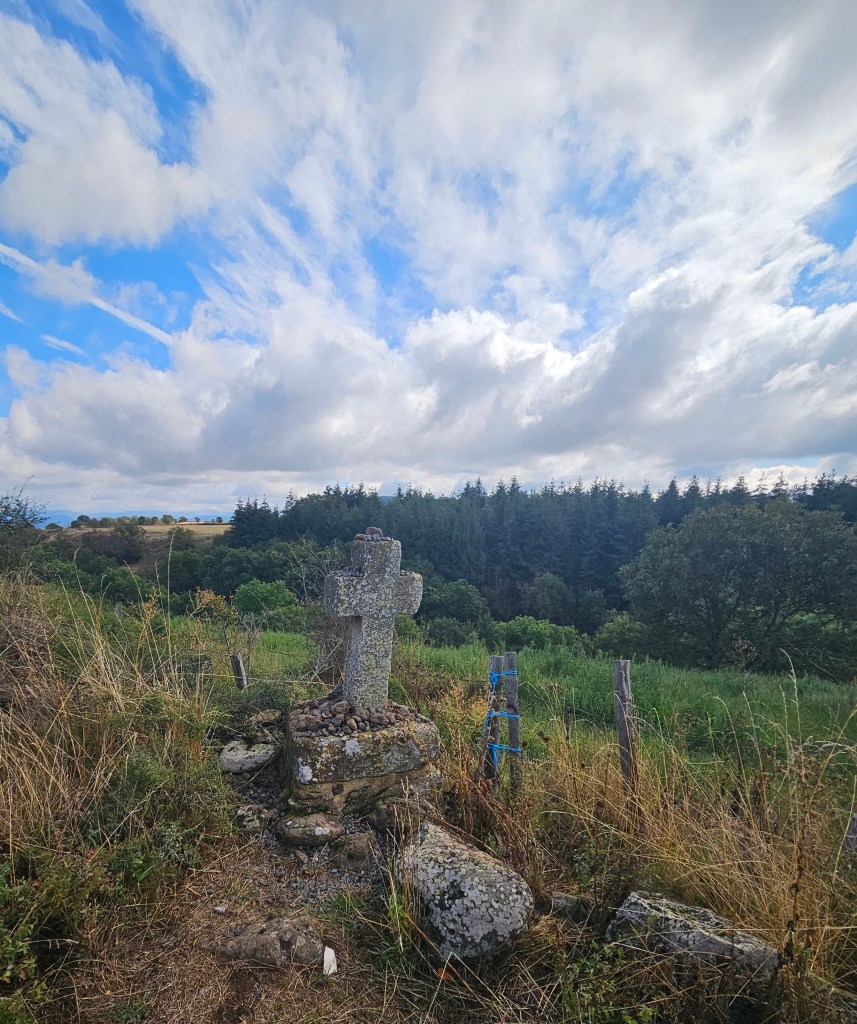
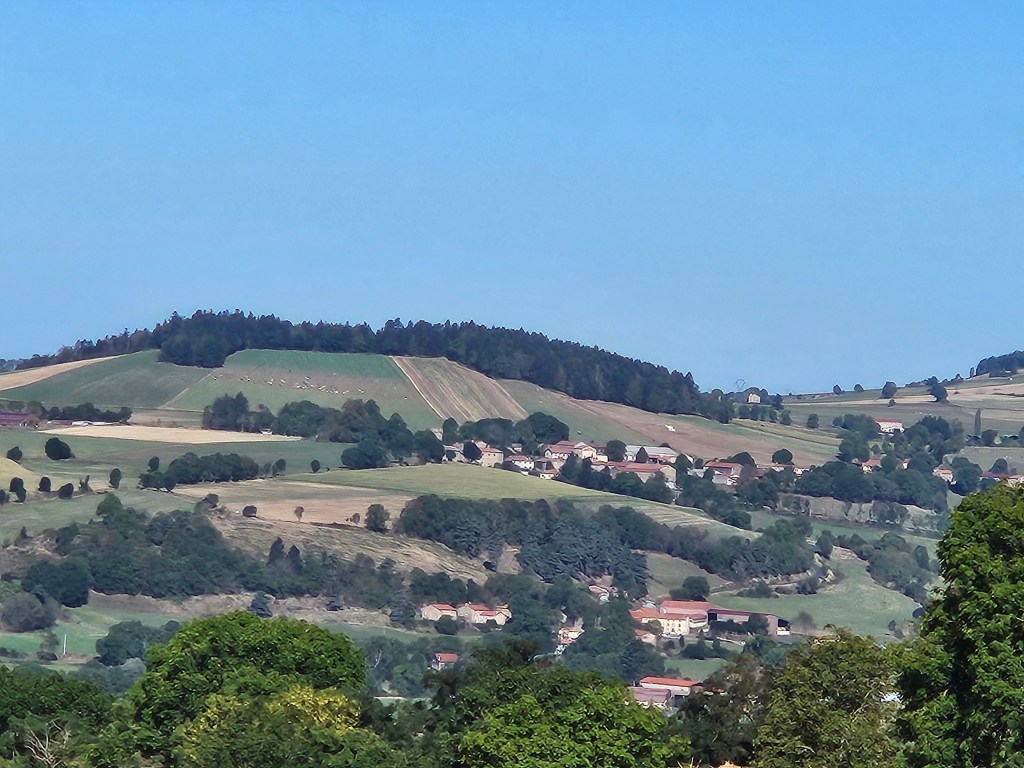
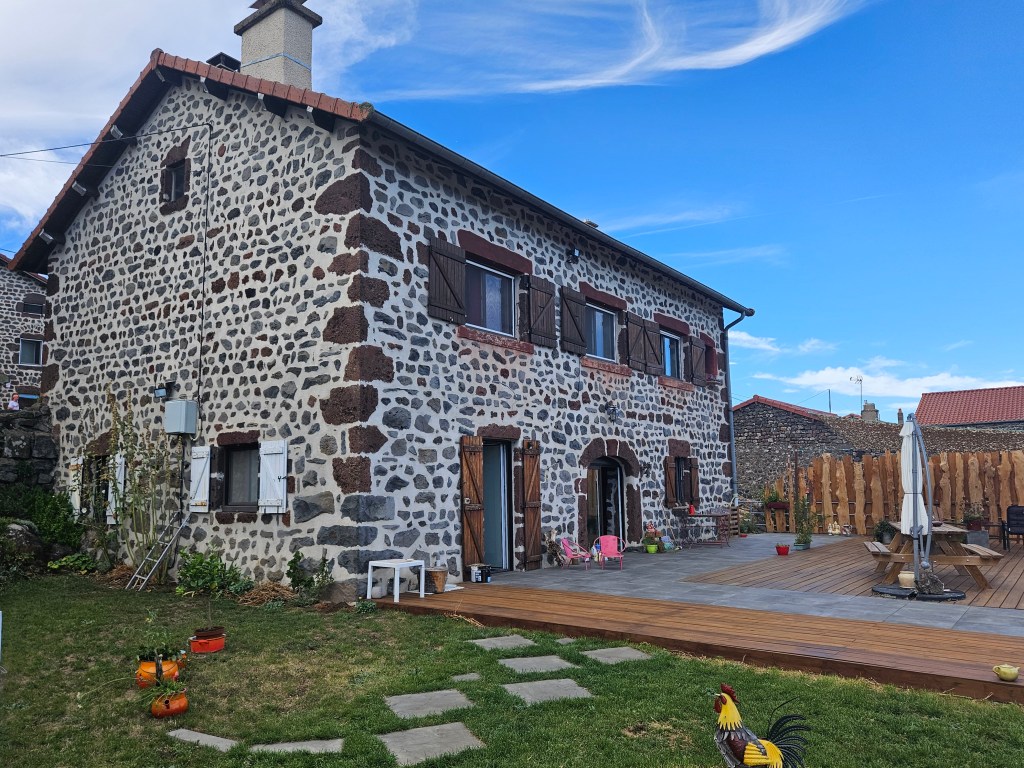
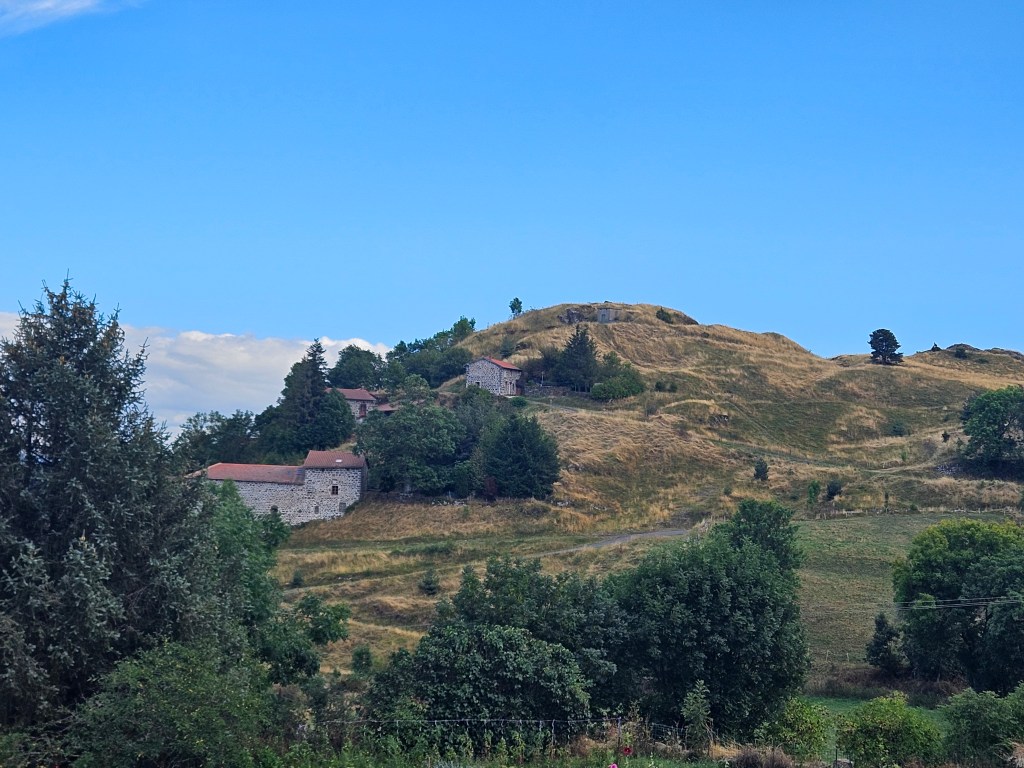
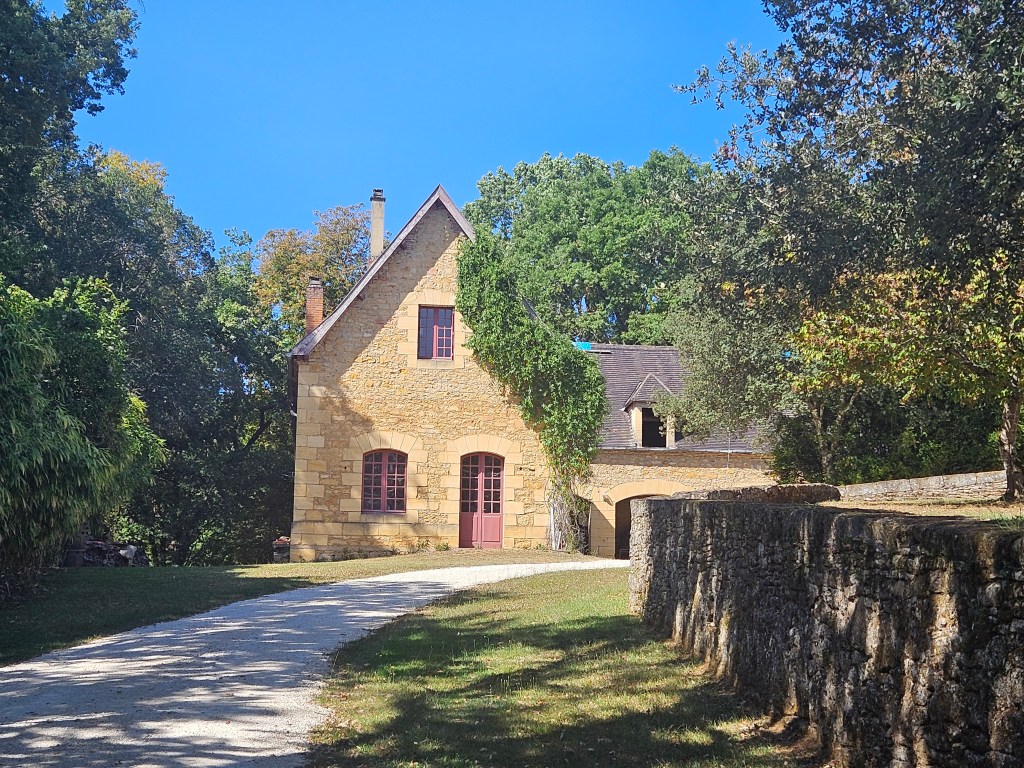
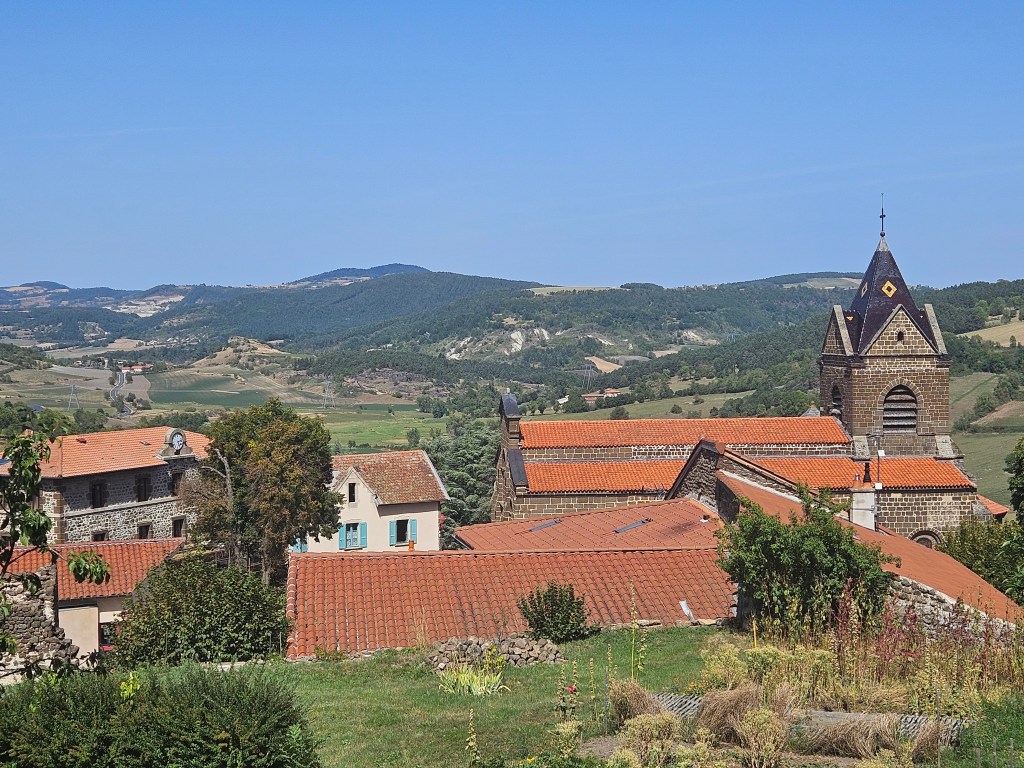
These crosses are ancient way markers of the pilgrimage route.Little towns tumbling down the hillsides.Gite La 1ère Étape in Monbonnet
We had a very comfy stay here. But we didn’t stay in that building. The owners, Anne and Didier, live above. A few rooms for pilgrims and the kitchen and dining room are below. We were 20 pilgrims gathered around the dining table, along with Anne and Didier, and the only English speakers. Everyone else was French. They were all very kind to compliment my ragged French. Mostly they carried on in a voluble way with lots of laughter. I wish I’d been born in France. I’m a Francophile for sure.
Dinner was delicious, multi-coursed, and filling: vegetable quiche and salad (with veggies from their garden), green lentils of Le Puy with sausage, rice, cheese, various desserts: a clafouti, a banana cake, a grape tart. A lot! Only thing missing was the wine! We could have bought a glass or a pitcher, but as no one else was drinking, we eschewed it as well. Did have a glass earlier…
The view outside my window
That’s the day (14 sept), mostly in photos. I’m a day behind because we had terrible wifi there. Maybe I’ll get to today, today, but maybe not till tomorrow!
We had a MUCH more comfortable drive returning to Lyon from Domme than getting there. We left about 8 am, so it was cooler. Plus it was overcast. So different from that so hot drive without air conditioner on the 7th.
Our welcome at the Gîte we had booked in Le was non-existent. The host had not responded to Ed’s emails prior to our arrival, nor did he respond to our phone calls that we had arrived and were waiting for him to allow us entry.
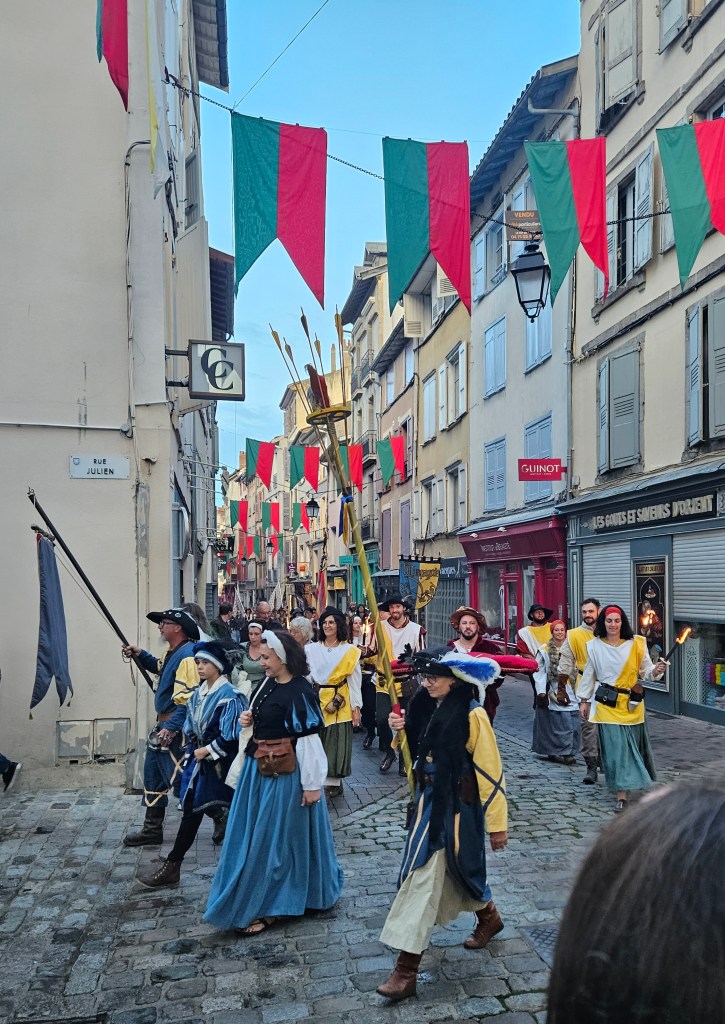
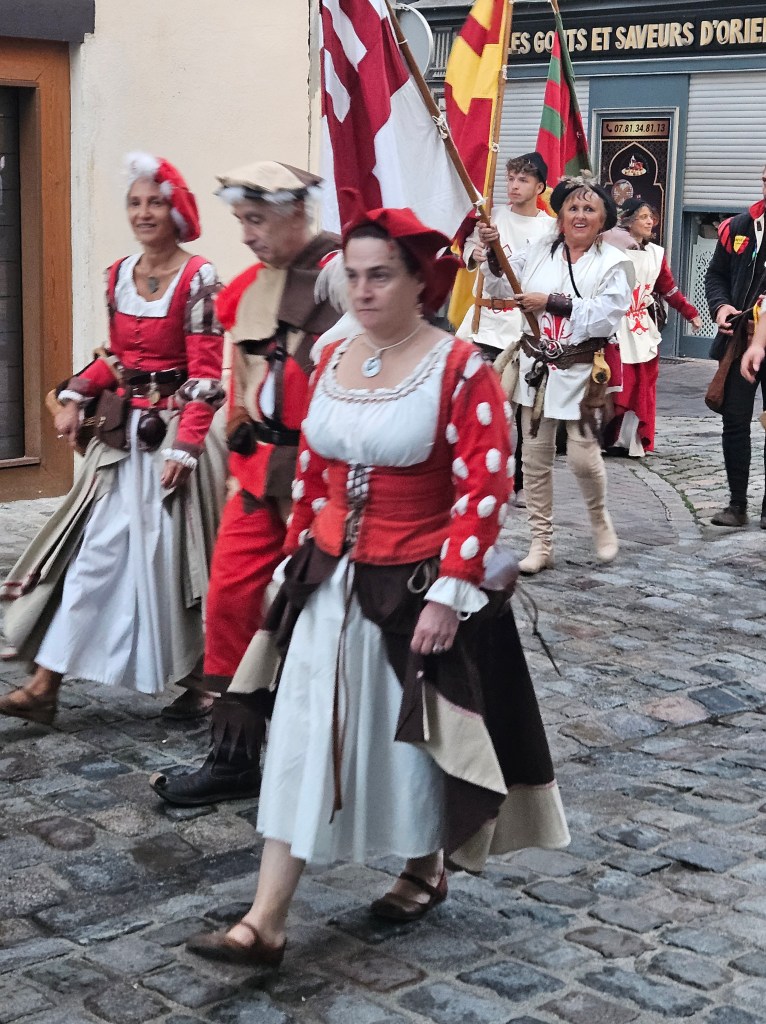
Plan B. Find another place. Not so easy when the 38th annual medieval festival, Roi de L’Oiseau, was commencing.
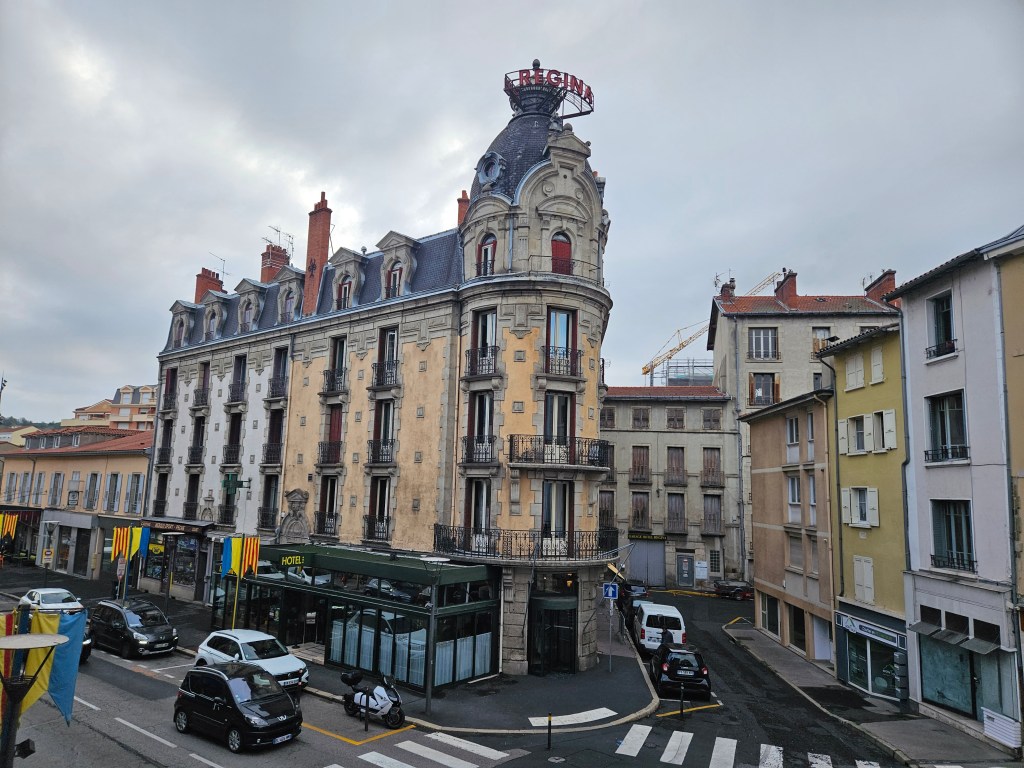
Called a few places. Complet. Third try, we got lucky – the last room at the Dyke hotel. Decent price and breakfast of French bread, croissant, coffee. The room faced a busy street and a bar, so the noise didn’t abate much, but we did manage to sleep some.
View from the room
Would have been nice to experience the Renaissance Fair, but the Chemin called!
I was about half way through my order of rougail saucisses when I had to ask, “What did I do to deserve this?” By “this” I meant being on a shaded patio in a roadside brasserie on a hot summer afternoon in a quiet country village in France. We are in the gastronomic heart of France and having another exceptional meal.
We had been driving from our home base near Domme to the prehistoric cave in Peche Merle, and now on the way to Rocamadour. In addition to being the heart of Deep France, this region is one of the longest continuously inhabited places in the world, having human habitations ranging back to 400,000 years before present.
How do you wrap your head around that? The cave art at Peche Merle dates from over 30,000 years ago, shortly after, in geologic terms, the Cro Magnon humanoid was emerging on the European continent.
And here we were, having transported ourselves in a metal contraption over the land at 80 km/hrs, powered by fuels that were slowly forming when this area was being settled.
What have I done to deserve being here, at this time, in this place, having this experience as the flavor of the sauce dissolved in my mouth, a sauce created through countless millenia of human evolution.
The answer, of course, is “nothing.”
When we determined to delay our start on the Chemin St. Jacque we had to make a few decisions, such as where we would spend the 10 days or so, how we would get there, and what we would be doing. I must admit that our initial response was to return to Lyon since there were more transportation options to a greater array of destinations.
After making a non refundable apartment reservation, we decided that we really wanted to spend the time in “Deep France,” a term we have encountered that refers to the southwestern rural areas, in other words the same general area ẁe had just left.
One of the reasons we chose”Deep France” derived from a series of novels written by Martin Walker about a municipal policeman named Bruno. Walker is a retired Scottish journalist who lives in the Dordogne region, and he situates his novels in the environs of his home. His descriptions of the area, the culture, and particularly the food, are quite compelling.
We rented a car in Lyon, reserved an apartment on the outskirts of Domme, and drove a bit more than 250 miles to get here. Although we enjoyed our time in Lyon it may have been a better choice to hunt down a rental car in Le Puy en Velay, which is less that two hours away rather that spent the time and gas and tolls to get here from Lyon.
Since we were already wasting money taking the long way here, it might also have been a good idea to not scrimp on the rental car, sorrento another thirty dollars on a weekly rental for a vehicle with more than one rubber band.
Is that an archaic reference?
As it is, we got a Fiat 500 hybrid with a six speed manual transmission. Sixth is fine for downhill and flat terrain, but is useless on the long uphill grades between Lyon and Sarlat. We arrive at our destinations much later than anticipated since we can only maintain a fraction of the 120 km/hr velocity that Google Maps uses to calculate arrival times.
On the rural country roads, however, the car is perfectly serviceable, easily able to maintain the 80 km/hr speed limit. The only question is, why would you? Perhaps is the smallness of the car, the narrowness of the road, the sharpness of the curves, or the fact that I haven’t driven a manual transmission since the last time I was in France (twelve years ago), but it seems to me thatyou have to be crazy to drive that fast here.
There are a lot of crazy people in France.
I can’t drive more than a few miles before finding myself in the lead of a caravan of up to six cars, trucks, campers, and mobile homes. They’ve been speeding on these roads for 40,000 years, so I guess they have become comfortable with them.
Every few miles there is a quaint, picturesque village, an imposing fortress, a beautiful chateau, or another magnificent view. What we don’t see are strip malls and fast food restaurants.
Le BugueCompagneRocamadourURocamadourFrom CastelnaudDomme
Or vaping, though smoking is far more prevalent. France ranks number ten in countries for lung cancer. Hungary number one. Lung cancer among wo.en is generally lower. We smoke less.
I forgot to say that Pêche means hill, as does Merle, which could be from the language of the Guals.
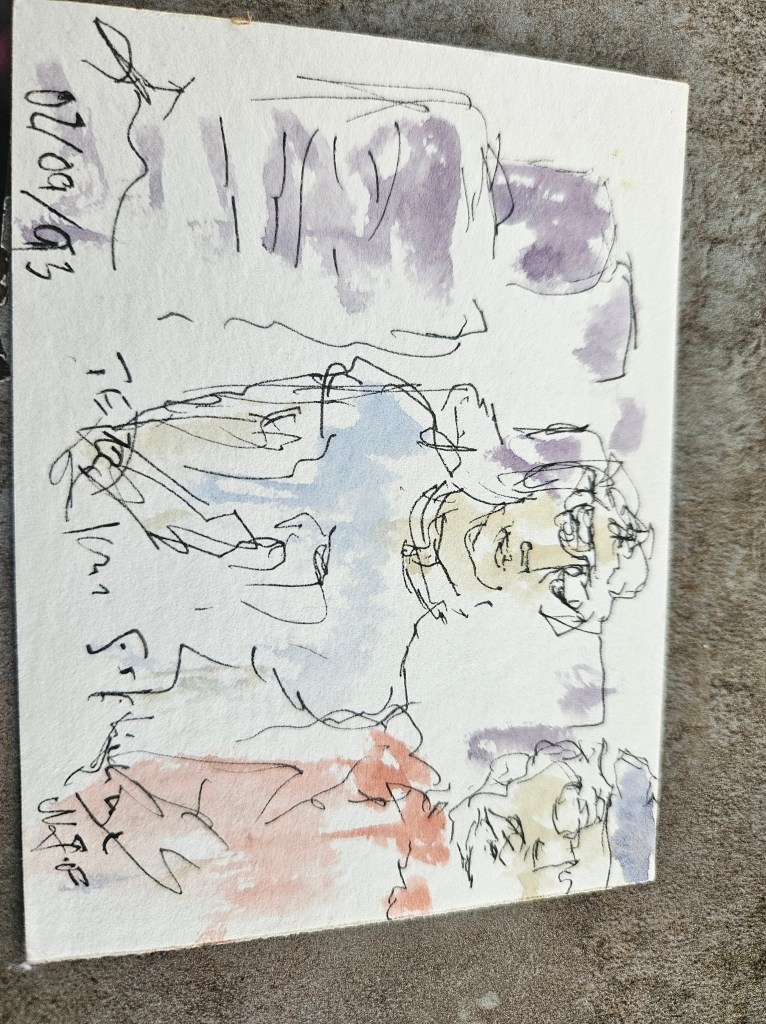
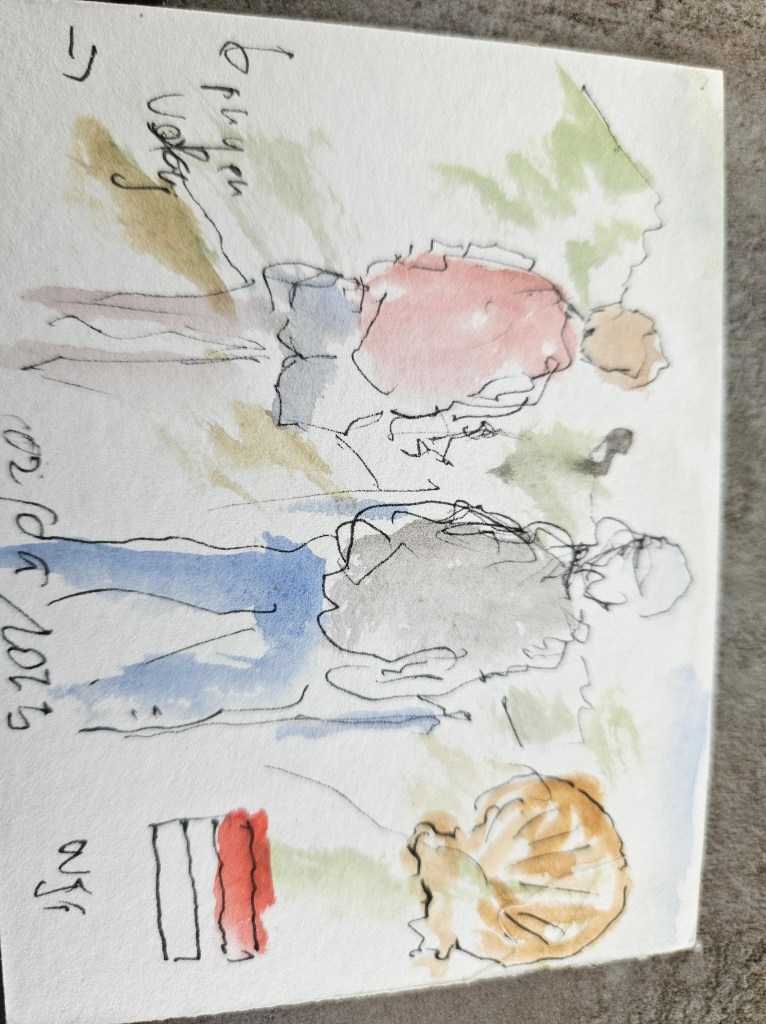
Remember François? We met him waiting for the train to Le Puy the first time we went to Le Puy. (We are heading there again today.) I didn’t mention that he travels with a small watercolor palette. Here are his gifts to us.
He imagined us on the Via Podiensis.
Toilet paper squares are rectangular.
If you want to add milk to your espresso, that’s an extra 30 centimes.
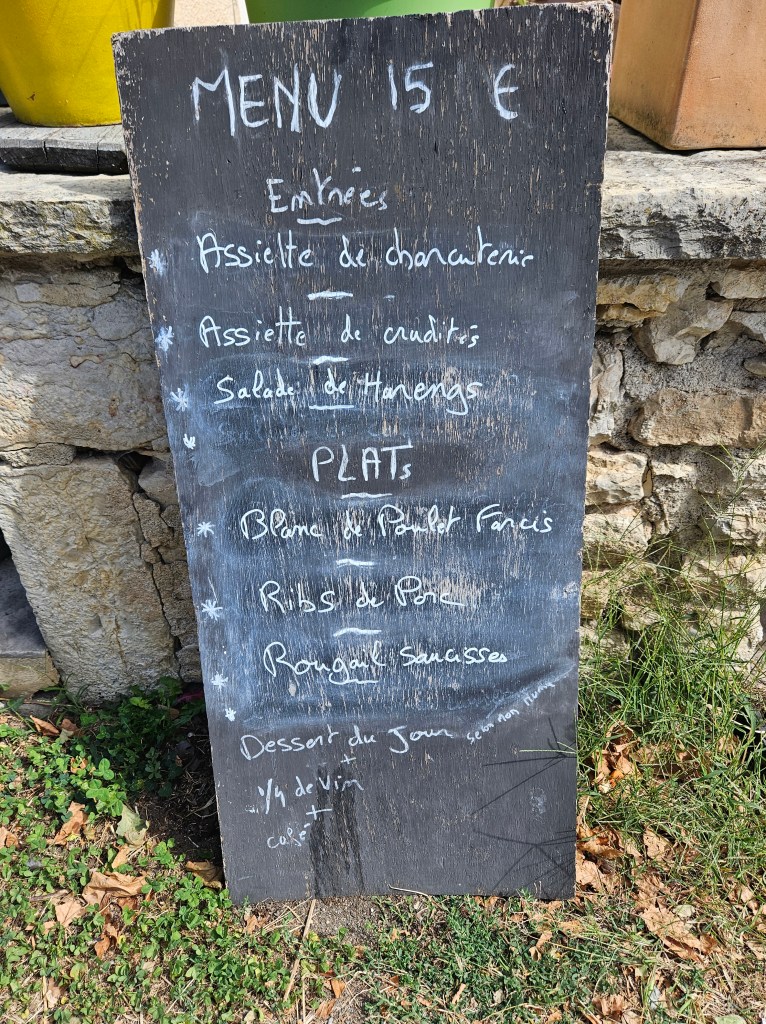
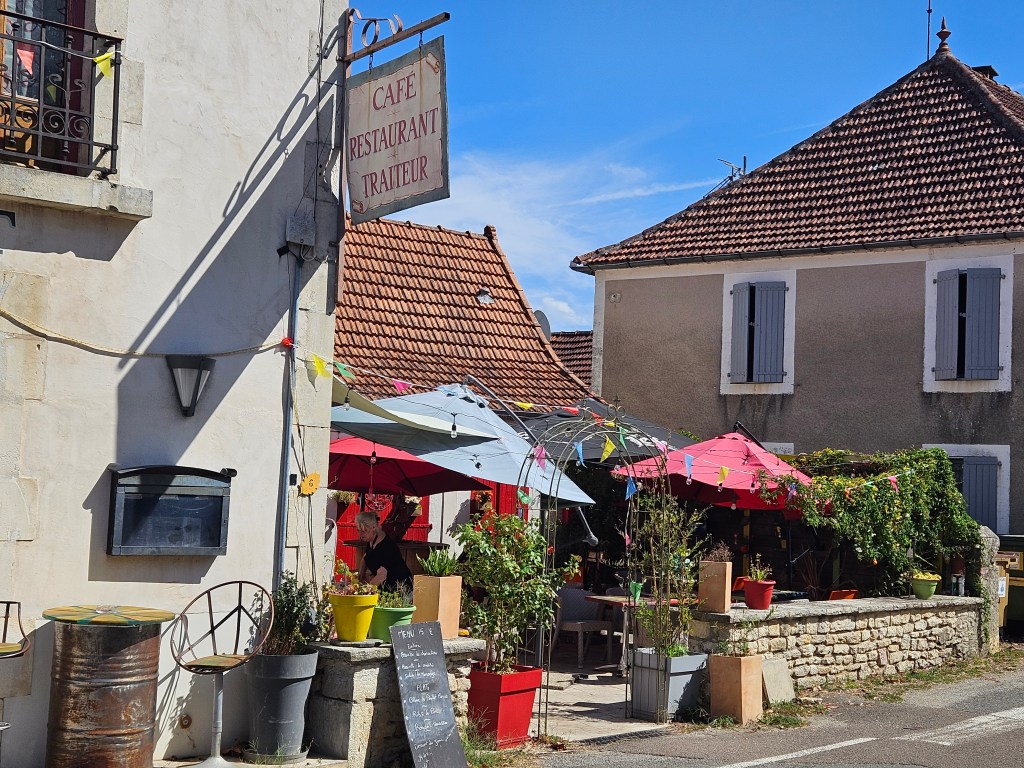
Between Pêche Merle and Rocamador, we stopped for lunch in Lauzes. Lauze is how the stone and timber roofs are named. I don’t think too many English speakers stop in here to the one bistro in town. Too bad. It was delicious! Here’s the menu.
I chose the crudités for the entrée and the Blanc du Poulet Farci for the plat. Chicken breast was never so delicious, in an unctuous cream sauce. Rosé wine. Chocolate pudding for dessert. And coffee! Can you imagine all that for $16.00? Blessings galore!A dream come true: sitting under umbrellas, eating fine French food, far from the maddening crowd. And friendly? Oh, yes.
This area is thick with them. Some appear to still be inhabited. Or the owners live nearby and use them periodically when the castle is closed for visitors.
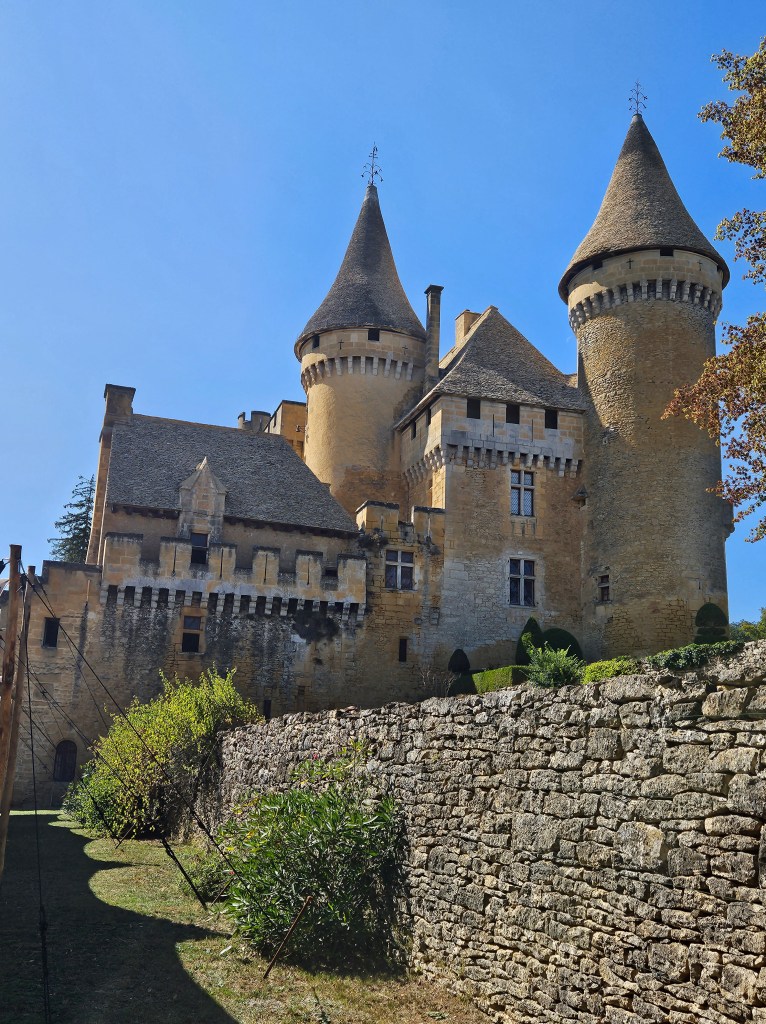
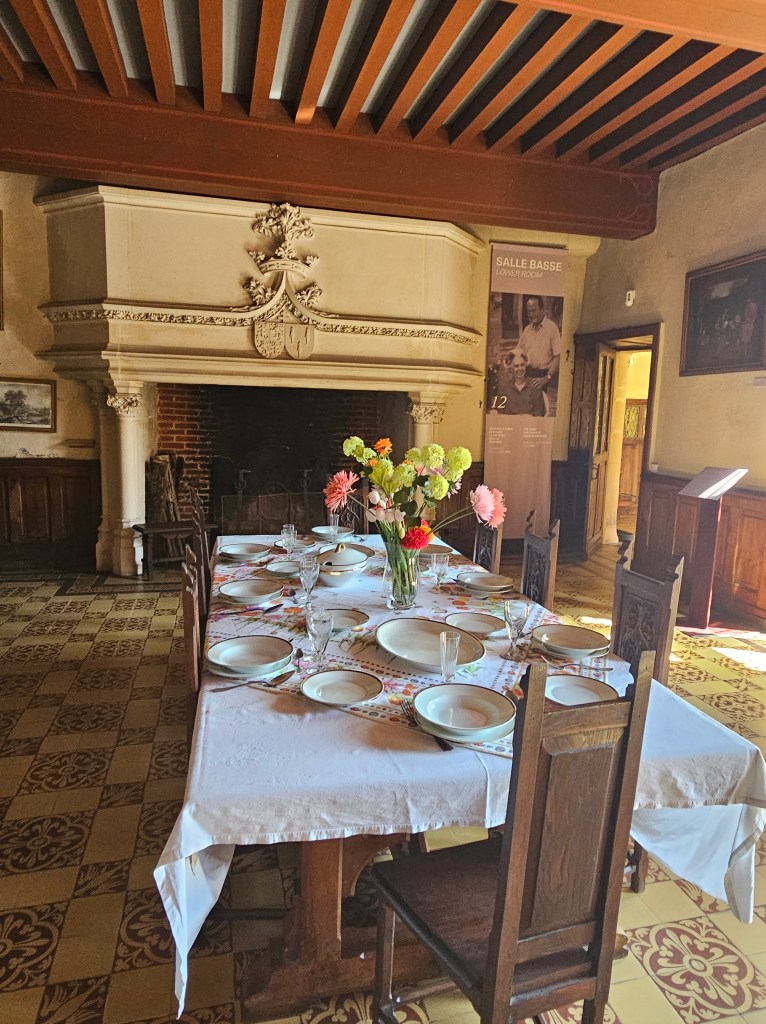
Chateau de Puymartin is one such we simply happened upon while driving. Built in the 13th century. It’s owners did live there as recently as 1920, when a daughter’s wedding was held there. Obviously that’s way too much history to go into. So here are a few photos instead. There’s always the internet…
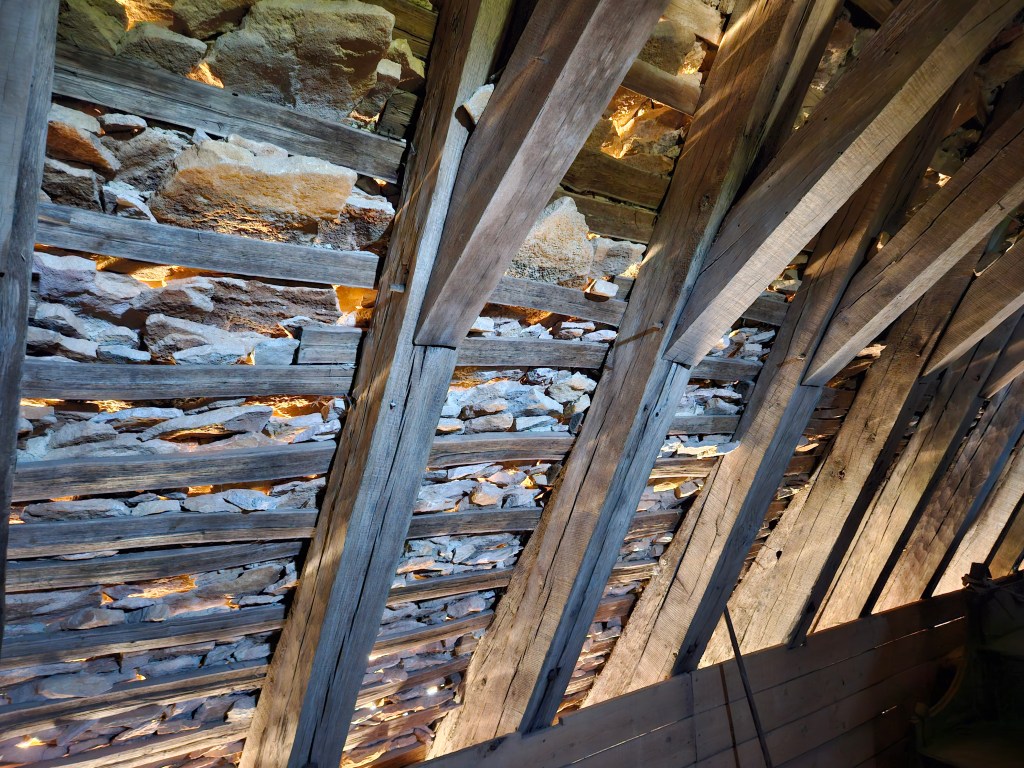
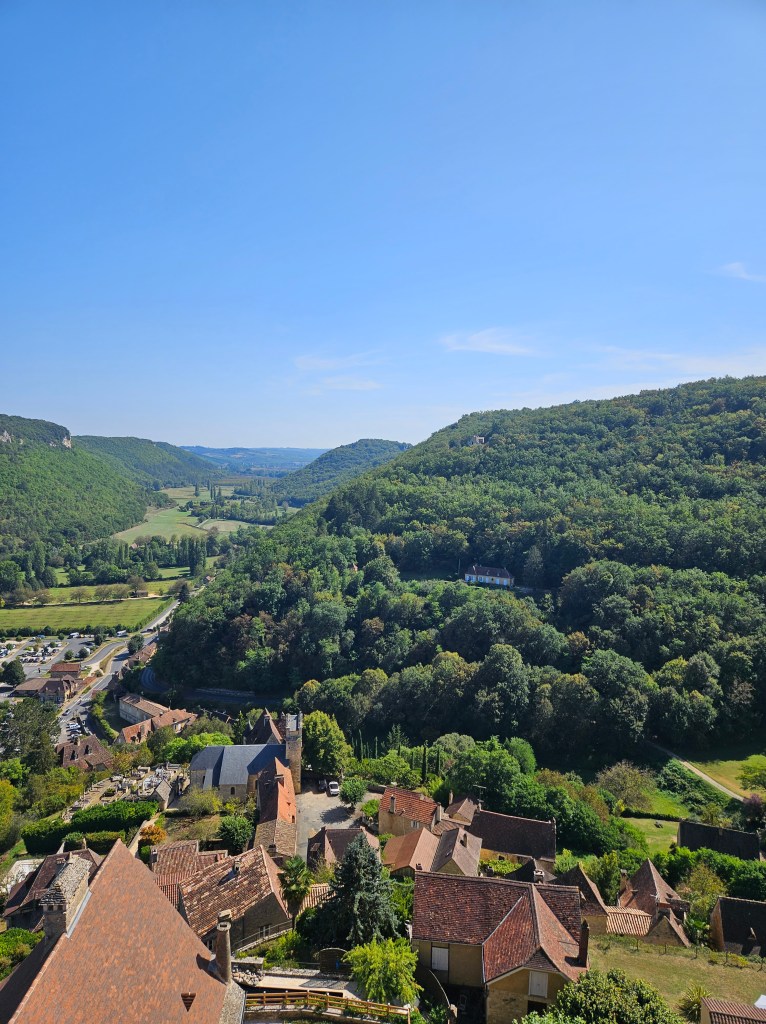
Chateau de PuymartinThis is a roof made of stone and wood, called lauzeDining room sometimes still used. Look at that fireplace!Chateau de Castlenaud – also the Museum of Medieval WeaponsView of the valley from the ramparts.
This castle had a fun interative game in which you had to rescue a comrad in arms. Scenarious were placed before you. Each time you had to select the course of action. For example, to break through a door do you: a. Use a petard (explosive devise) b. an ax c. a battering ram. The game provided 3 lives. We played twice and succeeded in saving Francois the second time!
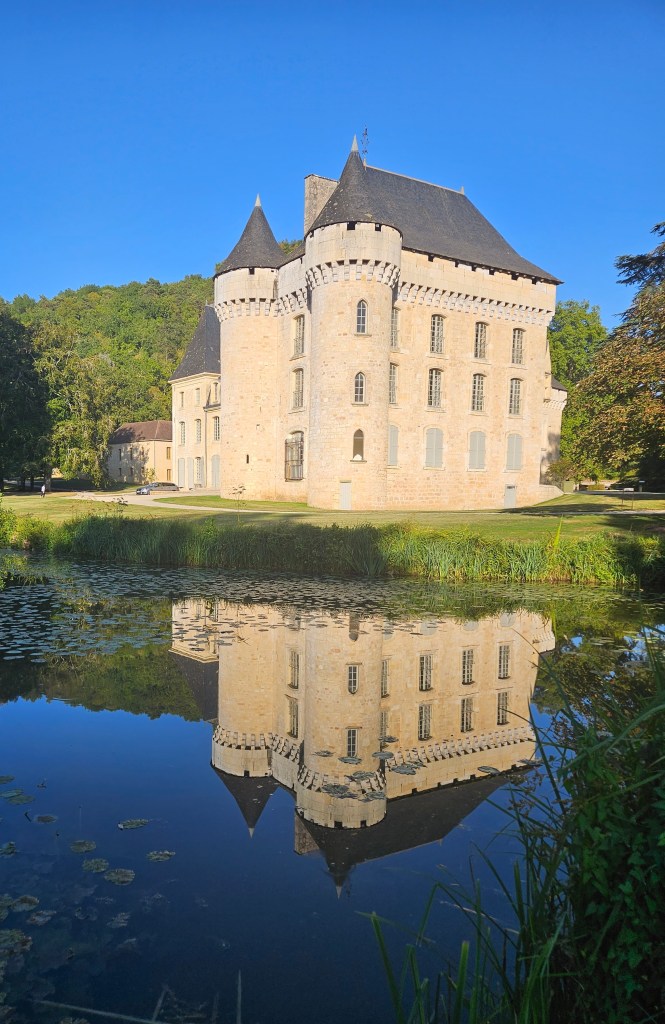
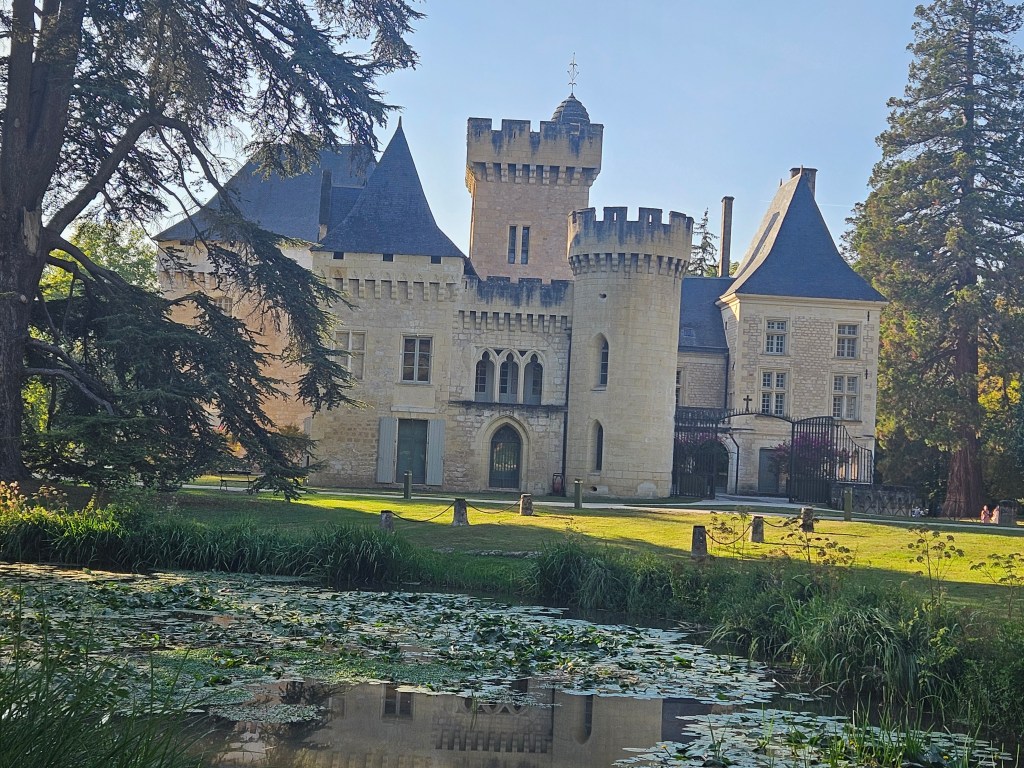
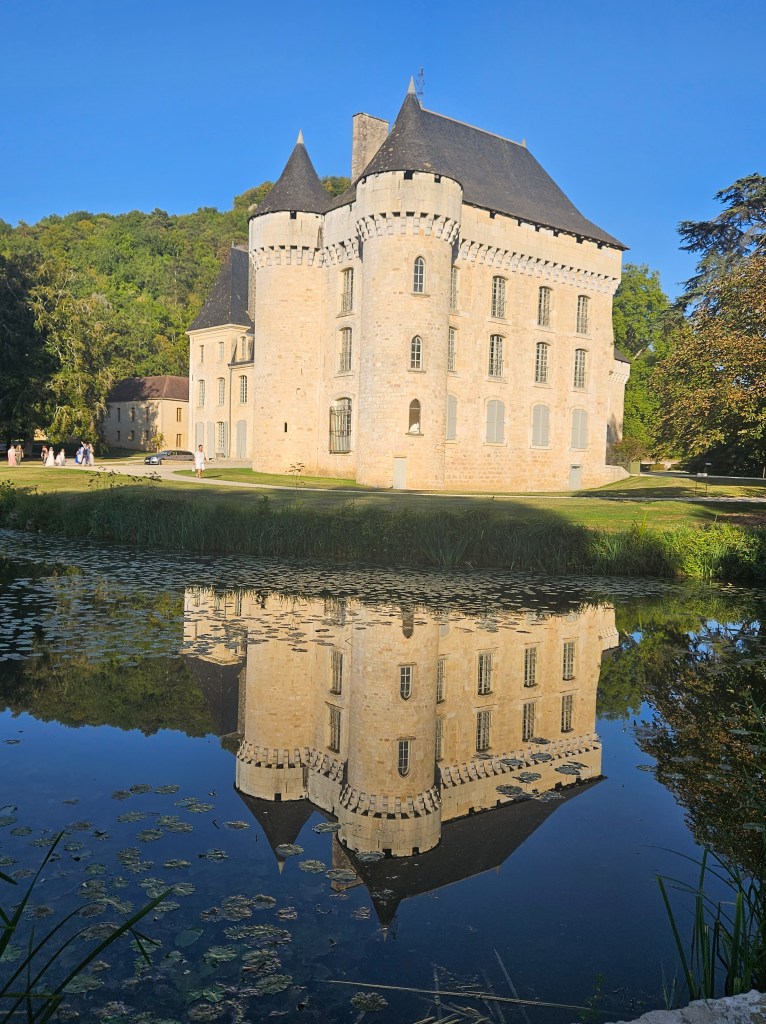
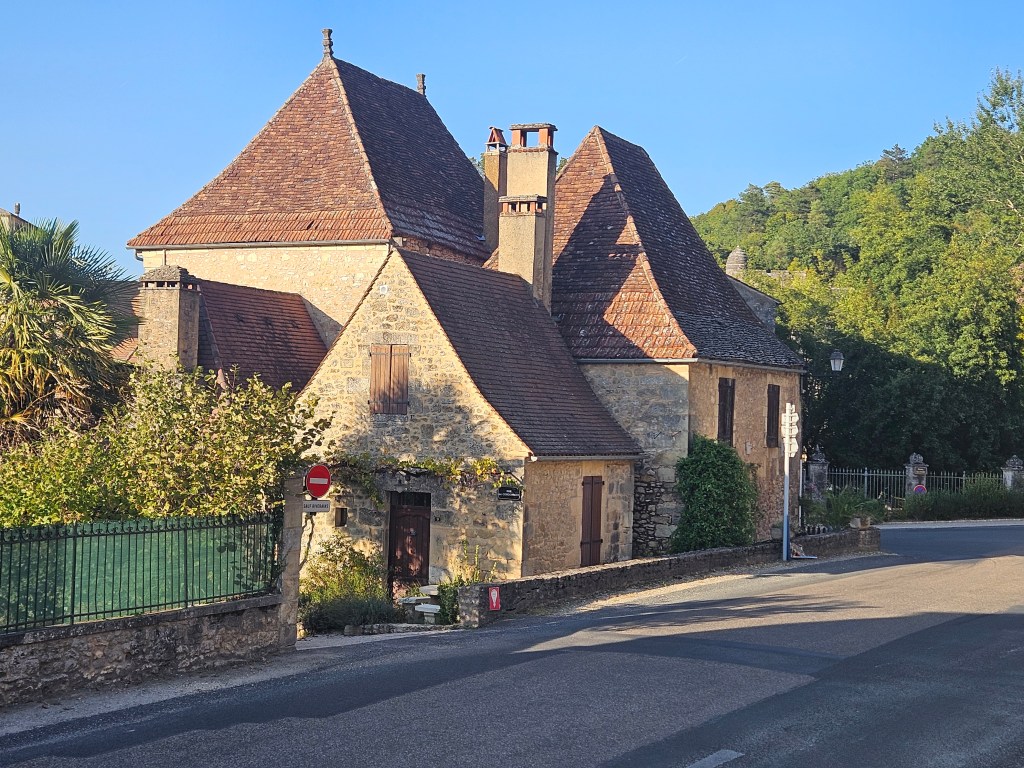
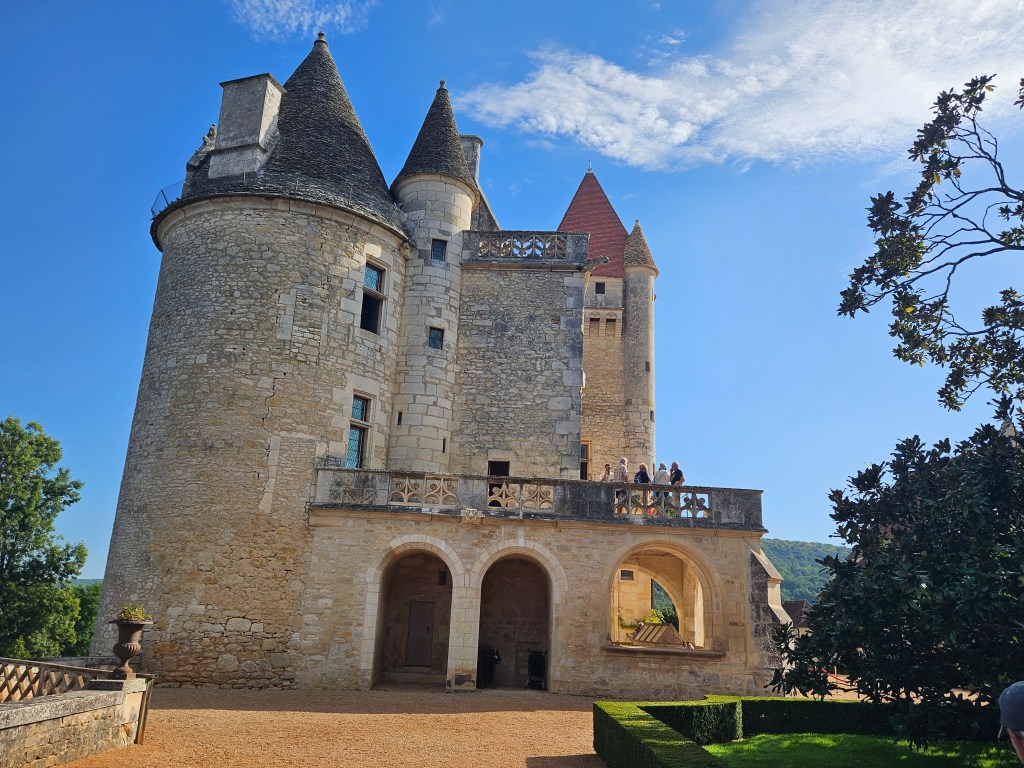
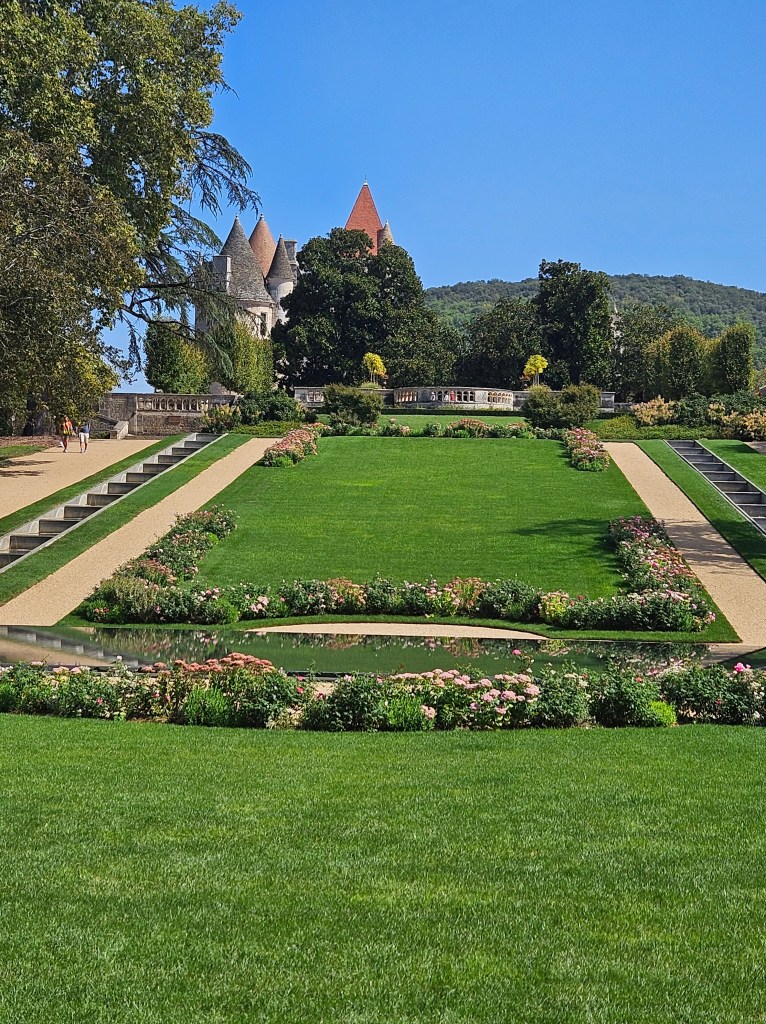
In Campagne, a tiny town with a lot of character – haven’t they all. Ed caught site of a castle, my eyes lit upon some roadside buildings.
Castle front – a serpentine garden surrounding the castle leading to a park Castle backyard – a wedding reception was being held here. Oh-la-laSo close to the road, though!
Rocamadour
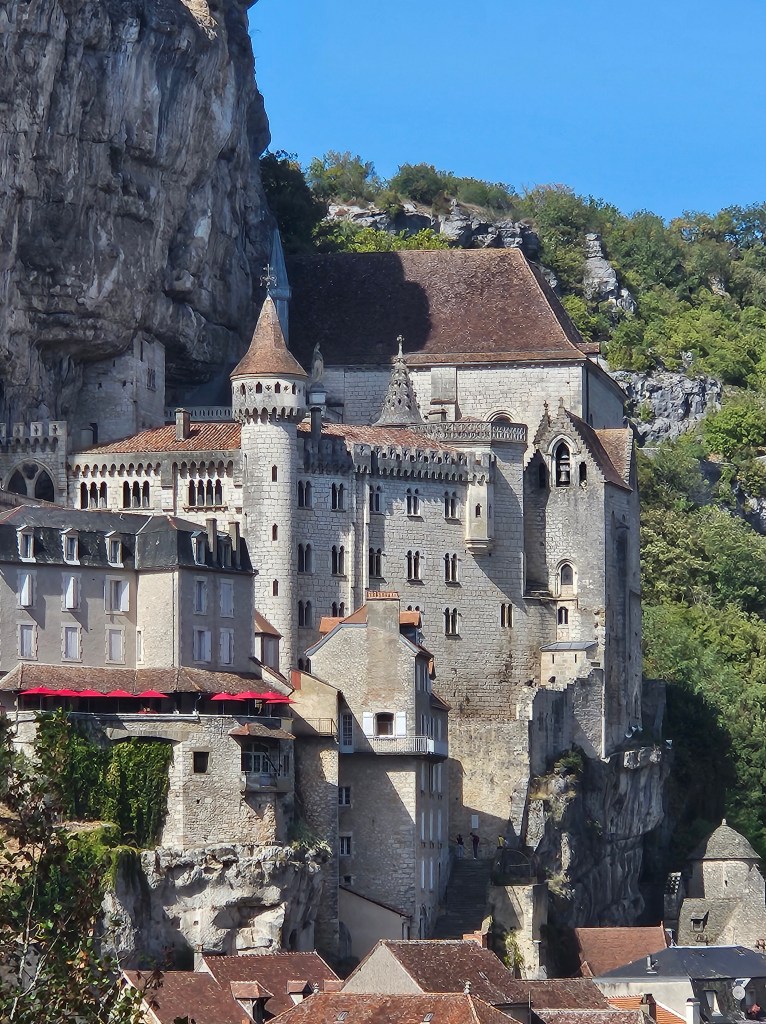
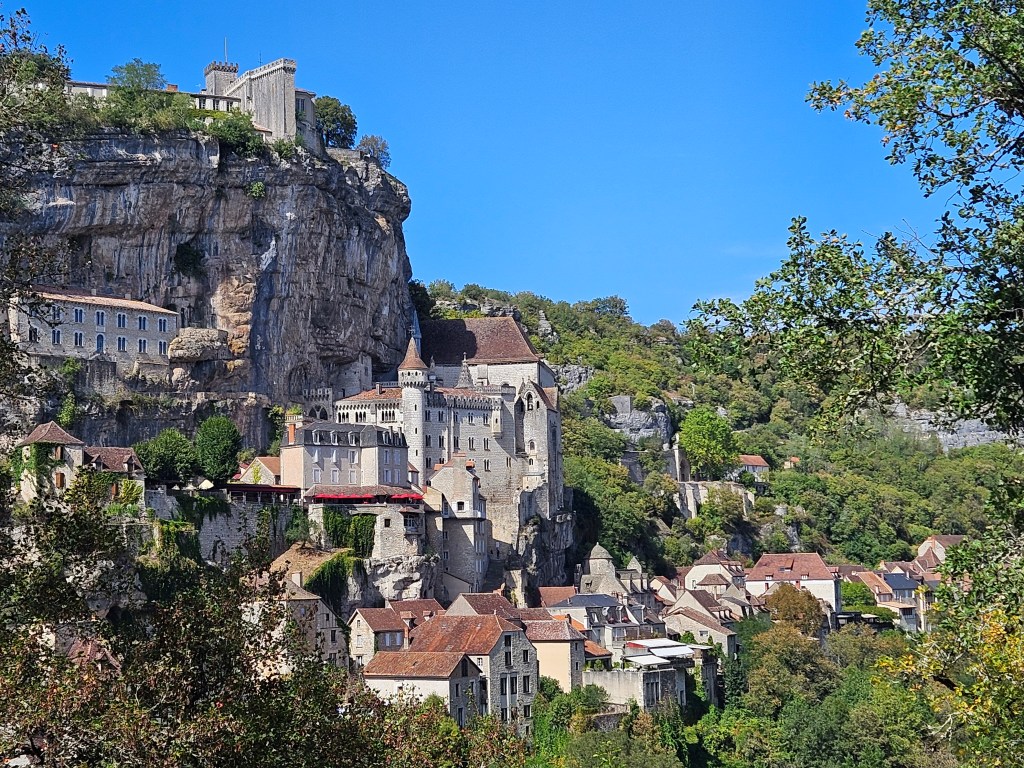
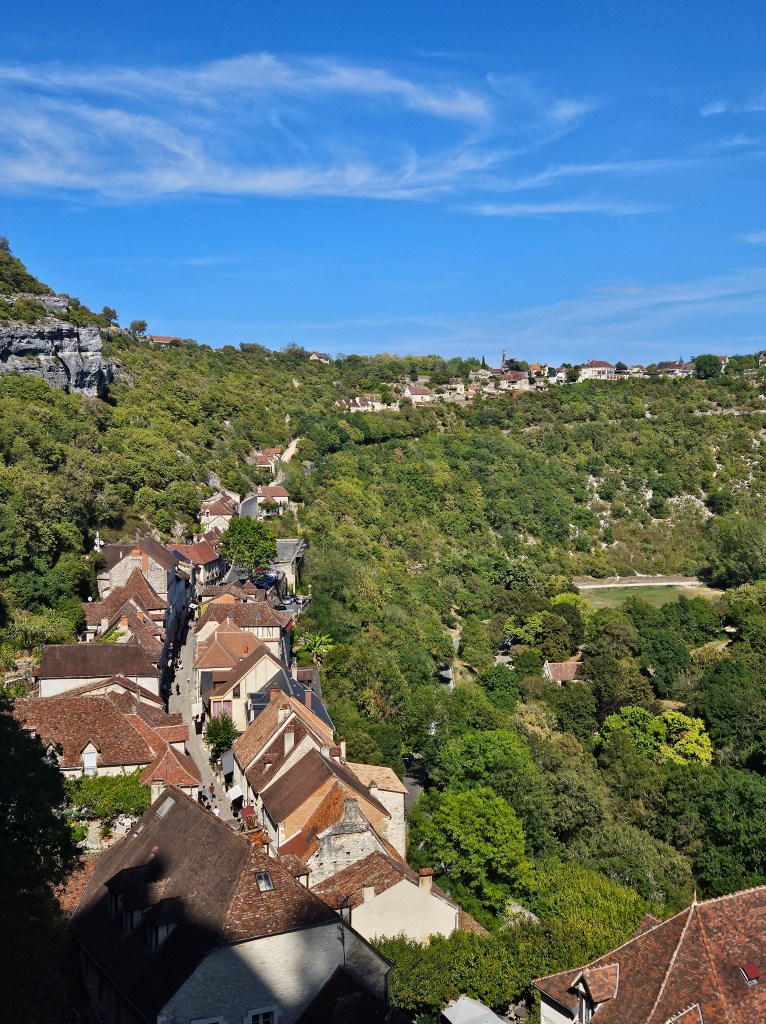
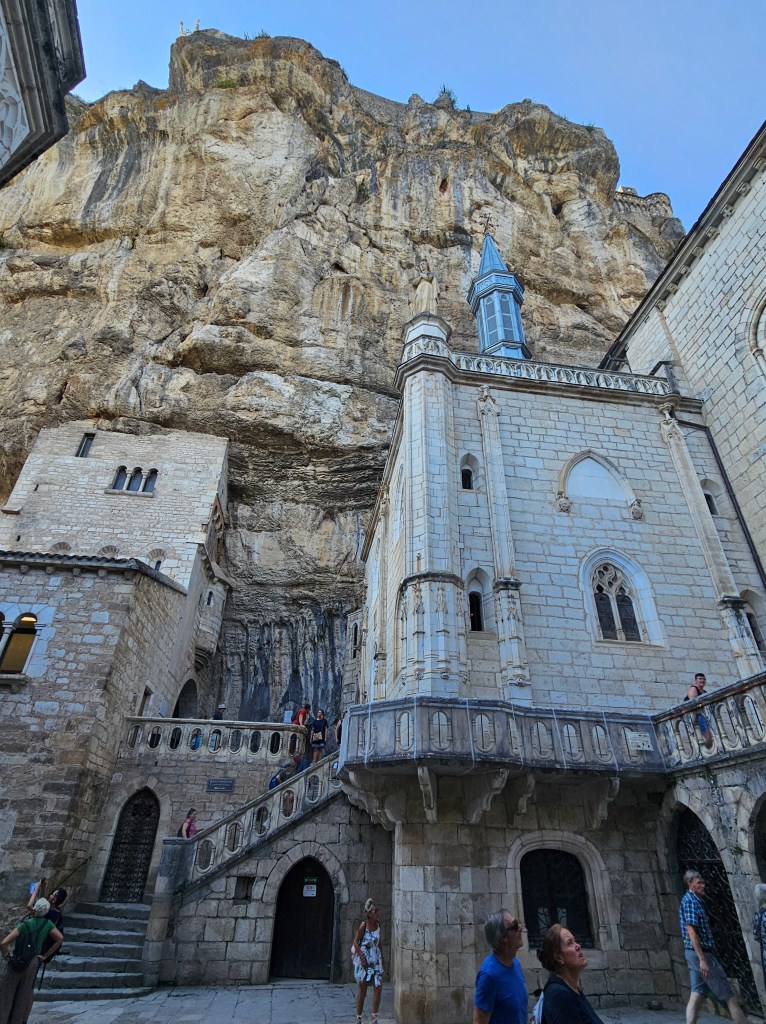
This is a popular variant on the Via Podiensis. Rocamadour owes its origin, according to tradition, to St. Amadour (or Amateur), who chose the spot as a hermitage. It became a place of pilgrimage in the early Middle Ages. More than 200 steps lead up the rock to the sanctuary. The churches in the sanctuary include the Romanesque basilica of Saint-Sauveur and the 12th-century crypt of St. Amadour. (From Wikipedia)
We drove there from Pêche Merle. BTW, Pêche is not French, but the language Occitan. I’d noticed signs in two languages. Here’s info from BBC website: Although many people have not heard of Occitan, also known as Langue d’Oc (language of the west), it’s one of several Romance languages that evolved from vernacular Latin, and is still spoken in six major dialects across southern France as well as parts of north-western Italy and northern Spain.
WOW.
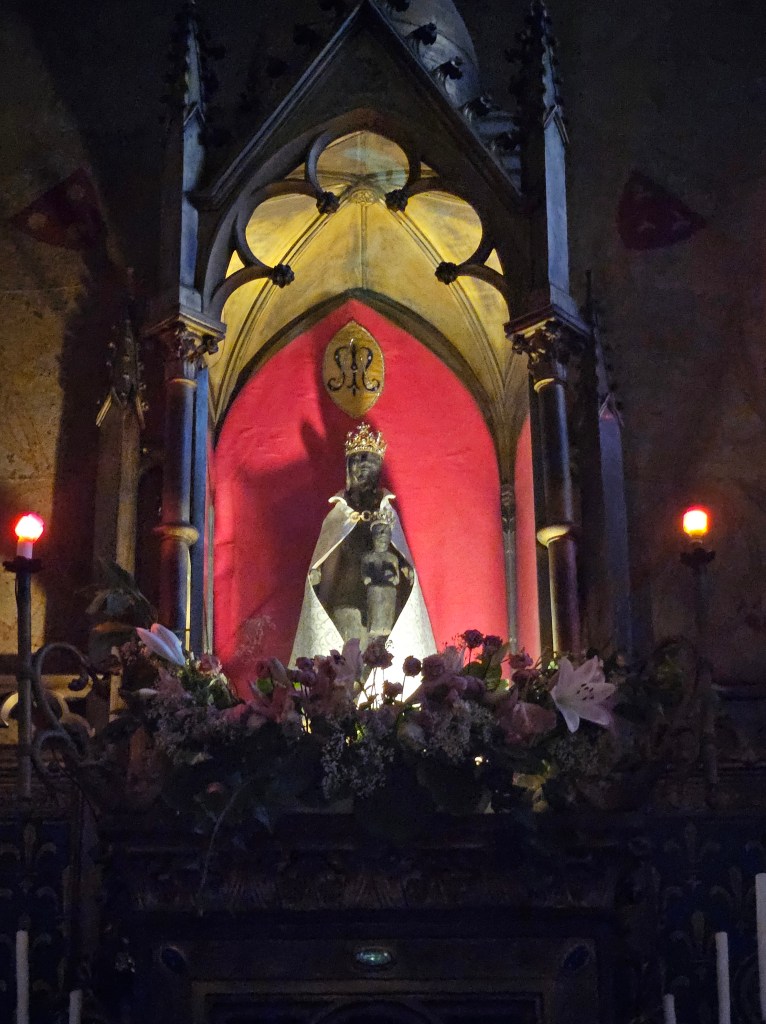
Rocamadour from the roadwaySomeone’s helpful suggestion about where to stand on the roadway Rocamadour townRocamadour – Roc (rock) Armadour (the Saint found preserved here)A Black Virgin- I’d thought these were rare, but we’ve seen several in these parts.
Saturday, we went to the Prehistoric Museum in Les Eyzies. Lots of bones and rocks. And some really good videos bringing life in the Stone Age to life. For instance, how they used rock on rock to create tools and weapons for hunting. Or a re-enactment of dis-membering and skinning an animal with stone tools. Amazing how sharp you can get a stone. The Stone Age lasted roughly 2.5 million years. That’s not even grasp-able. It ended about 5,000 years ago with the Bronze Age. Then along came the Iron Age.
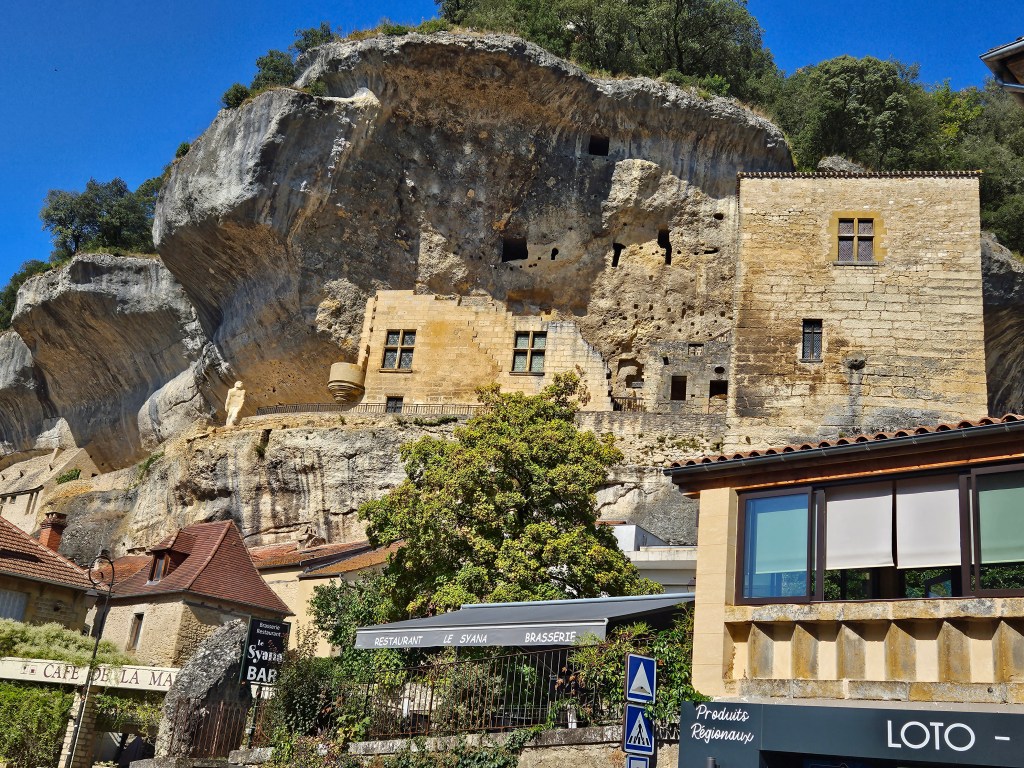
Les Eyzies and homes built into/under a cliff.
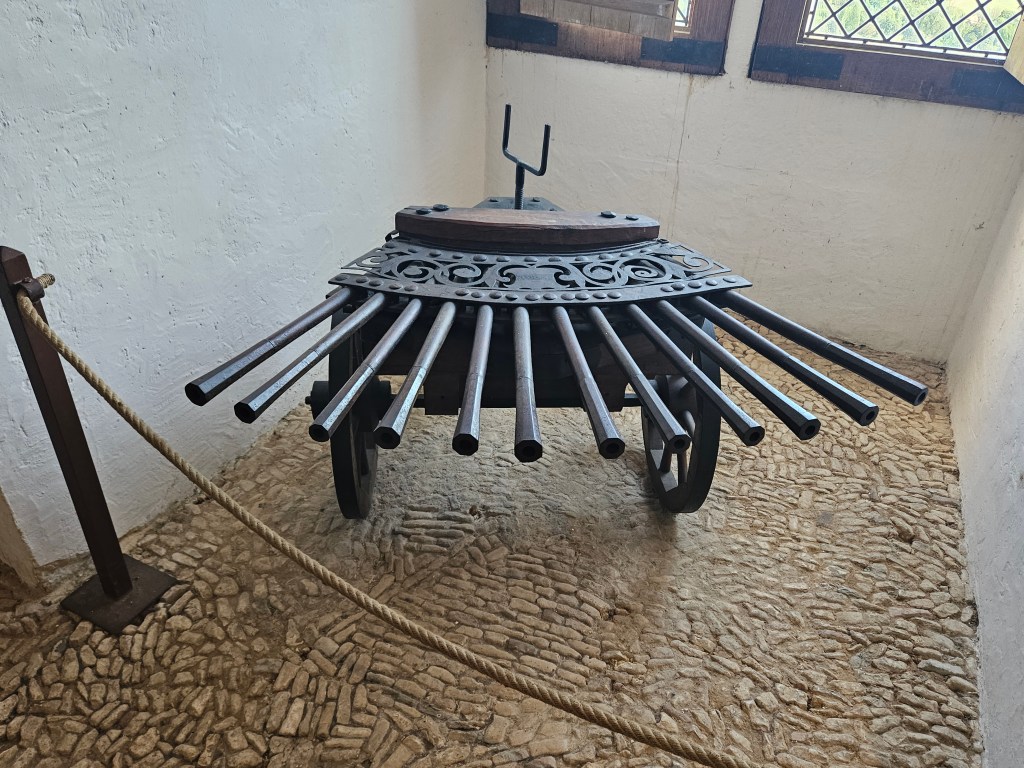
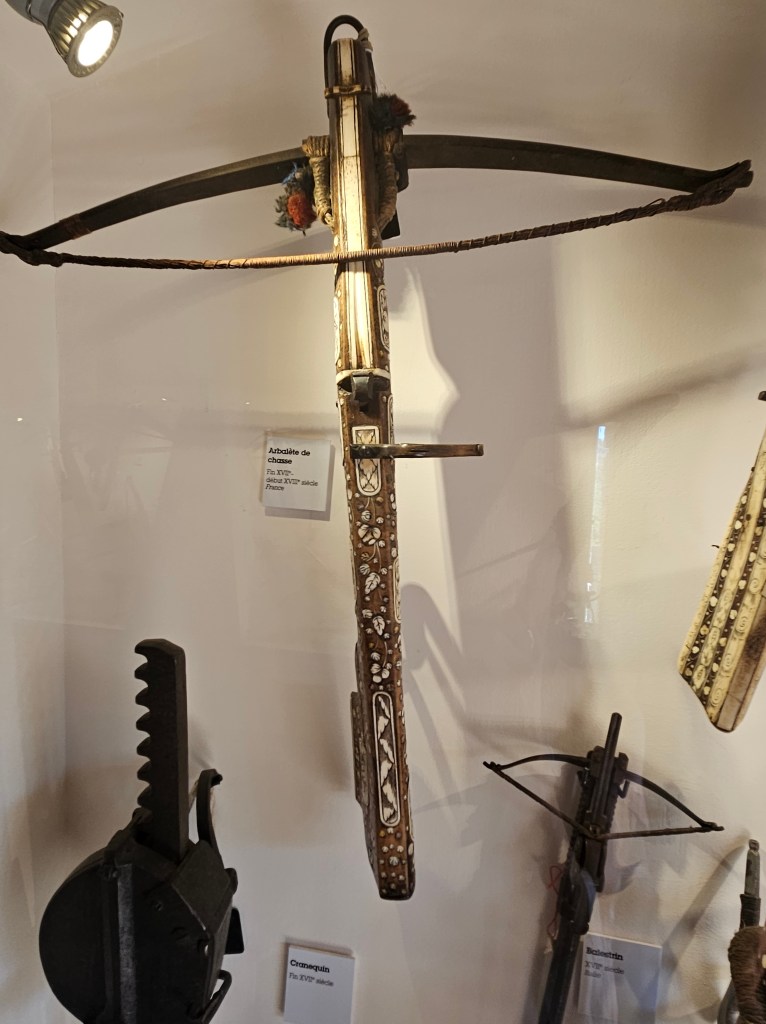
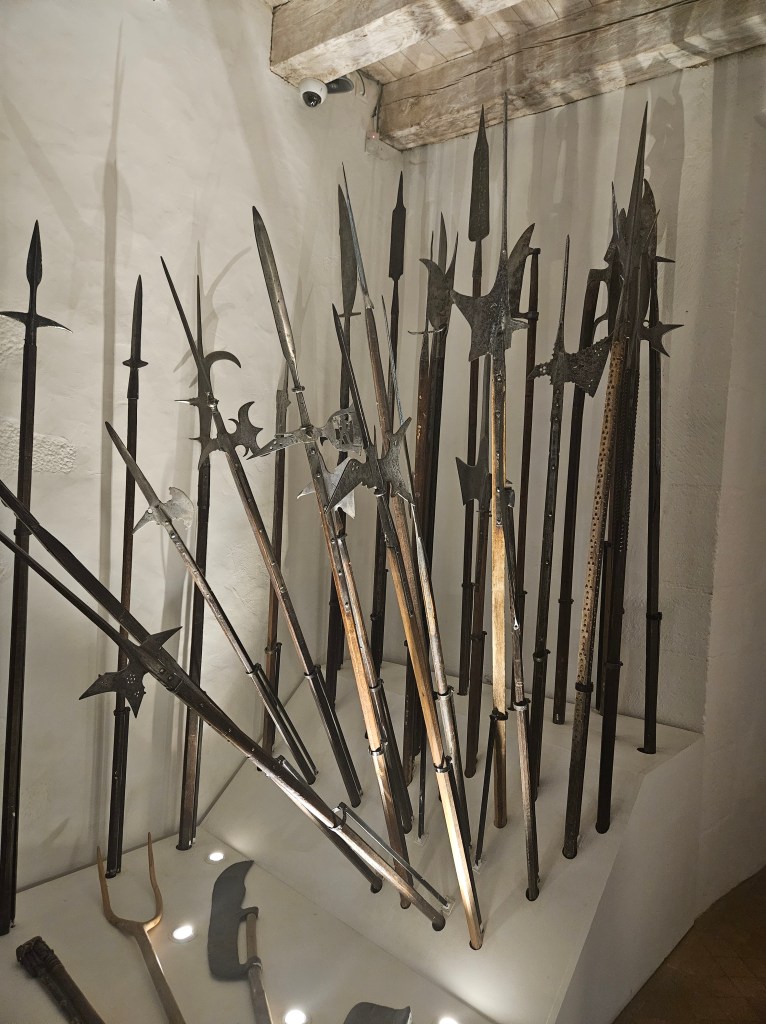
Sunday, we went to the Chateau Castlenaud, a museum of medieval warfare. It was a bit disturbing, disorienting to move so fast , so far forward in time. Especially considering the weapons deeloped.
The original “cluster bomb”Trebuchet
Then at Pêche Merle today, learning that early man, 29,000 years ago likely didn’t engage in warfare against one another. They were too few, had lemty of space, and ostensibly, nothing to fight over. Or so the experts suspect.
Pêche Merle is a massive cave, one of not too many, where you can enter the cave and see the actual art by ancient people. Also stalgmites and stalagtites. The cave at Lascaux is closed to visitors. There are 47 caves or grottos in France, but not all of them are open.
The tour provides a clear sense of what it must have been like to enter a narrow fissure, exploring in the dark with just a small hollowed rock contining burning fat and a plant as a wick for light. Bears and lions possibly taking refuge in them. Did many enter together, each with their small lamp, to create enough light for the artist to see his work? The drawings, some of them, are quite large. The artist(s) also incorporated some of the rock structure into their work to complete the likeness of bison or mastodon, or…
Living in these pasts – stone age and medieval age – and contemplating the swift changes wrought within the fairly recent past compared to the extensive years of the Stone Age – my mind is confounded.
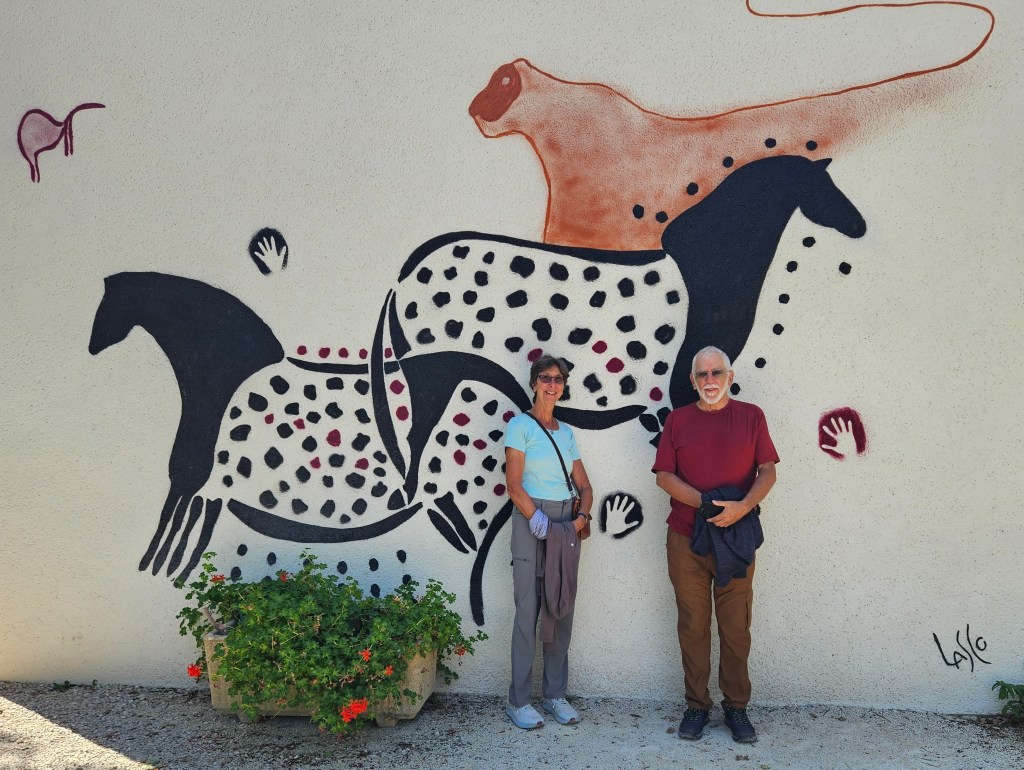
No photos allowed in the cave, so here we are in front of a reproduction on the museum wall.
I’ll start with today’s lunch at Les Tilleuls, the linden trees, under which we sat. I had cœurs de canard: duck hearts. It takes quite a few to make a meal, though they were larger than one might expect a duck heart to be. And delicious in an olive oil, garlic saute. Tender too. Ed had manches de canard: duck sleeves. Actually duck legs confit. Also delicious. Both meals accompanied by frites (golden, crisp outside, fluffy inside) and salad. Salad is lettuce, bibb, and dressing.
Vin de noix as an aperitif. It’s slightly sweet, made from green walnuts as the base. Various recipes call for different alcohol, from wine to vodka.
Yesterday in Sarlat de Canada we both had the omlette Perigordine, made with the meaty cepe mushroom and topped with slices of foie gras that melted into a rich and velvety deliciousness. How do they get their omlettes so rich, puffy, and tender? Best ever.
Have had two blue cheeses, one better than the other, a brie with truffles, and a triple cream that was both bright and mellow at once.
Darling strawberries that look wild.
IPA on tap (pressión) is available in Lyon and Le Puy, but so far, not in this area. Favored beers are blonde, Bud, and a Belgian style.
Josephine Baker, that’s who. What do you know about her? That she wore a skirt of bananas and little else, dancing on stage in France? That was the extent of my knowledge. Somehow I learned that she owned a chateau in the region. We went today to Les Milandes and learned just what a remarkable person she was.
Born poor in St. Louis, MO. Anxious to make a better life for herself, she sought work at a local theater. Started dancing with the Jones Family Band at 13 or 14 to entertain folks going to theater. Recognized as a talent by the theater manager who was putting together a black revue for Paris. Off she went. By then she’d already been married twice – once at 13 and again at 14 or 15. She was to marry twice more in her life.
She added singing to her repertoire. Her popularity was worldwide. Was dressed by Dior. Rented the chateau before buying it. Her career spanned 50 years.
She was active in the French Resistance. Smuggled out information written in invisible ink on her music sheets.
Active in the Civil Rights movement. She spoke in Washington just before MLK did when he gave his famous Dream speech.
Adopted a Rainbow Tribe – 12 children from various parts of the world, Korea, Finland, Venezuela, and Africa among them.
She developed ormaybe marketed a hair pomade, called Fix and a cream to darken skin, which was a hit with women in Paris.
Sadly, she lost control of her finances and the chateau.
Les Milandes had extensive photos and a wonderful collection of her outfits, including the banana skirt.
Unfortunately, no photos were allowed inside.
What a life!
Chateau Les Milandes – built 1489 by François Caumont, Lord of CastlenaudChapel The backyard
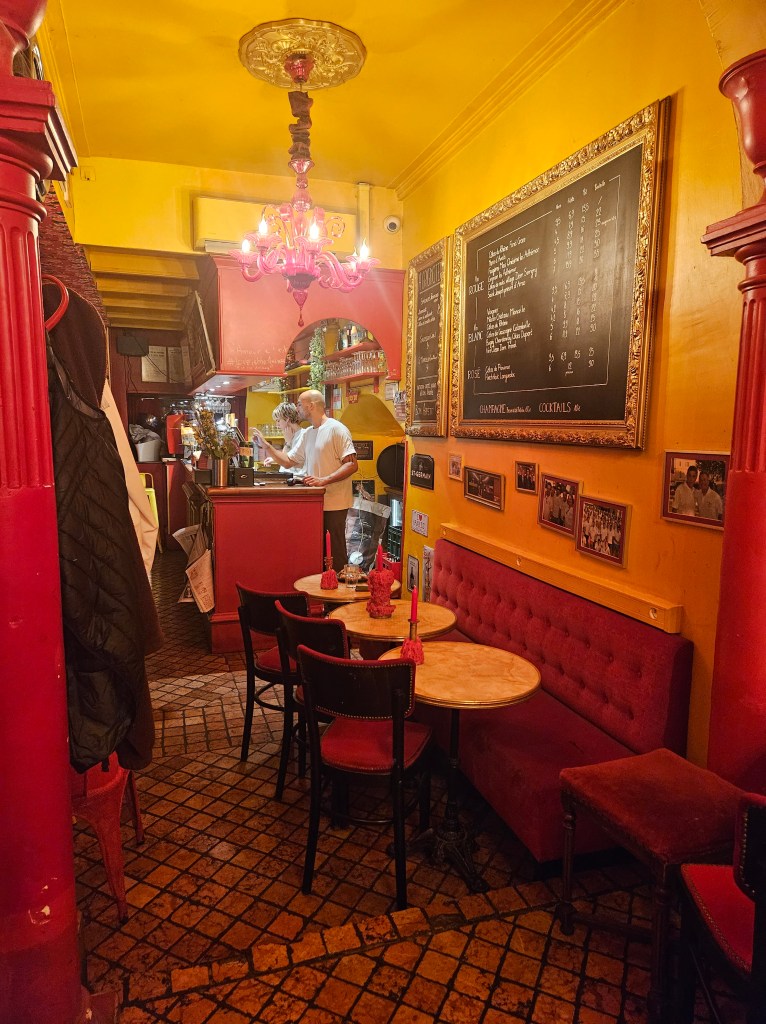
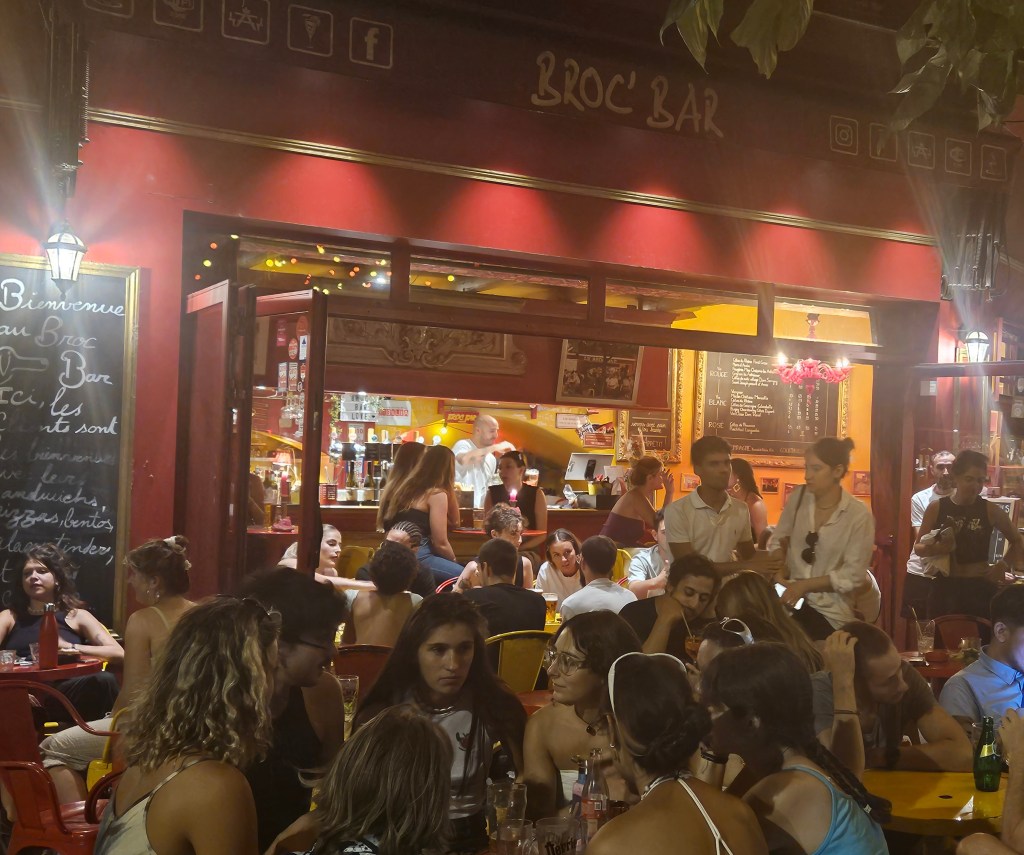
I often forget my age. We were out one evening, a few evenings ago, looking for a bite to eat. But it seemed most people were just drinking. Myself happened upon a place that was packed, not that most establishments weren’t, but this one also had a menu listing food and the waiter said yes they were serving. Down we sat and ordered a beer to contemplate the offerings. It soon became evident that the waiter was way too busy serving drinks. I thought I’d order at the bar. No can do. In the meantime, I’d gone to use the loo and met a young woman who insisted I meet her friend from the States. We chatted a bit, until I extricated myself from these two charming, but obviously bombed darlings. In the end, no food was to be had. But it was a quintessentially French bar, albeit for the young. Which I didn’t notice for awhile. Charlie, of course, did. We were in a Quartier of youth.
The interiorThe exterior – look at how young they all are! And then there was us. 😀
Eating while traveling is one of my biggest challenges. At home we eat late, as they do in Europe, so you’d think we’d be naturals. But somehow it doesn’t work out that way. Fortunately, there’s always bread and really good cheese. And great pastry.
Currently we are in walnut country. Had a walnut tartlett that outs pecan pie to shame.
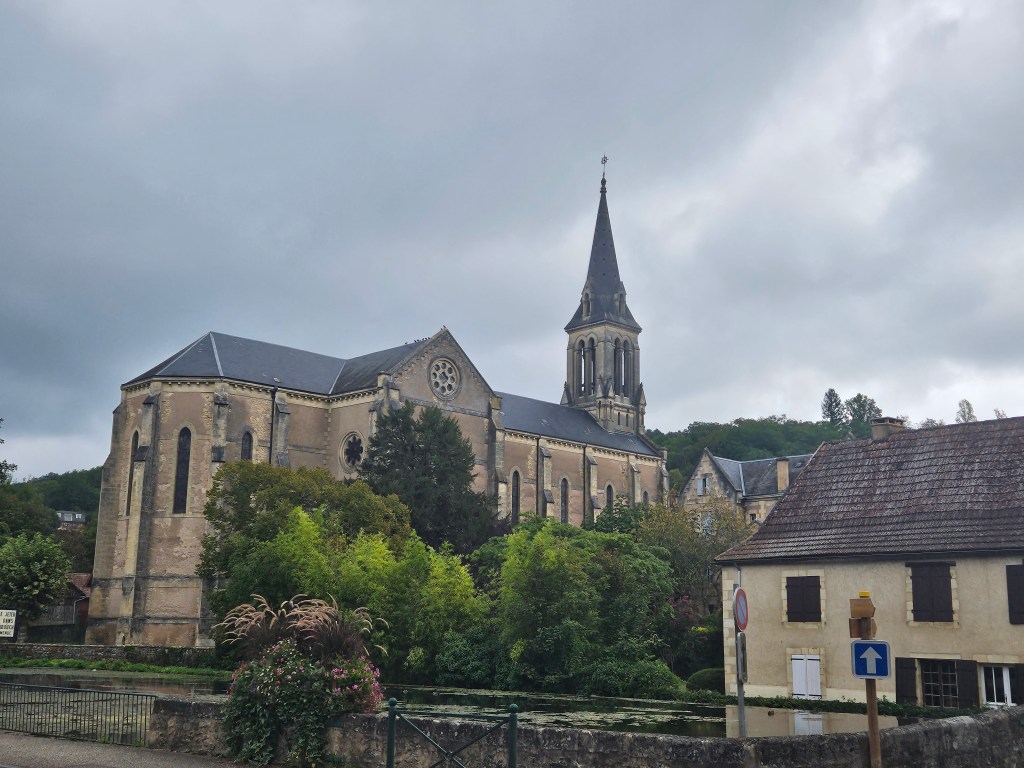
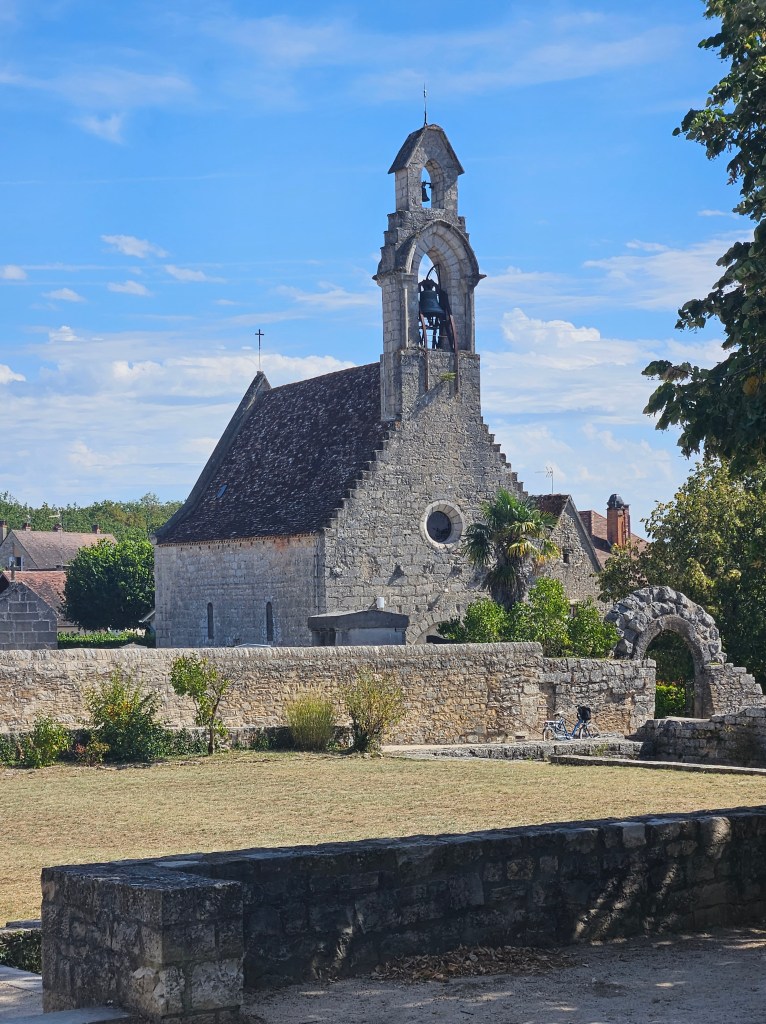
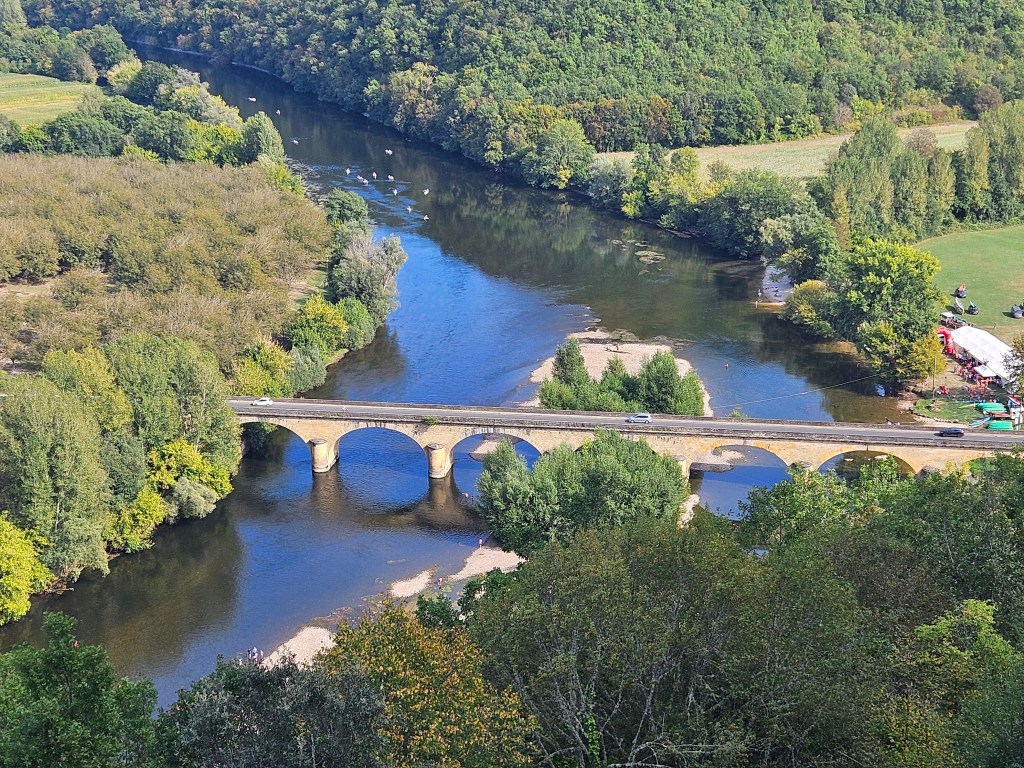
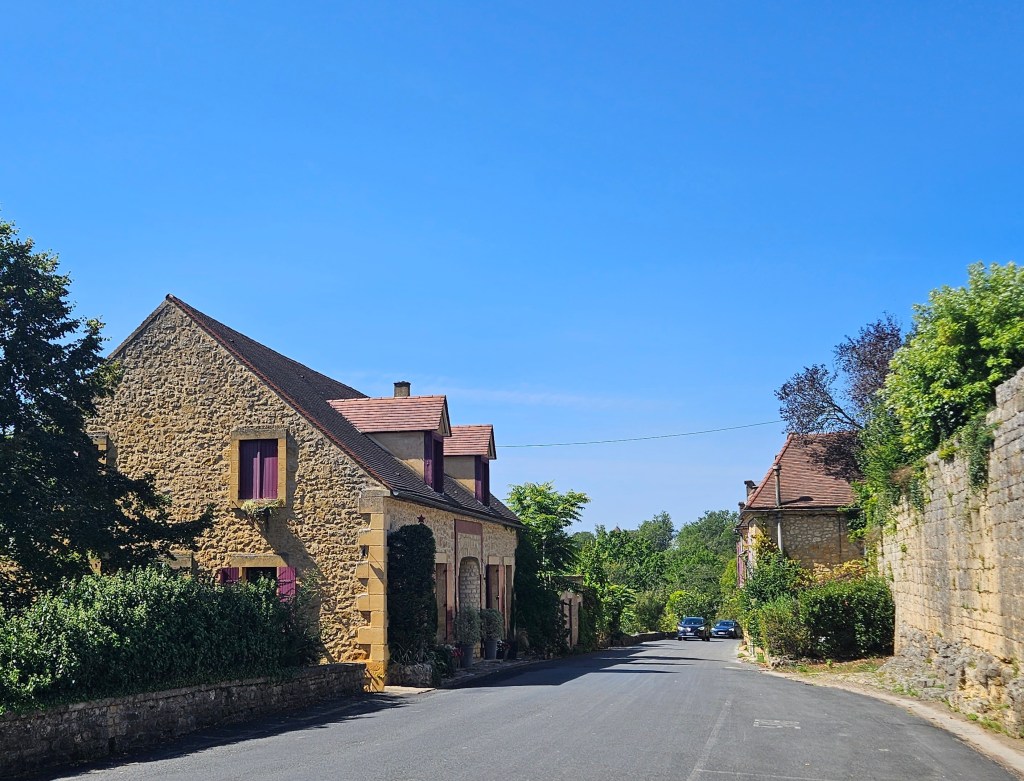
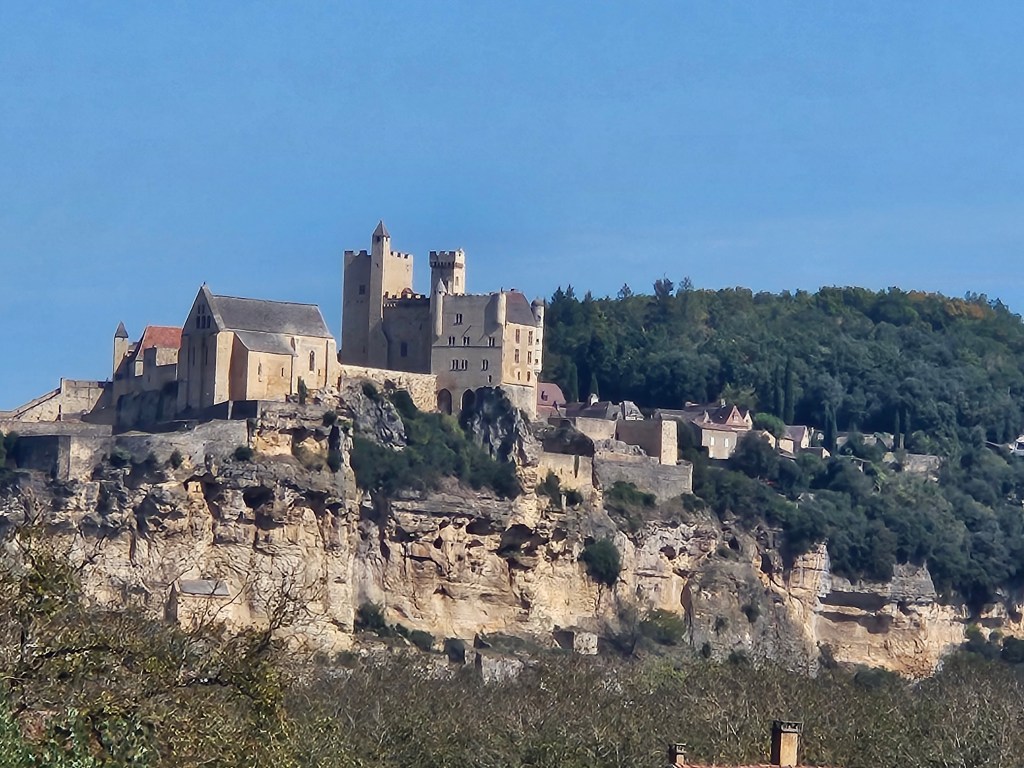
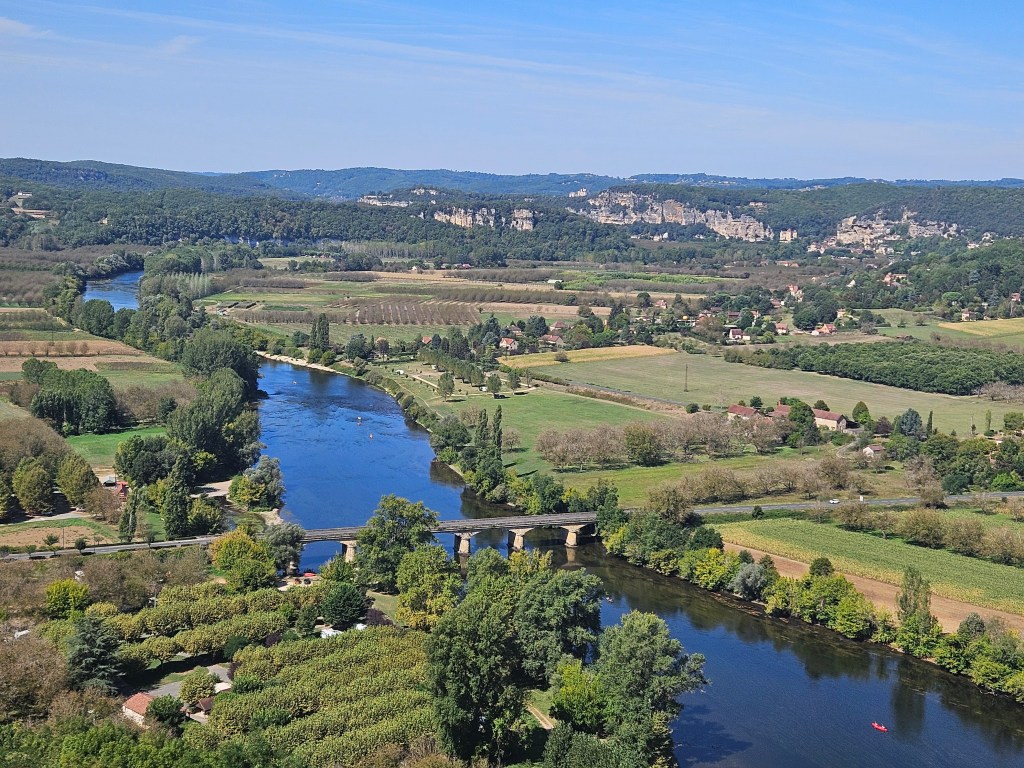
Photos of the Dordogne area, referred to more frequently by the French as the Périgord.
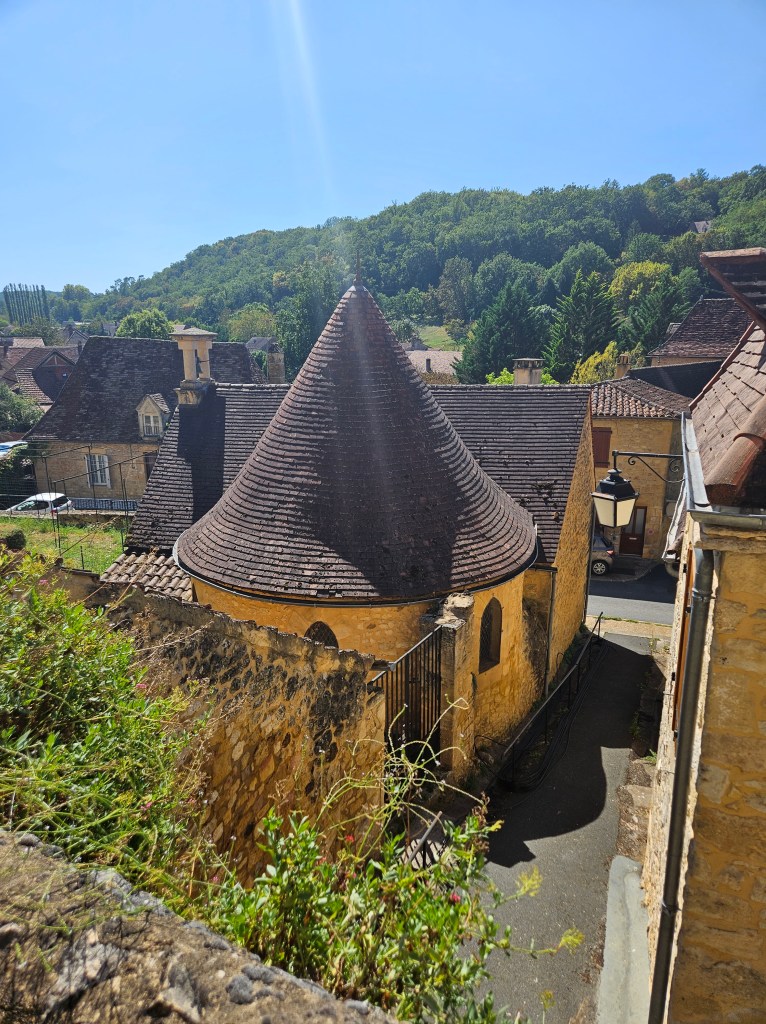
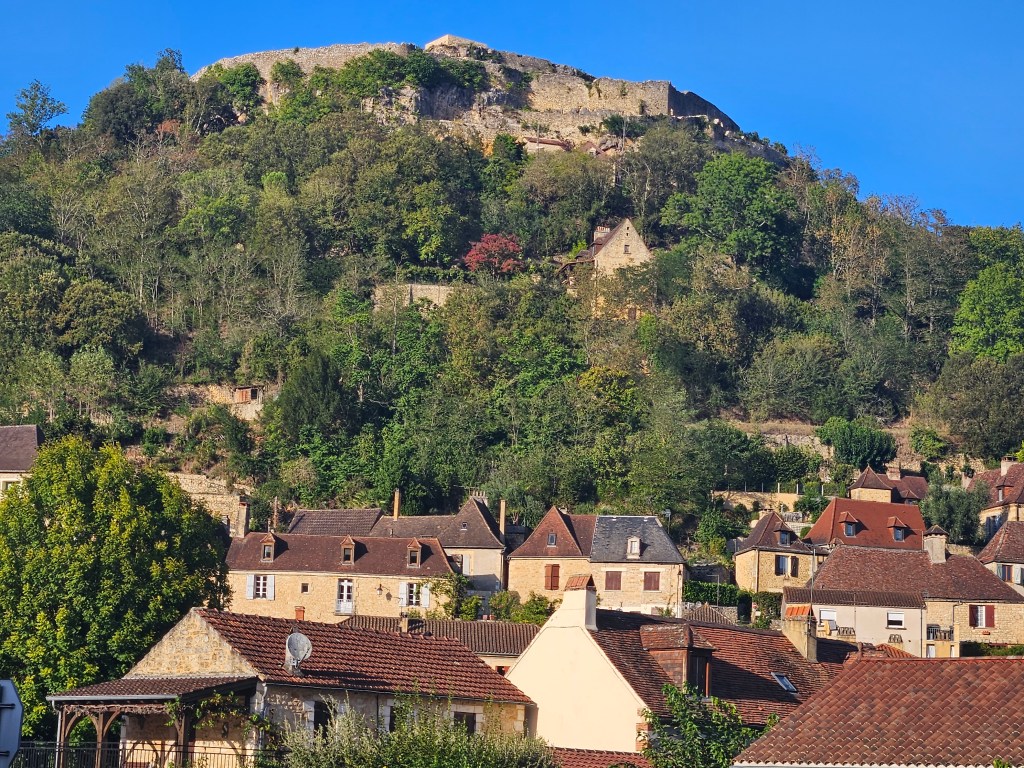
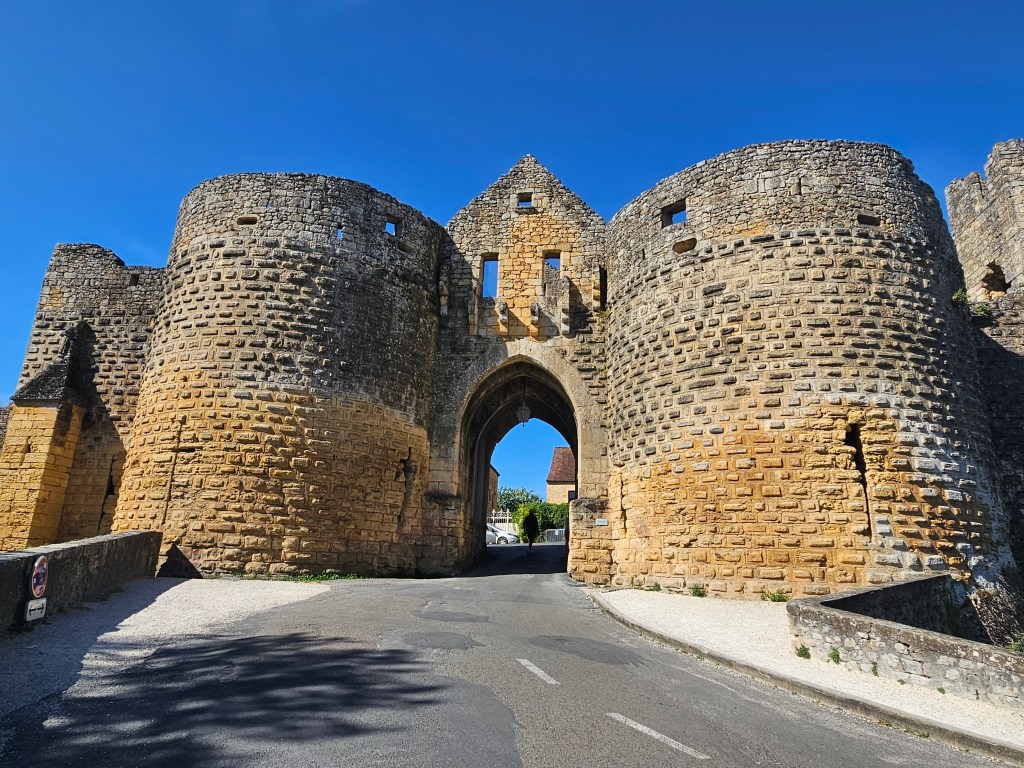
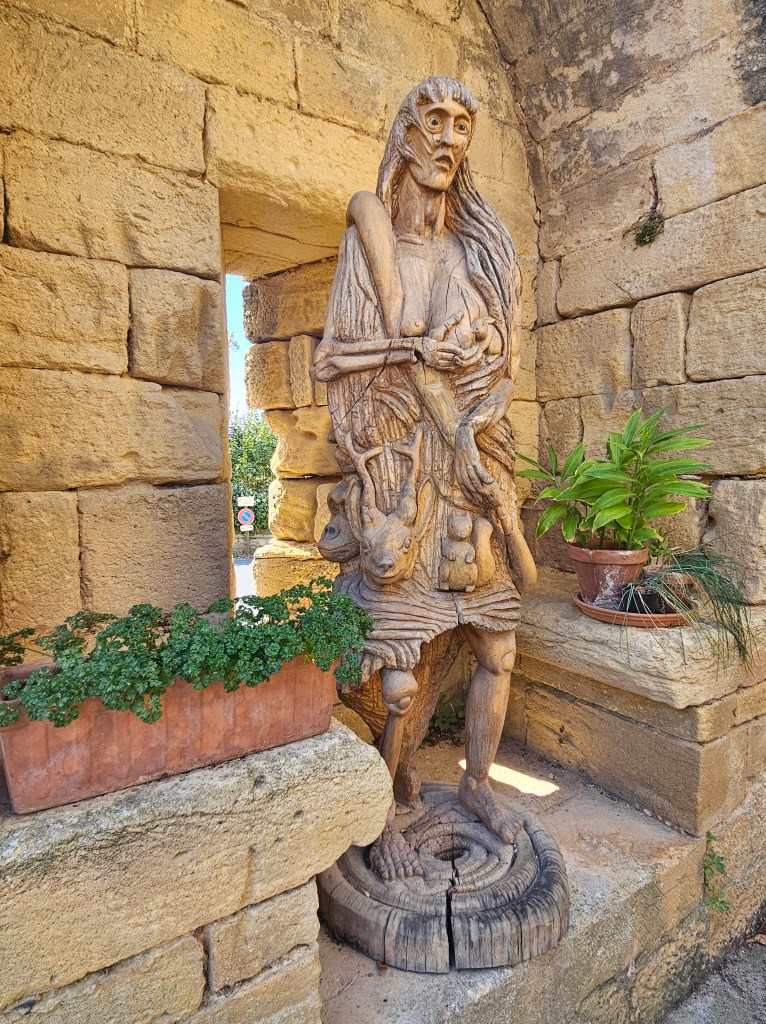
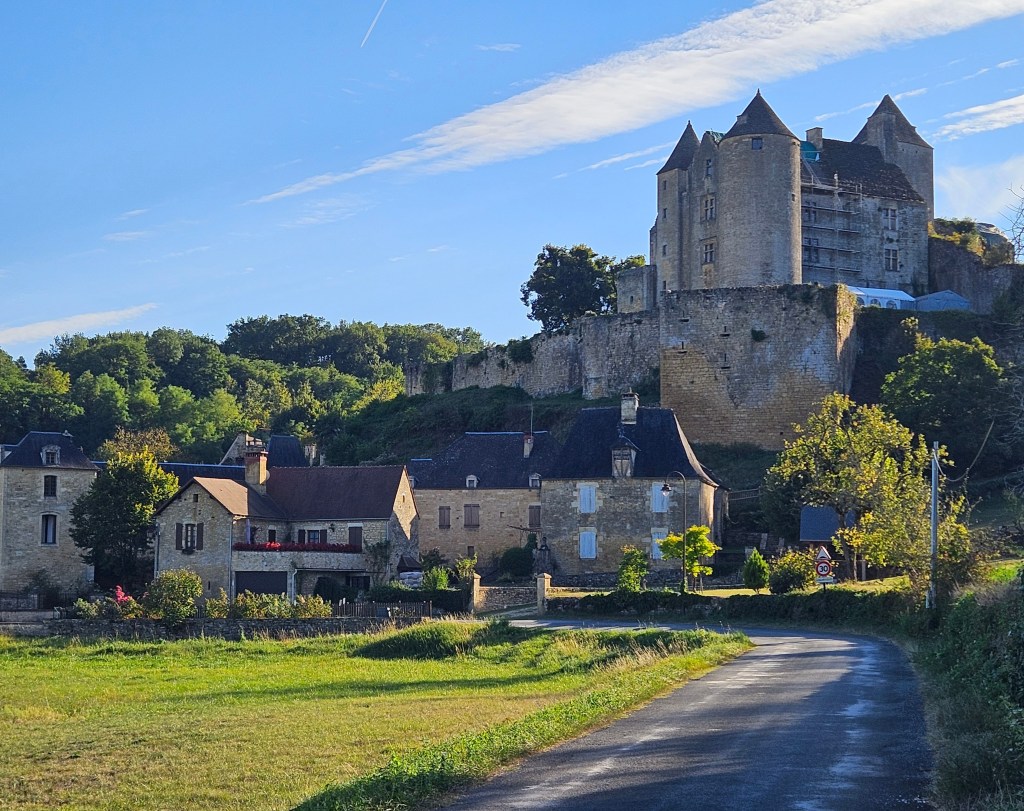
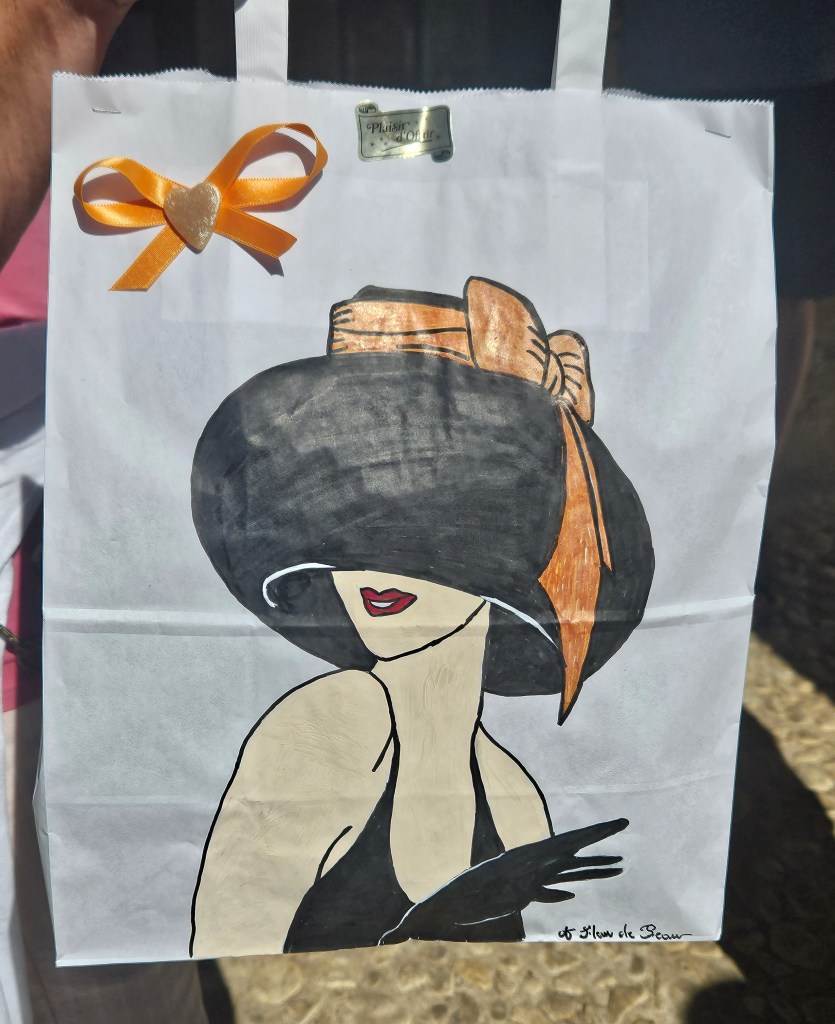
Dordogne River – pretty low right now. We are staying just across the bridge, on the left.Domme, town we are in.Gate and fortification to La Veille VilleInteresting wooden sculpture – a St. Francis of Assissi type figure, but a women. Fortress of Salignac, a town purported to have a night market. Can you believe the artistry of this bag?






 Shared Illusions