A not so hidden agenda

The truth is we did not head out on our See Part of America Tour without a purpose. We have both a primary and a secondary aim. The first is to visit family and friends in Rhode Island. Second, are taking paintings that our friends have stored at our home to them in Ithaca, NY. For the last few years we have been considering selling our home and moving into a place that would be easier to manage in our golden (or in my case, rust filled) years. It’s unlikely we’ll actually get around to doing so, particularly since we have so much stuff to sort out. Moving these paintings from under the bed in our guest room will be a small start.

There are a lot of miles between Albuquerque and Jamestown, Rhode Island, and we chose to limit our daily dose of sitting and drive between 4 to 5 hours per day. We also thought we should increase our total sitting time by adding a hundreds of miles by not taking a direct route. We also want to keep to what William Leastheat Moon calls the “Blue Highways” when feasible. Blue highways are the roads that show up on maps in muted colors, frequently blue, as opposed to the major highways and interstates. The Blue Highways passthrough the smaller cities and towns and provide a view of the America that is not always visible from the main roads or the main stream media.
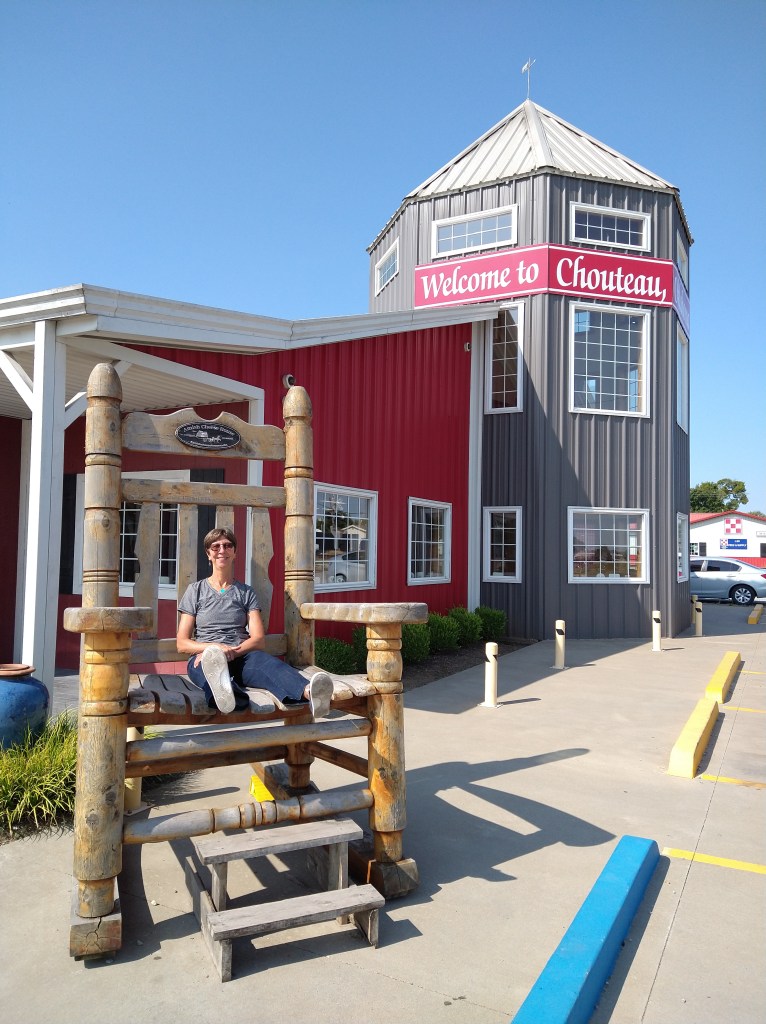
Leaving is our first opportunity to take some of those slower and more scenic roads. We added Eureka Springs, Arkansas, to our itinerary with an intermediate stop in Bentonville, home of Walmart.

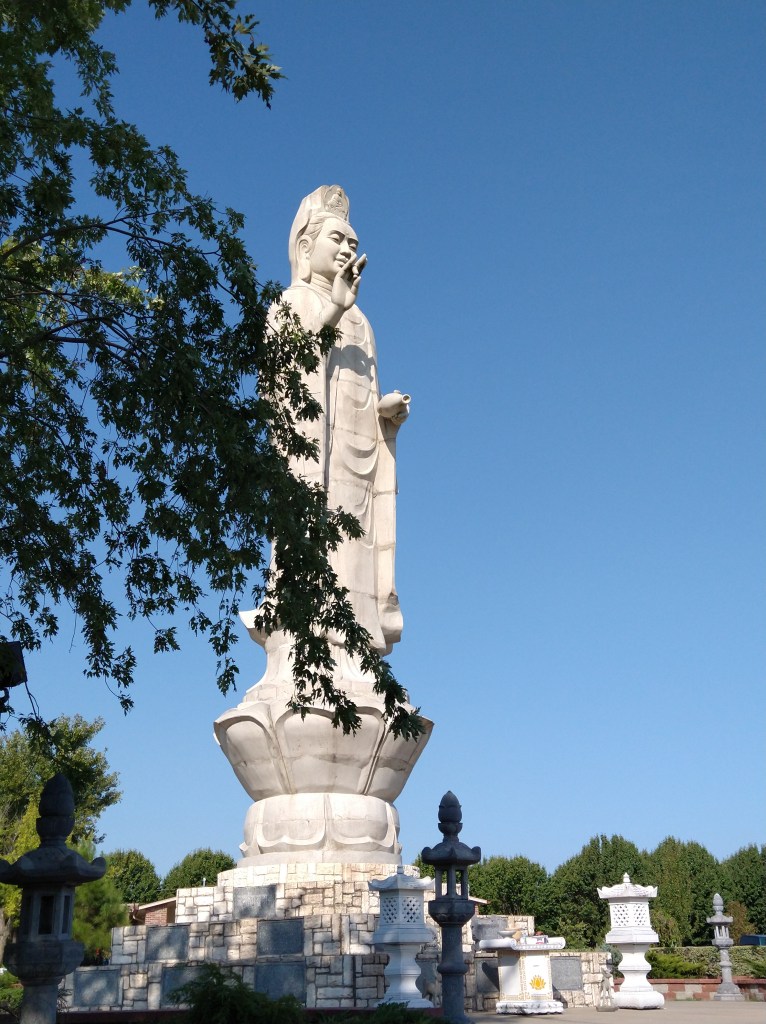
A few miles east of Tulsa we stopped to visit one of the roadside attractions: the 50 foot high Buddhist deity (so described on the Roadside America web site) at the Vietnamese Chua Tam-Bao temple. The temple is peacefully situated along a quiet country road some distance from highways, though not so far as Hellen Gawn’s. Although we would have liked to tarry there we only took a few photographs to capture the quietude and contentment so we could have it available on our phones if we ever had need of it.
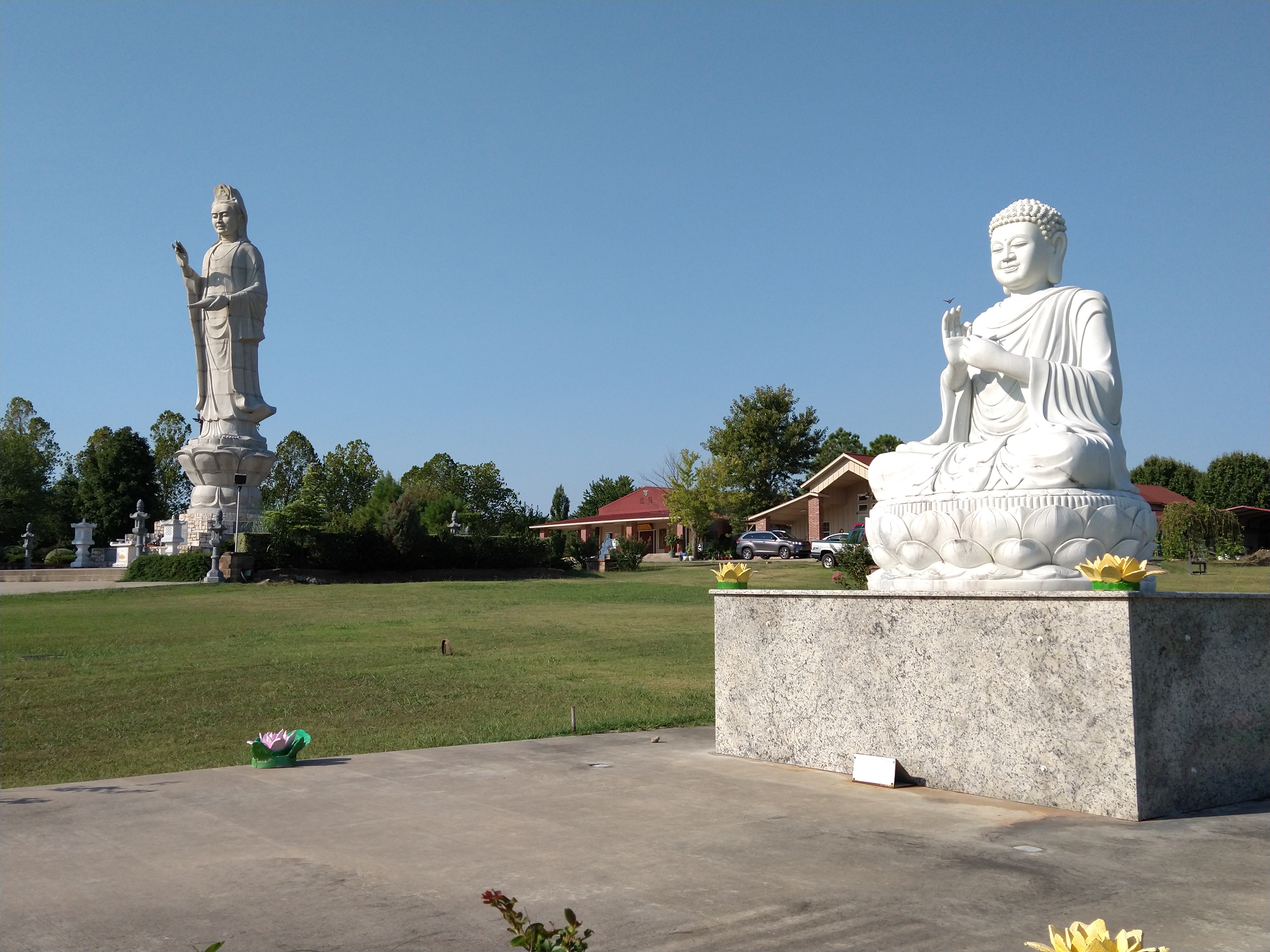
Eastern Oklahoma and northwest Arkansas are quite beautiful, though there are many abandoned and decaying buildings and villages that serve as a reminder of the urbanization of the country. Only a few hours from Tulsa we entered the growing metropolitan area that encompasses Fayetteville and Bentonville. That area contains a thriving network of strip malls, franchise restaurants, and and instantly quaint establishments that illustrate the finest expression of modern life.

So much for my attempt at eschewing cynicism. There are many aspects of the economic development that have upgraded the quality of life for people in the area and we certainly did not explore much beyond the main road in the area. Let it be sufficient to say that the stereotypical view of a backward and poor hill people is not an accurate reflection of the population. If we were to repeat this trip I think I’d schedule a few days to explore the area. There are a large number of outdoor activities, including hiking and bicycle trails and many types of water sport adventures

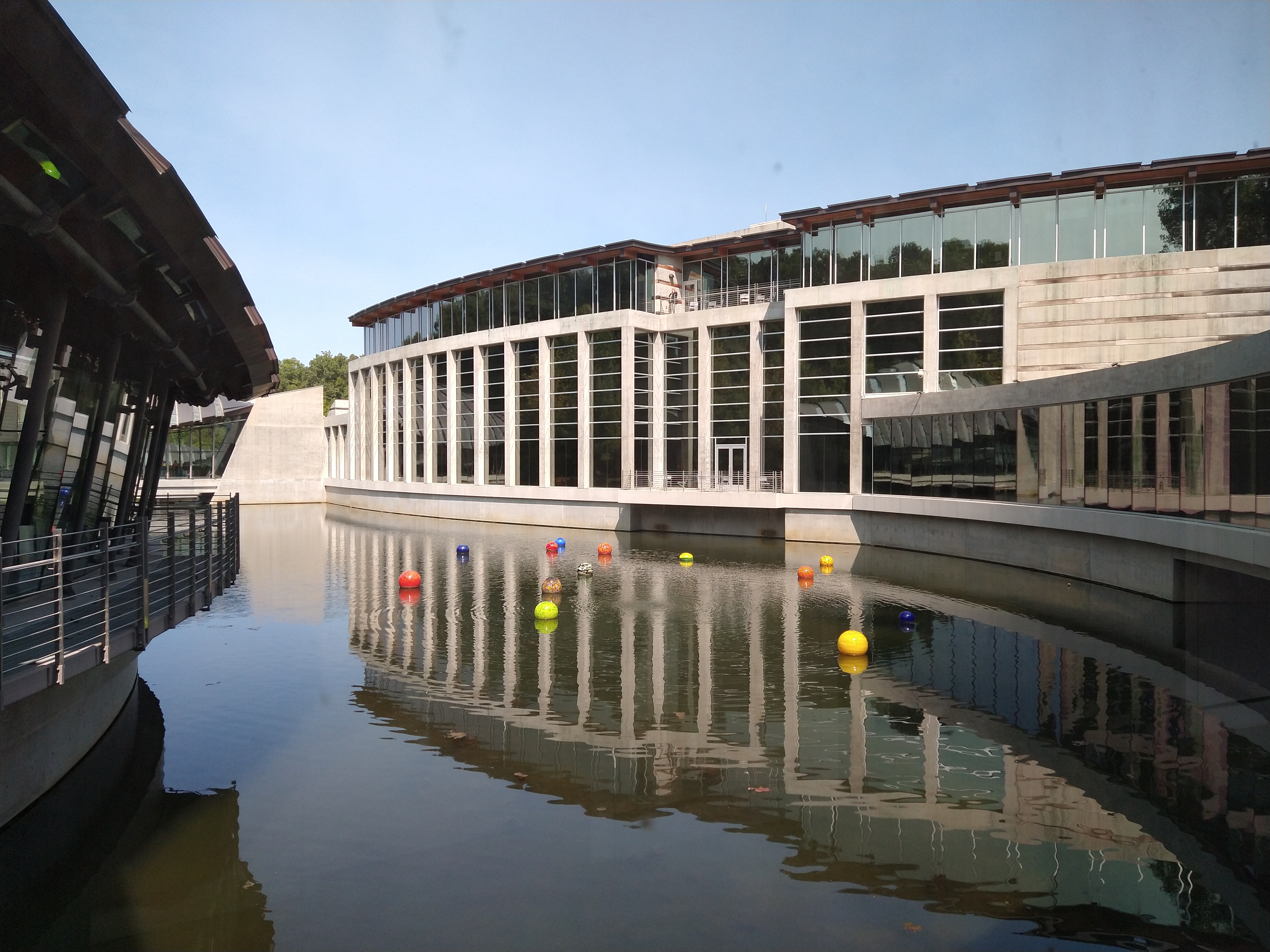
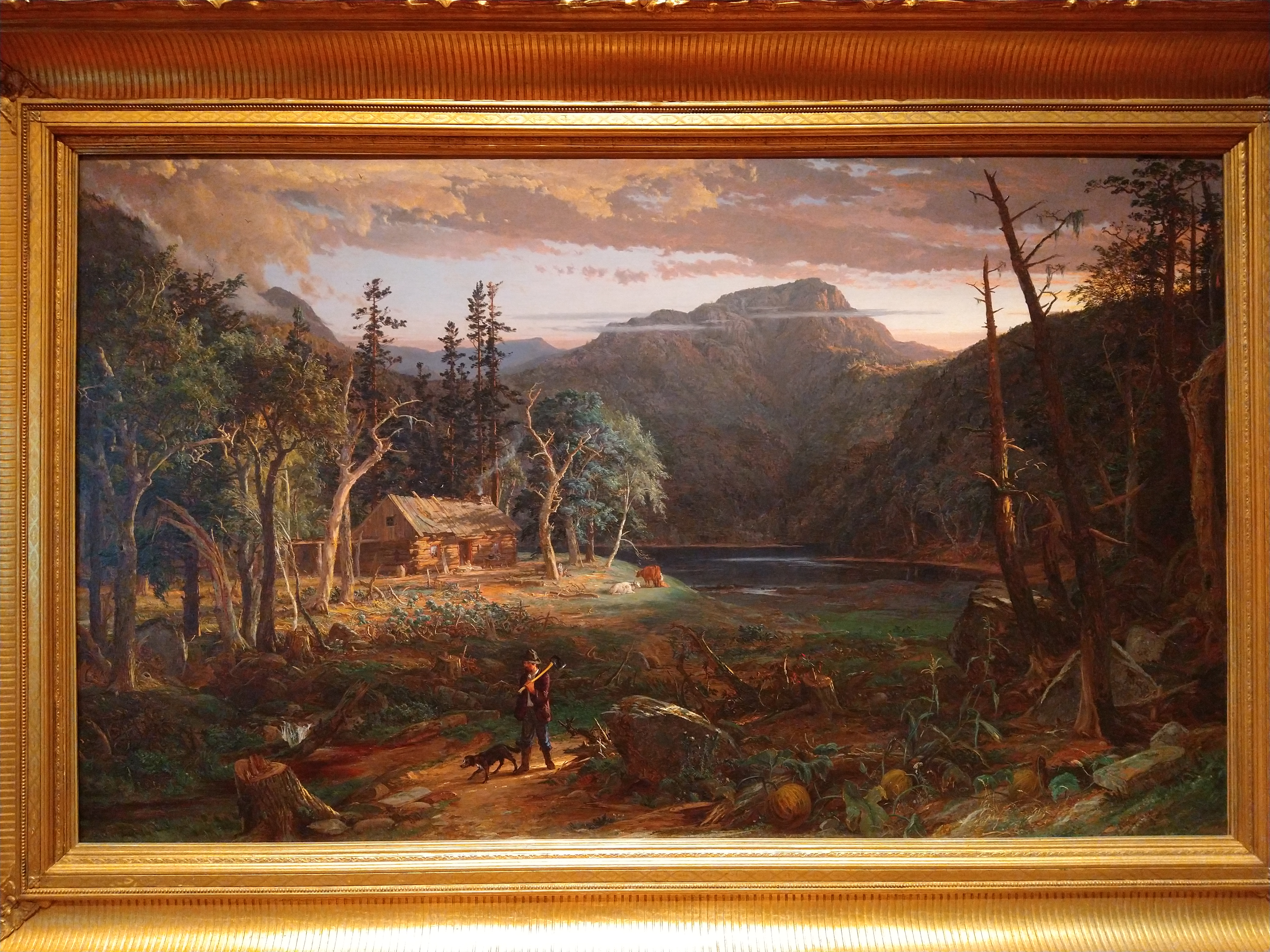
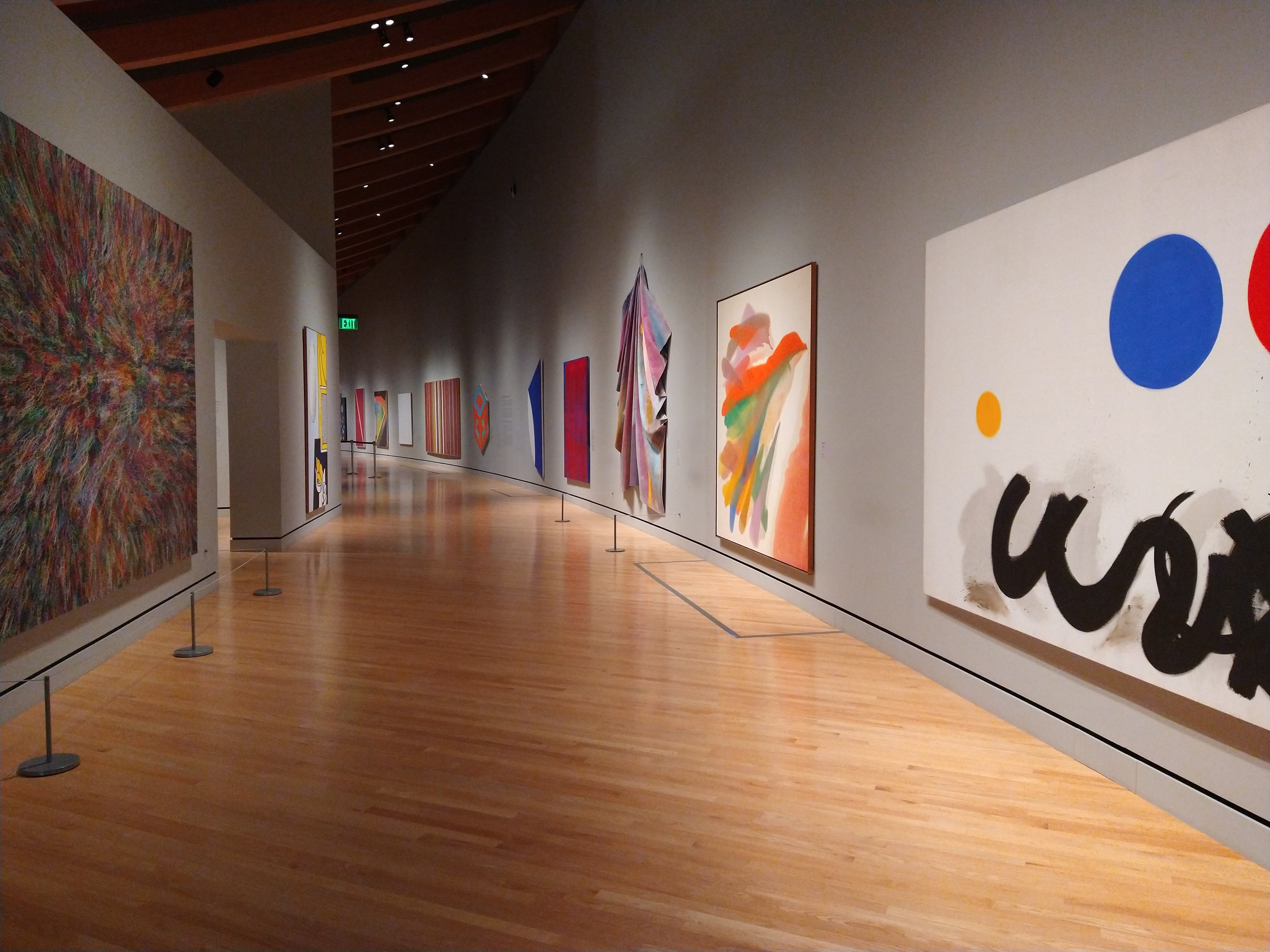
In the midst of Bentonville is a development that exemplifies one of the best opportunities afforded society by an economic system that fosters inequality. The Crystal Bridges Museum of American Art is a good example of private investment in public infrastructure that would be difficult to finance with public money. The linked Wikipedia article shows how donations from private sources make the project possible and simultaneously there is criticism that the project does not generate sufficient tax revenues to satisfy certain elements of the populace.

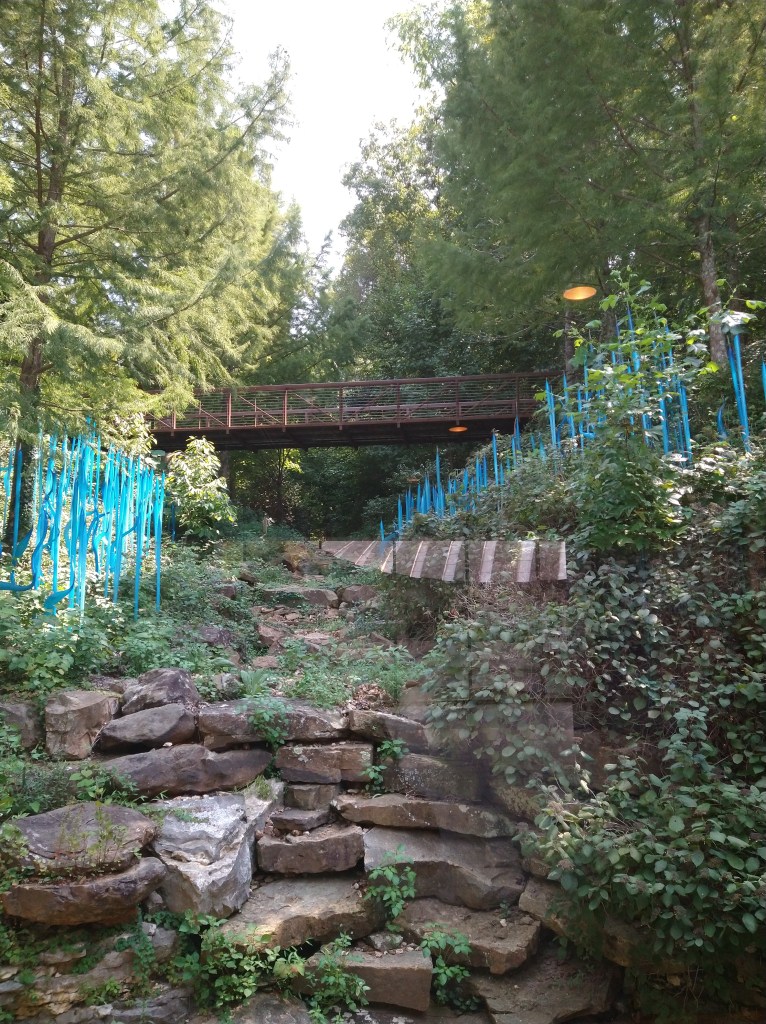
The structure is too large and complex to adequately capture with photographs, but here are a few.

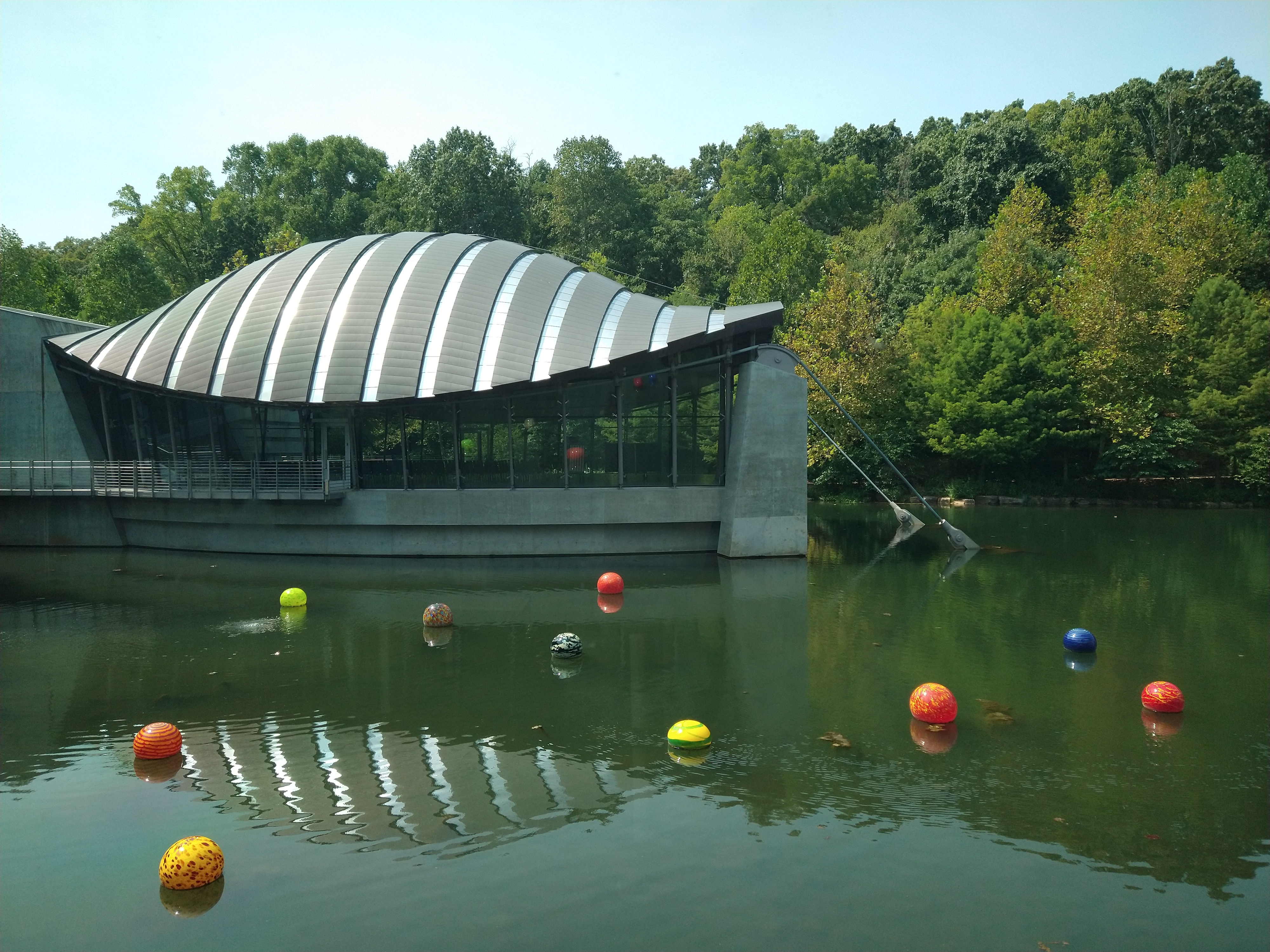
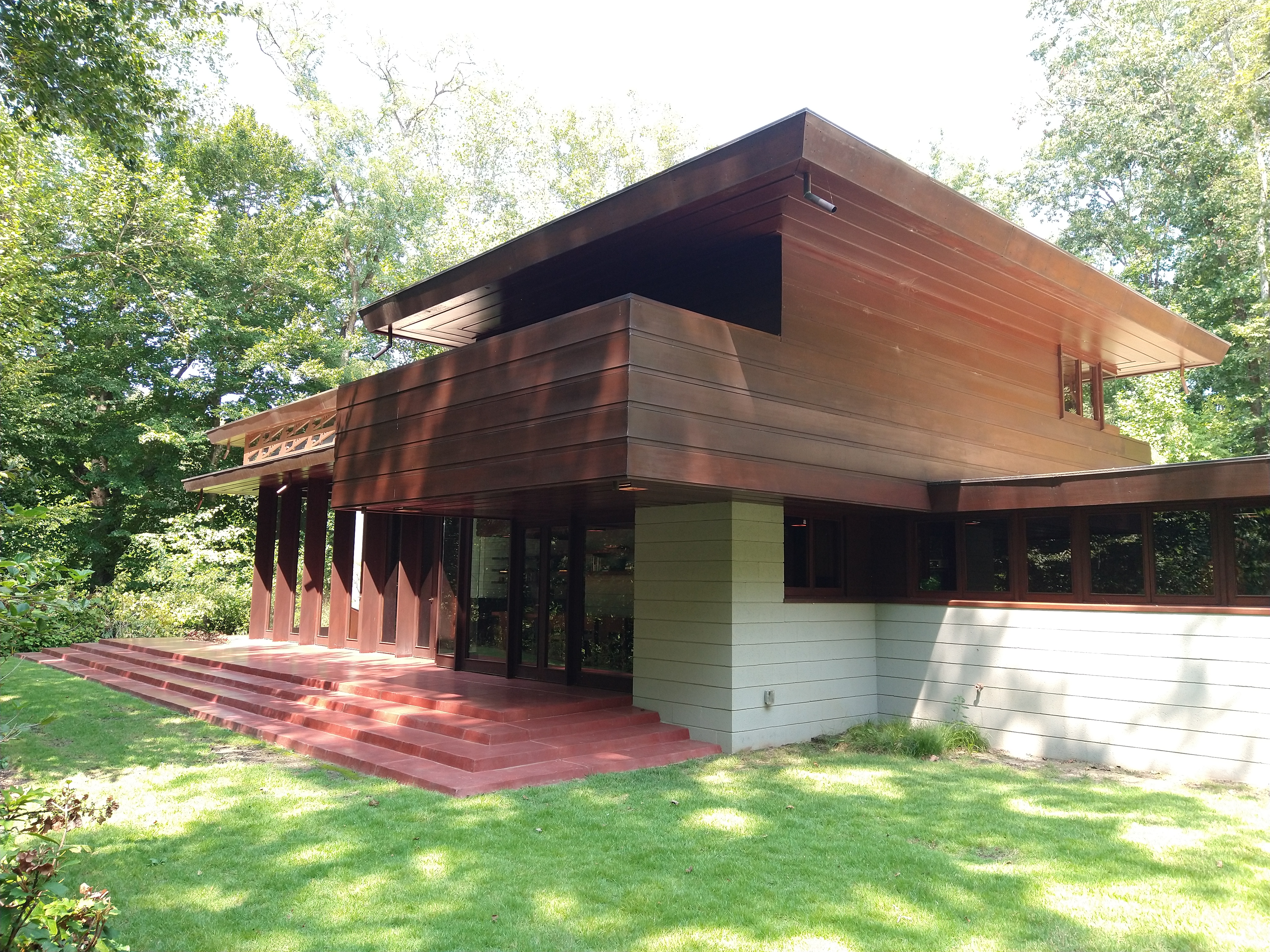
The museum includes a modular home designed by Frank Lloyd Wright that had been disassembled in New Jersey and reassembled on museum grounds. We had been planning to tour Falling Waters in Pennsylvania on the way to Rhode Island but have been unable to get reservations on acceptable dates. Seeing one of Wright’s smaller homes provided a small taste of what we will miss. There are a lot of design features that make the construction interesting and intriguing. However, I cannot envision living in such a unit for more than a short time. I think the starkness and linearity would become tiring.

Photography of the building interior is prohibited, so I only have external views to share.

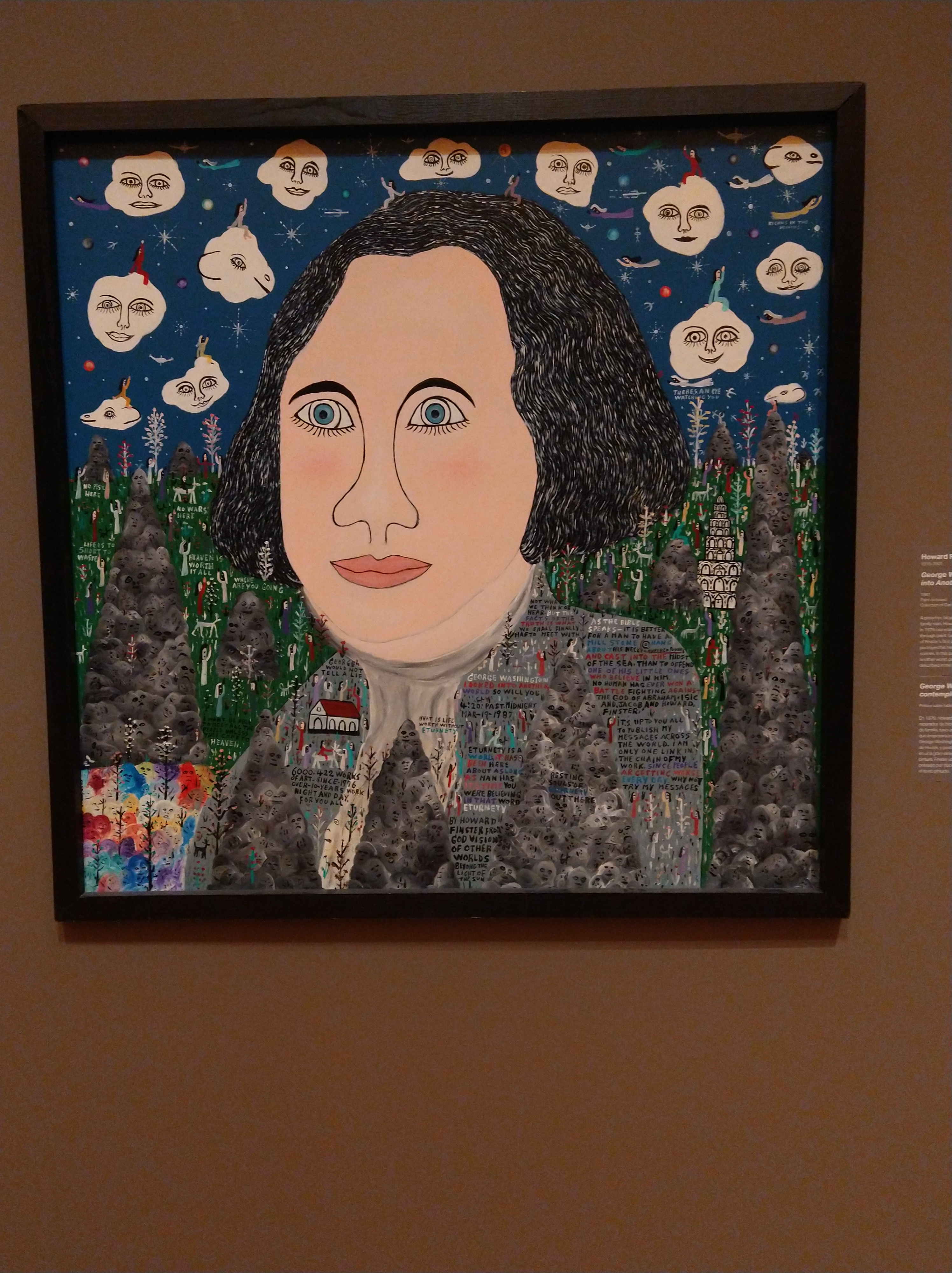
Our visit to the museum was somewhat truncated since Paula had a massage appointment in Eureka Springs in the afternoon. The collection is probably too large and to truly appreciate in one visit, and since there is no charge for admission making multiple visits over a couple of days would be appropriate.
I will leave off here and continue the saga on the next post.
Rambling while meandering

We have started our “See Part of America” tour.  Our destination is to end up we started with stops along the way.  Armed, as always, with our trusty sidekick, Internet, and his new companion Roadsideamerica.com we set out, with songs in our hearts and an audiobook in our speakers, hoping to visit as many interesting features of the American landscape as feasible in our limited six week journey.

We planned our first day to be the longest, 650 miles from Albuquerque to Tulsa, putting the arid and not so compelling landscape behind us in one leap, and leaving some treasures to be visited on the return trip.  Cadillac Ranch, Big Texan Steakhouse, the National Cowboy and Western Heritage Museum will still be here in October. 

We thought two nights would be enough to appreciate the best of Tulsa, but I must admit we hardly scratched the surface in the one full day available to us.  Tulsa is very comfortable city.  Its history, dominated by the industrial harvesting of liquified organic matter, has left parts of the area with a built environment expressive of luxury and abundance.  We stayed with a friend in an older neighborhood where one can envision that sixty years ago children roller skated in the streets, organized pick-up games in the park and bicycled though farmlands that had not yet been replaced with interstate highways and strip malls. Those homes, modest in comparison to the oil financed estates, are a testament to the economic vitality of the post war years.

We are fully cognizant of the parallel history of racial strife. The scars from that period are present, with reminders and commemorations scattered through the city.  I will leave it to others to make the requisite noises about that period in history and I am sure someone will feel it necessary to express concern that our past did not live up to our expectations.

We planned to visit some of the interesting oddities listed on the Roadside America website, but unfortunately did not have time to fit them in. Perhaps the future will see us fulfilling our desire to see the muffler man, the monument to the runner who died in a car trunk, the sonic center of the universe, the buried car time capsule from 1998, the freedom chainsaw tree, and other features.  We missed these sites due to spending much more time than anticipated the Philbrook Museum of Art and Oral Roberts University.

I had been to both over thirty years ago and wanted Paula to appreciate seeing them.  The intervening years had embezzled the details from my previous experience and left me with only vague random recollections.  I was surprised at the relative newness of seeing them again for the first time.

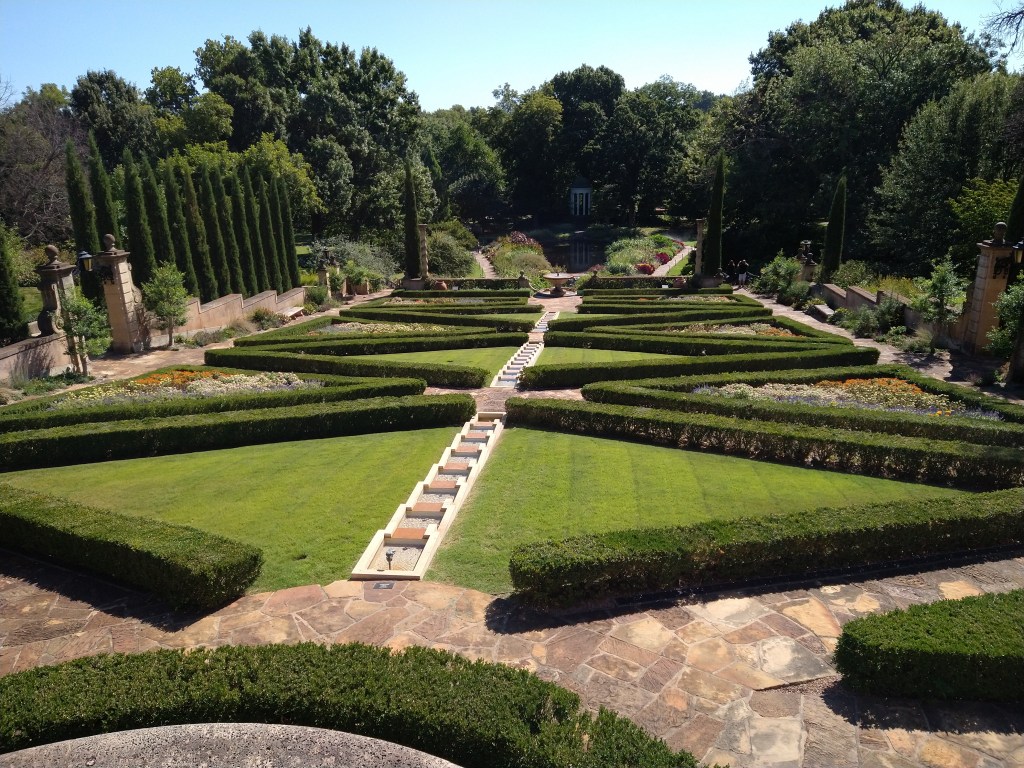
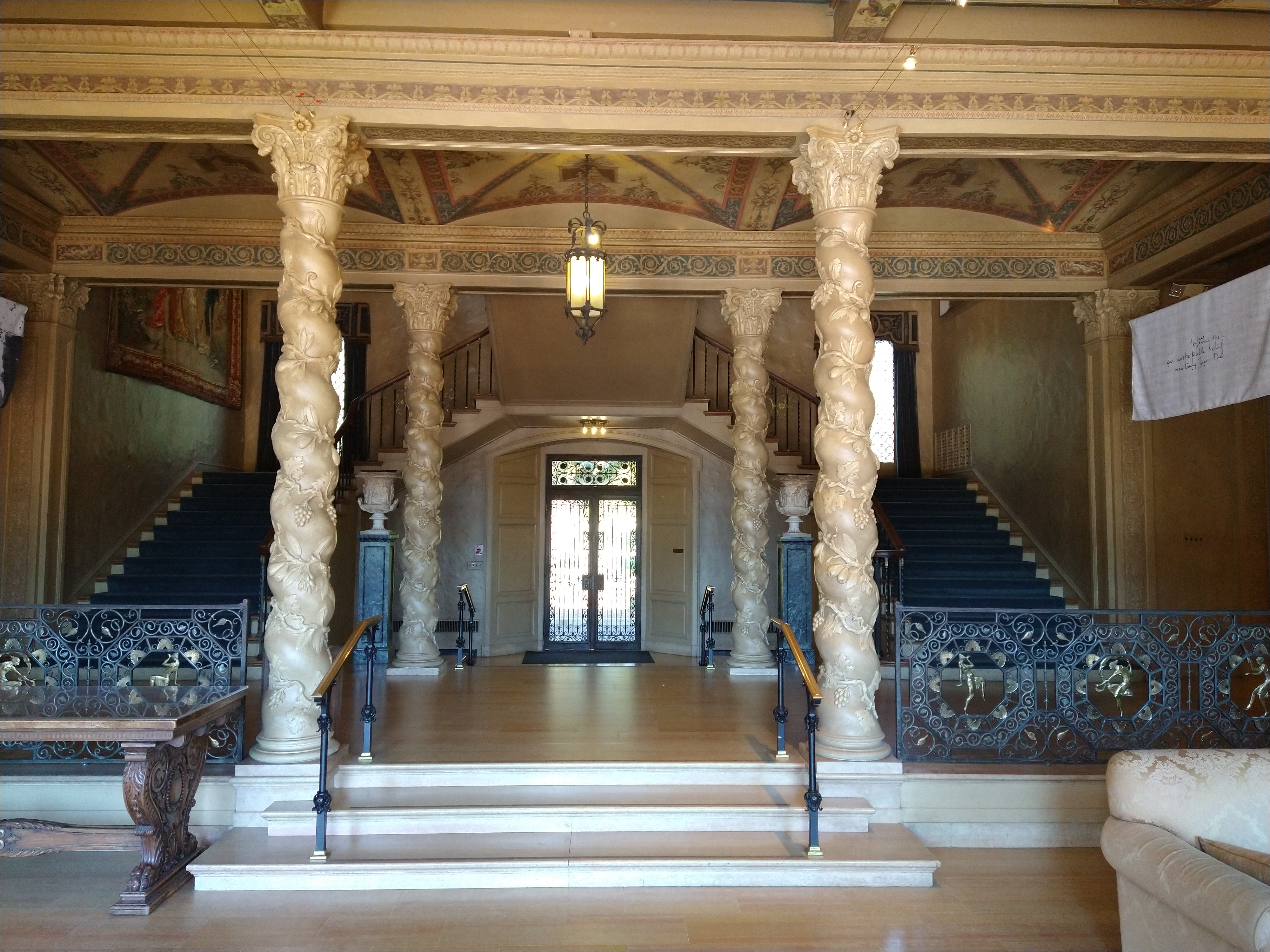
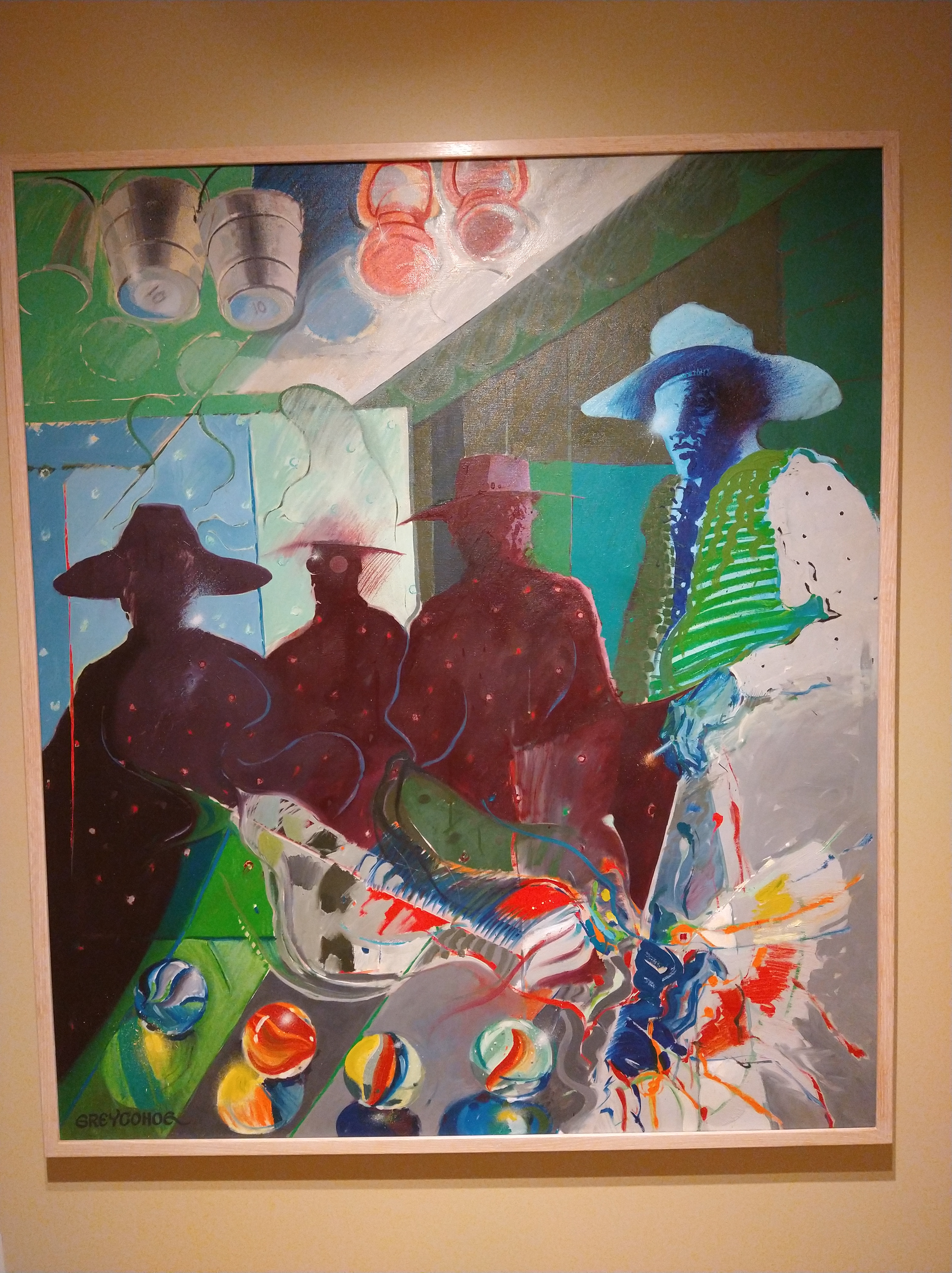
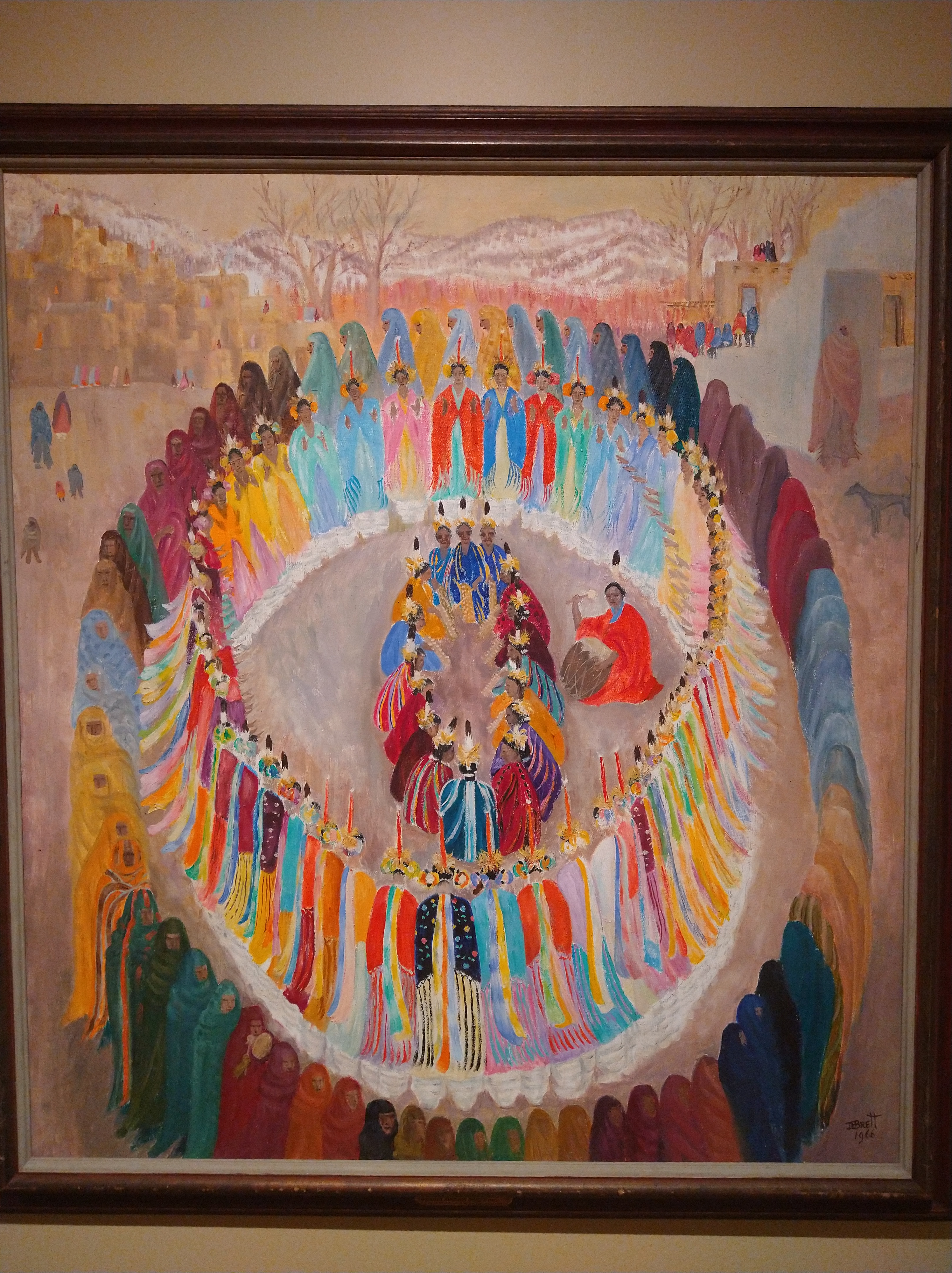
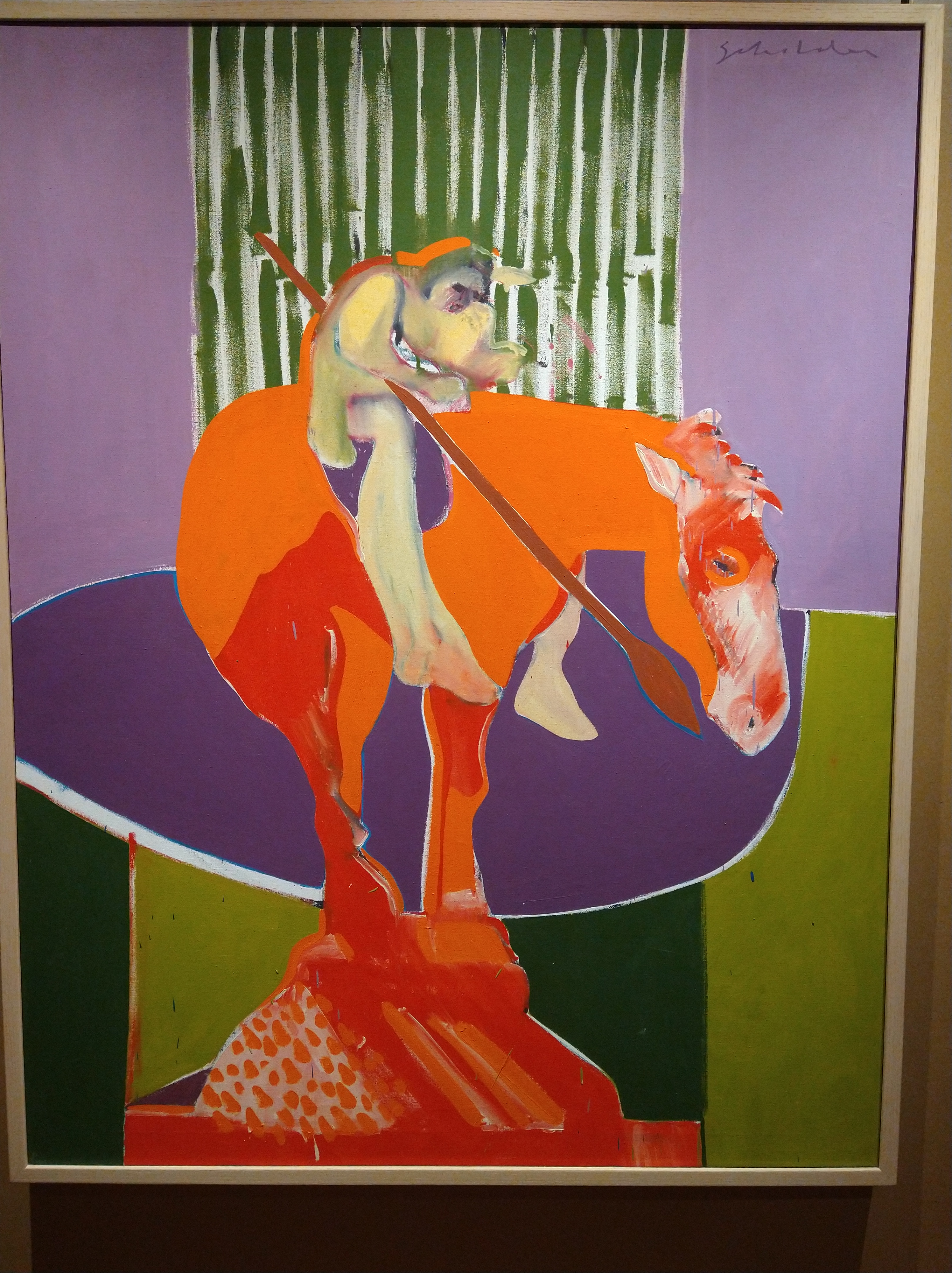
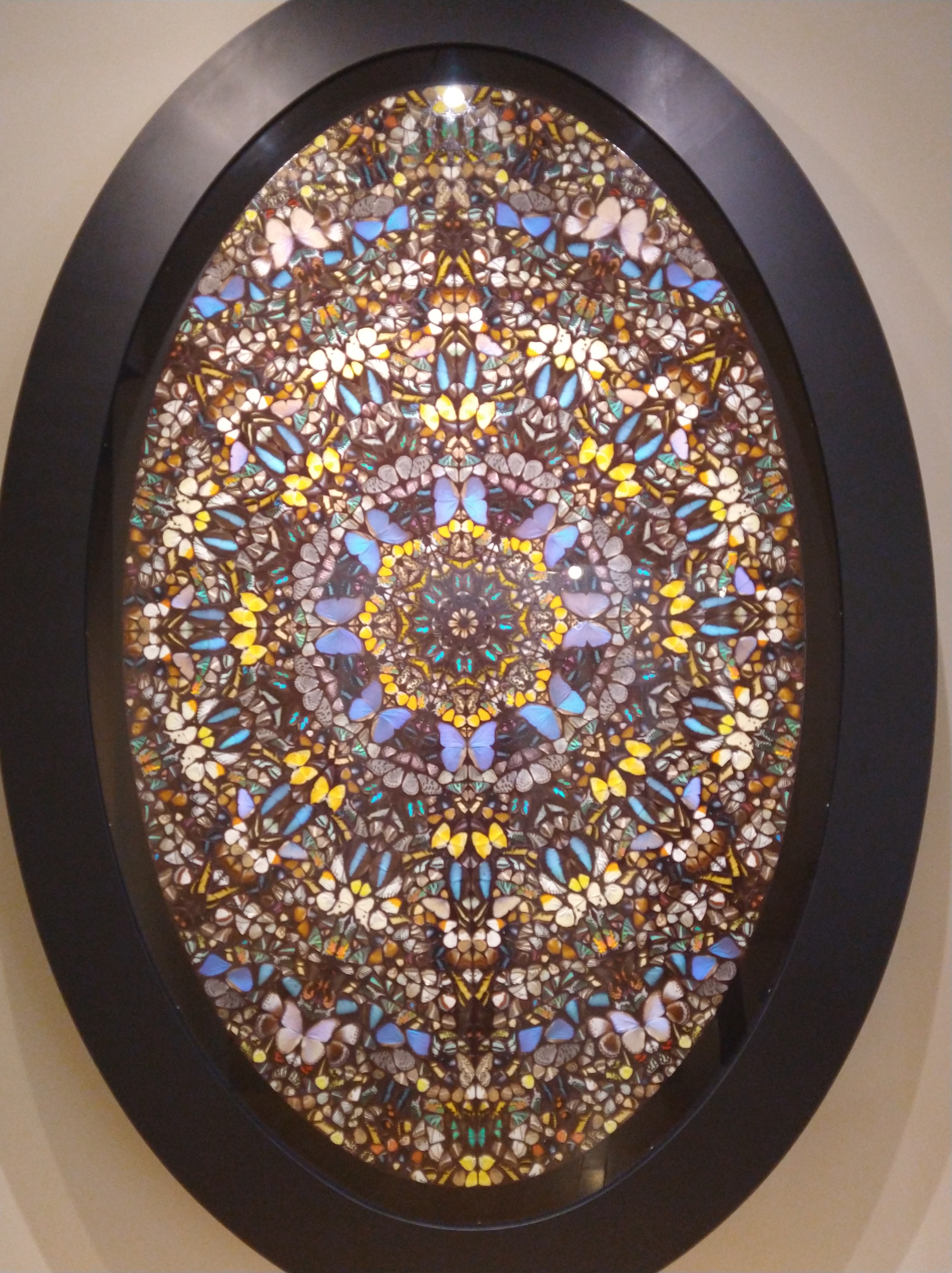
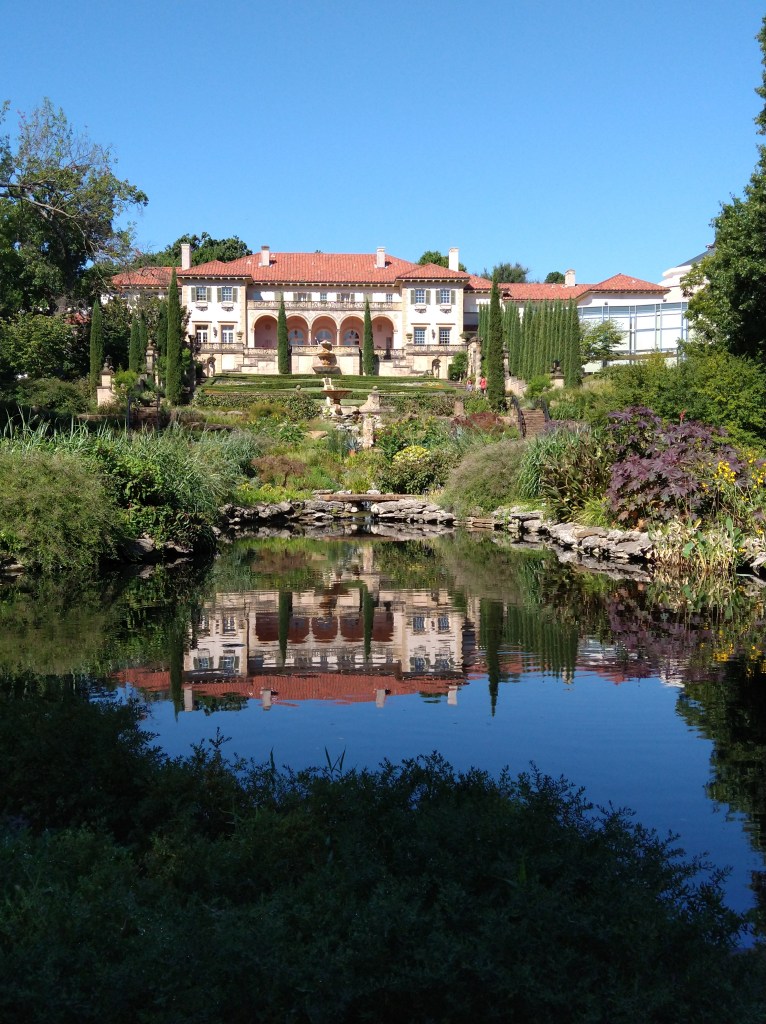
Here are a few images from the Philbrook.

The Phillbrook Museum of Art is a wonderful building on a lush and verdant estate and has a well curated collection. The Phillips family built the estate in the twenties, and for ten years it was inhabited by Waite and Genevieve, their two children and 22 support staff.  They donated the whole lot to the city o f Tulsa in 1936 and it opened as a museum a few years later.  If I were a resident of the area I would make it a frequent place of refuge. If I were to visit again I would schedule two days, one to appreciate the art and another to enjoy the grounds. The Museum appears to provide considerable opportunities for children to experiment with unstructured play on the grounds. Information about the museum is available at https://philbrook.org.

Composed completely of butterflies

One room contained a multimedia display on the history of the property It described how property that was communally controlled by native population became allocated to individual tribal members and then sold to investors.  It has become popular these days to be outraged by the colonization of indigenous lands. A good measure of the outrage is due to the events being recent and properly documented and recorded. It is the same process, however, that has occurred throughout the world over millennia.  Populations lose their lands to better armed and empowered invaders. The European ancestors of the industrialists and entrepreneurs who acquired the land form the native Americans had once been dispossessed themselves.  European history is the history of invasion and conquest.  The pain of the loss is more pronounced to those who can remember it. History is written by the winners, they say, but perhaps it is better said that history is forgotten by the losers.

Enough of that.

We were at the museum for nearly four hours after which we had a late lunch in the Arts District. One of the quaint things about Tulsa is you will probably get green beans with your meal, whether you order them or not. That is my determination after having 100 percent of our meals in restaurants having those morsels on the plate. I forgot to take a photograph of my meal to post on this site and social media, but I can assure you it had green beans served on the side.

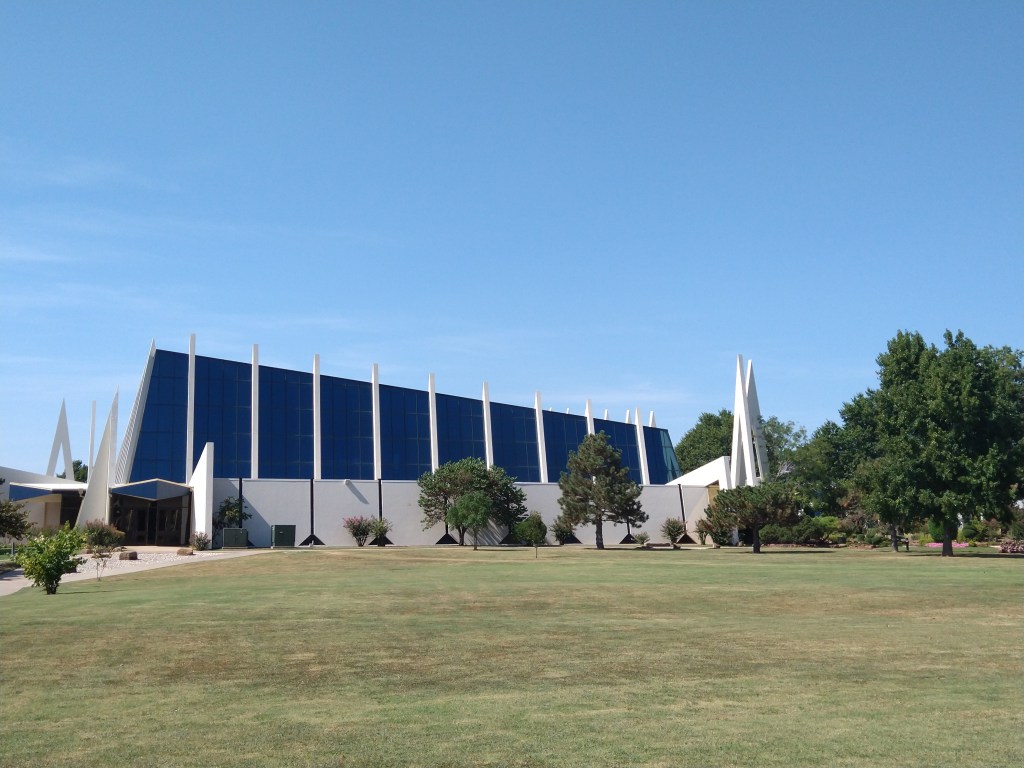
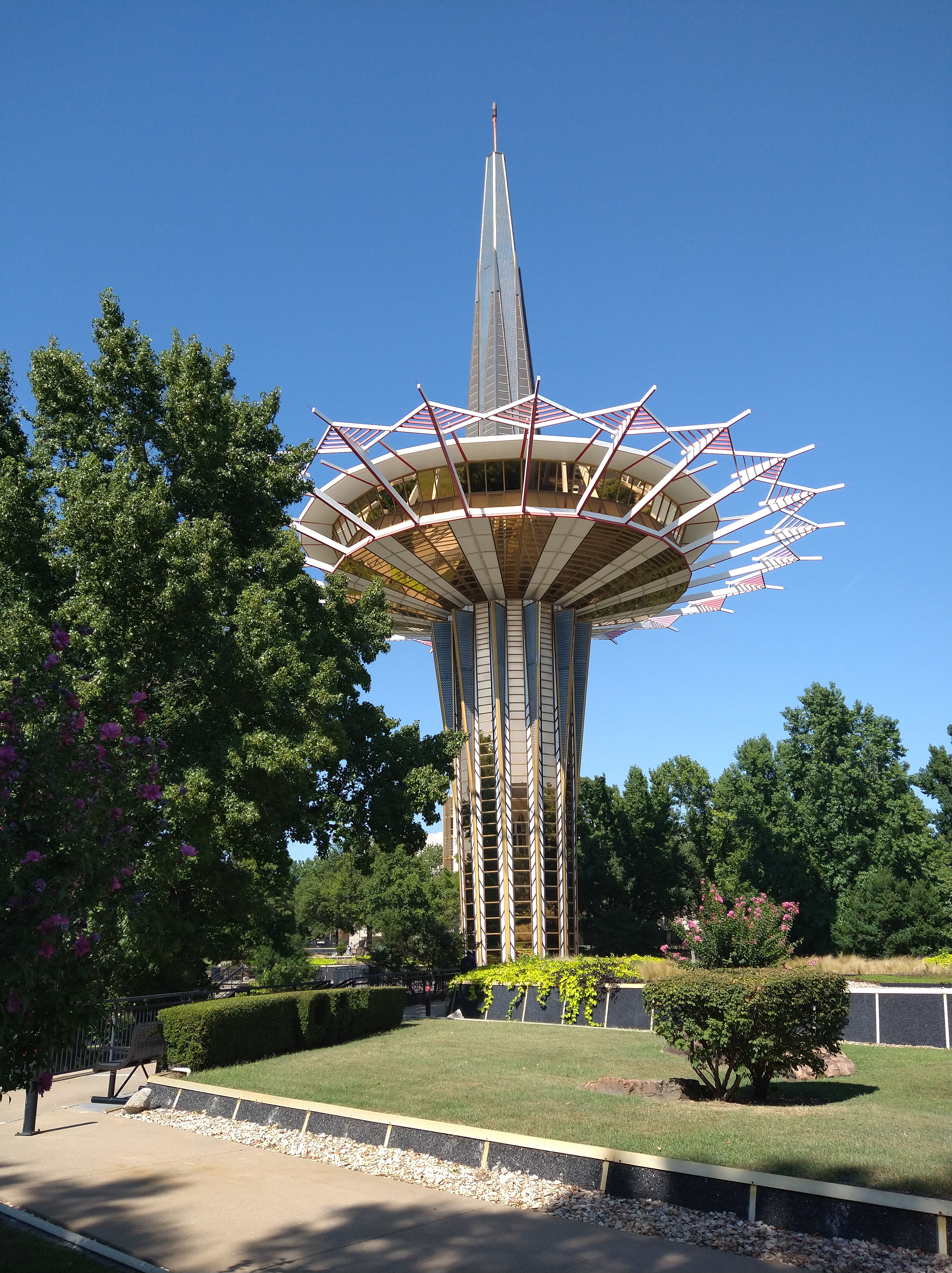
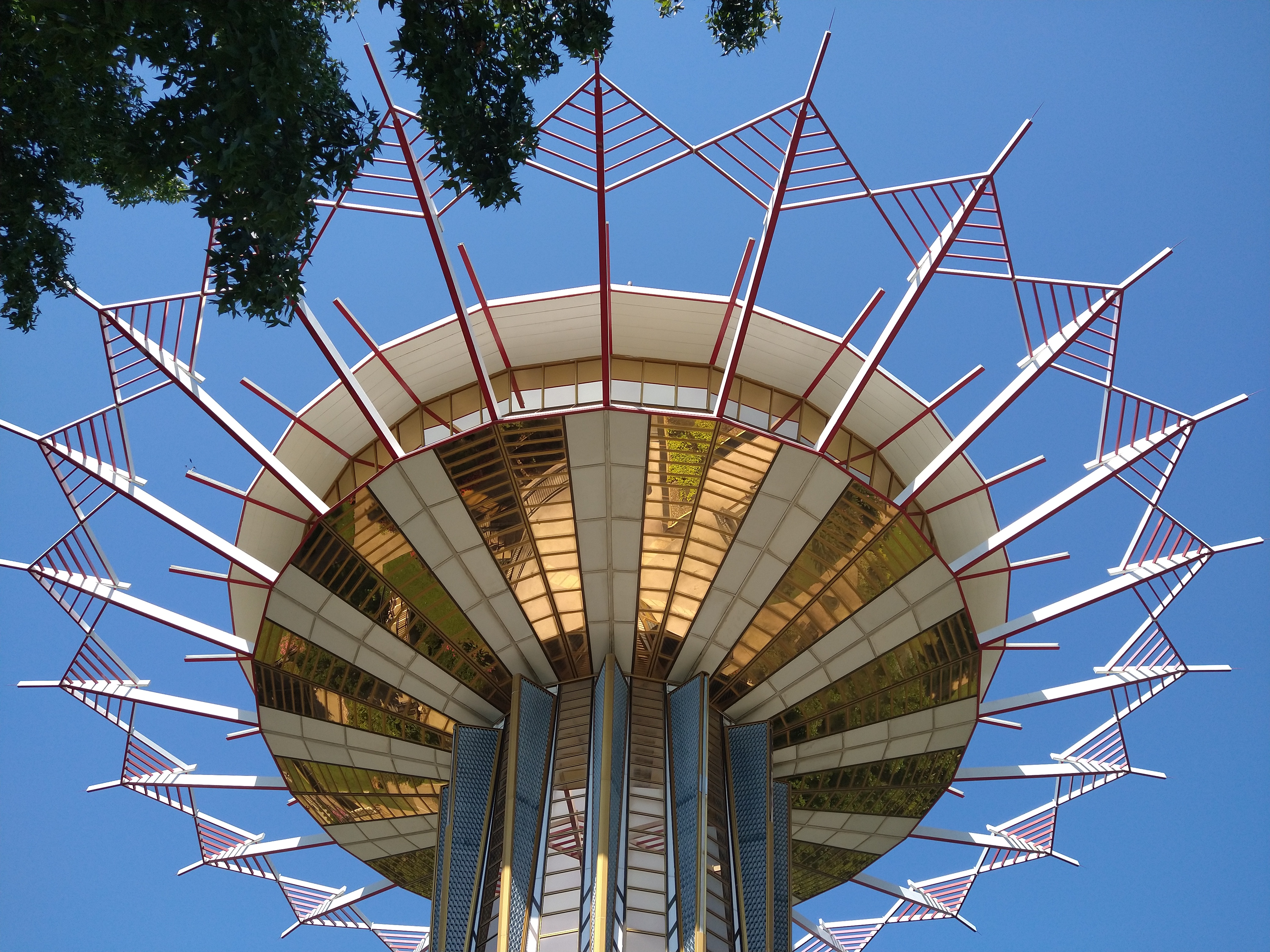
My recollection of my visit to Oral Roberts University thirty years ago was seeing an an eerie, alien and futuristic cityscape shimmering in the light from the setting sun. On this visit I was still impressed by the architecture that seemed to suggest some sort of divine manifestation. The campus is meticulously manicured and has a serene and peaceful ambiance. On this occasion we went to the prayer tower and found it a good environment for meditating on life, consciousness, the universe and everything.

There was a video about the construction and mission of the university playing in the visitor’s center. While I watched I recalled that I always thought of Oral Roberts as something of a crackpot and wondered it that was something I actually thought or simulated thinking since it was so much the conversation among the people I knew at the time. While in that space and at that time I came to marvel at the man who had a vision to create something as big as a university with a special mission, who actually built it. Many years after his death his vision is still alive. What from my cynicism will survive me?

Too late to travel?

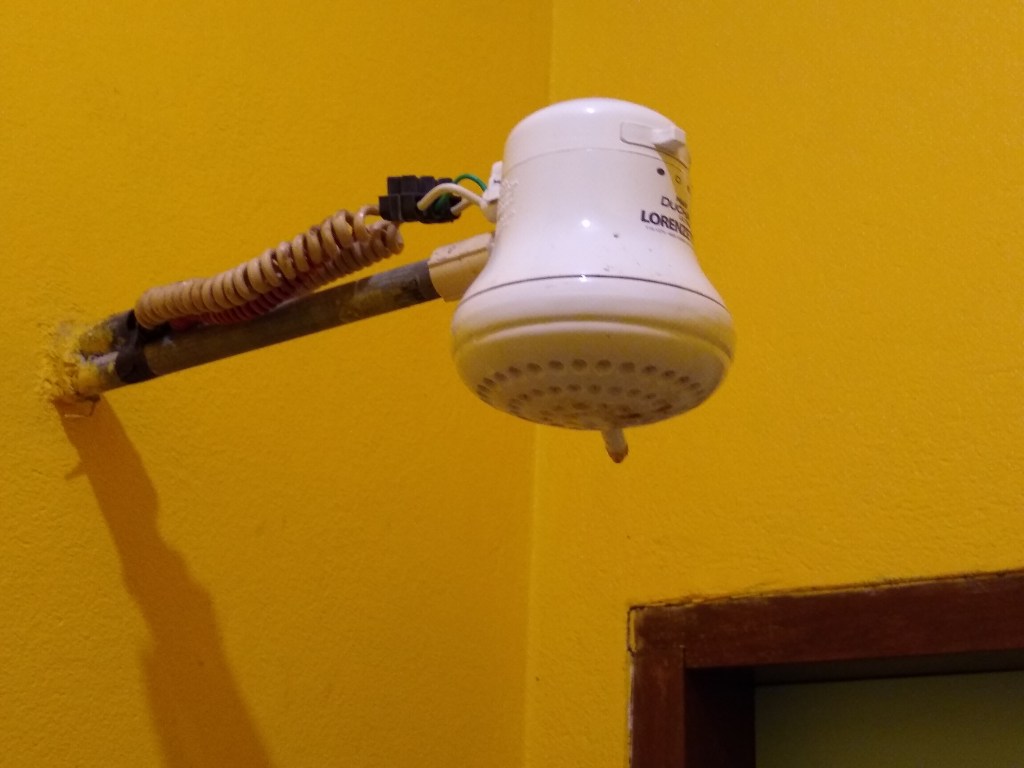
This is the third place we have stayed that provides hot water using electric shower heads. It’s a pretty simple design. There is a 220 volt heating coil inside the head, that is activated by a pressure switch. You turn on the water and when the pressure is high enough the contacts close and electricity flows through the coil. You know when the pressure is high enough because that’s when the ceiling light dims.

This is probably not allow by the authority having jurisdiction for your home

You adjust the water temperature by adjusting the water flow rate. You can not adjust the head position. I found that out when I tried. When water flows through an electric field it is likely to pick up a charge, or at least the water provides a low impedence path to the service entrance that might include the user’s wet body. In other words, I got quite a zap.

Learning that failure effect by direct experience is chilling I might say. The sole safety to prevent an electrocution is a grounding wire that passes through a couple chambers in the shower head. Apparently this is an attempt to dissipate any electrical charge in the water. I would classify that solution as “sub-optimal.”

I learned about the design and construction of this device by watching a Youube video wherein a Scandinavian man disassembled one of these units and described his observations in a very interesting combination of English and Scandinavian tongues.

This is one of the many observations that lead me to think it may be becoming too late in history to travel to foreign lands. Lands are not quite as foreign as they used to be.

Twenty years ago you would not expect hot water in many accomodations in Costa Rica. You also would not have internet access for instructional videos.

We have mosquito nets poised above our bed, but we do not need them since the windows are all well screened. And we don’t need to worry about currency exchanges because credit cards are accepted almost everywhere. It is very easy and convenient to travel here, and it will become somewhat more so when the highway expansion project is complete.

Puerto Viejo has been here since before there were roads to this region. Now there are paved roads between San Jose and Puerto Viejo. The principal route is slower than usual since a massive construction effort to expand the highway is underway. It is very convenient to travel her and will be somewhat more so when the project is complete.

Of course the place is filled with tourists from around the world. Many from Europe, Argentina, Canada, and the US. Prices have increased considerably over the years as the area has become a playground for rich people like us. And hippies.

Land values near the beach areas are very high and much of the land has been absorbed by the tourist industry. Hotels, restaurants, and various stores take up nearly the whole of the Centro. We see abandoned buildings under renovation, and it is clear the economy is humming along famously for now.

Today Paula and I rented bicycles for the day. As we rode in town before dark I saw three local men walking up a hill leaving town. I imagined they were heading home following a day’s work and I considered what if must be like to be relocated from your village while the investors and entrepreneurs took it over. Where capital moves in people move out, it seems.

I do not get any sense of resentment from the local people we have encountered. Has here been a sufficient improvement in standard of living to make the loss of one’s home acceptable? The salutation is well earned by the people here. Pura Vida.

I figure if you have read this far you may have expected a photo or two. I’ll leave you with one, an a promise to post more in the next day or two.

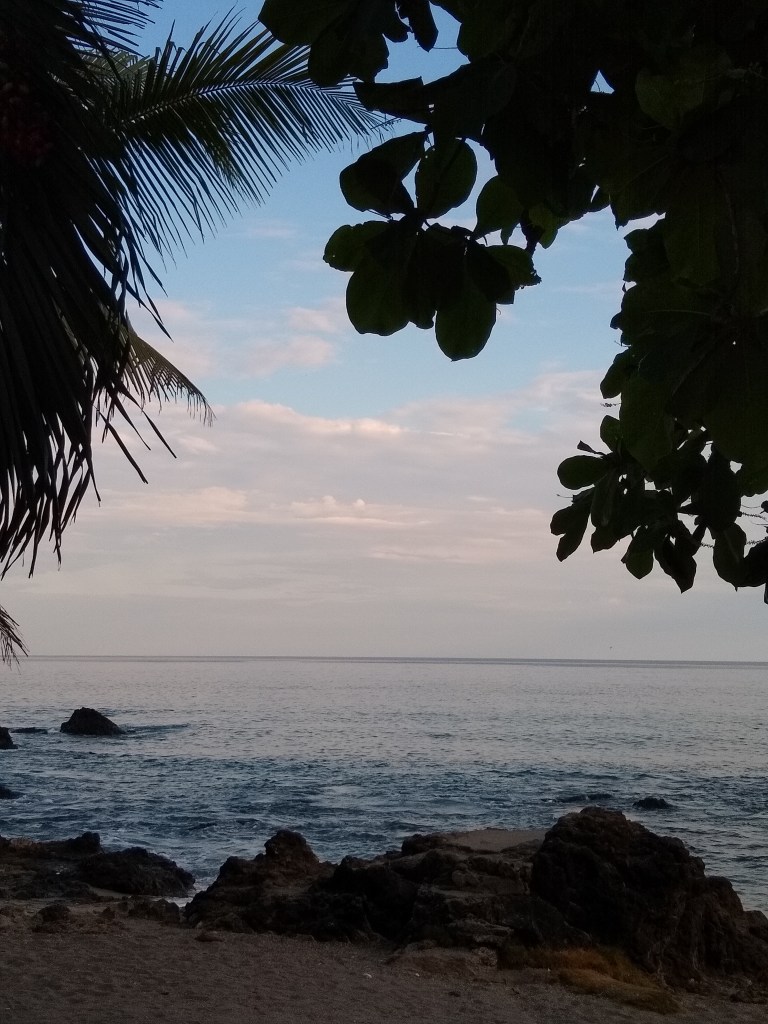
You don’t need to see the Sun set to see a great Sunset.

A wonderful day in another paradise.

One of the benefits of being a budget traveler is that recovery from a mistake may not be very costly. Before coming to Tortuguero we questioned whether we should stay two or three nights, and being the happy go lucky people we are, we paid three nights in advance.  That was a mistake (just as far as we are concerned).  Two nights will be enough for us so we will forgo one nights rent and catch the early shuttle to La Pavona in the morning.

We have no complaints, except maybe we should have spent more on the hotel.   It’ been great to be here.  The weather has been nice, even though we’ve sampled a lot of rain.   We are leaving early because we have the choice to do more of what we did today or head off to a new location.  Which is what we will do.

Tortuguero is an interesting town. The national park (since 1995) is the focal point of tourism for the area, and many resorts and eco-resorts in the area, and a number of hotels and hostels in the town. The town is maybe 200 meters in length, and fills most of the space between the main canal and the Caribbean Sea (200 meters or so). Calle Principal runs between the national park entrance on one end and a resort hotel on the other. Along the street are shops, sodas (casual eating, generally family owned), tour operators, travel agents, restaurants and curio stores. The main tourist attractions involve being on the water, unless you are walking on the beach or around town, eating drinking or drinking, eating. We have six more nights to be on the coast and will be spending them elsewhere.

This morning we went for a canoe tour of the park by an independent guide who has been giving tours for 31 years. He is at least second generation guide in this area.  Our hotel and many internet sites warn that you should book through a tour company rather than going with an independent, but that would have been a mistake. Castor was a fabulous guide. He was knowledgeable and observant and had a very cheerful disposition.

Our tour started at early o-dark thirty (545 AM in real time). This is both before the park’s ticket office opens and before the sun rises. That didn’t matter, though since the clouds never lifted and we could not see the sun. We were first in a very long line, and were able to be the first canoe in the water, getting into a number of areas before the larger tour groups, particularly the ones from the nearby resorts.  Castor pointed out a large number of creatures we would not have seen with a lesser guide.  He also chided us in a good natured way for being blind and unable to see what was right before us. He took us into channels where he had to chop through branches with a machete.

For two and a half hours he pointed out spider monkeys, howler monkeys, foosinter monkeys, Macaws, toucans, lizards, caiman, and sloth and many variety of heron. It was a fire hose of sensory experience.

After a long walk on the beach, which ended well after the rain began, we came to feel that we have done what we wanted to do here and rather than hang out for a day we’d head on to Cahuita, a village on the coast at the entry to another nature preserve.

A second benefit of being a budget traveler is that we have more opportunity to at least sample the life of the folks who live here. Starting about four o’clock the shuttle boats from the resorts start showing up, filling up, and draining the town of tourists. There are those like us that stay, wandering on the Calle Principal for a while, and who drift off to restaurants, bars and hotels. That is when the families take over the park and plaza. Children play with the kind of enthusiasm I recall from the time we still had neighborhoods in the US.

Although Tortuguera is a destination location for tourists, I get no sense that the merchants and businesses take advantage of the isolation. You cannot get here except by boat and most things they have to sell are imported. Yet the prices at restaurants and shops are in line with what we would expect to pay in San Jose or Heredia. Except wine — that cost way too damn much. Paula reminds me: “we haven’t been to Heredia.” I say, “of course, but I can still have expectations of what I would pay there.”

Paula wants me to start a new blog. she thinks I should call it Sabelotodo.

The internet is really slow in this hotel, so no photos tonight. We’ll see how it goes in Cahuita. Perhaps we can catch up then.

Pura vida, amigos.

And so we are

Years ago when I was a lowly compliance officer for OSHA o was scheduled to inspect s construction site in the mountains of northern New Mexico. After a bit of wandering I found the project superintendents trailer, presented my credentials, and described the process of inspection, citations, fines, and speaks.

The super told me I would likely not going the actual construction site on my own, and should ride with him in his 4wd pickup. After a half hour crossing streams and climbing hills we reached a meadow where he stopped the truck, shut off the engine, turned to me and said, “you and I are the only people who know where you are right now, and I bet you’re not to sure yourself.”

The feeling I had them was a lot like how I felt this afternoon on the boat from La Pavona to Tortuguero. The trip took over an hour and I lost track of the number of twists and turns cruising past mangroves and crocodiles. The sky was overcast and it rained during most of the journey.

It was an invigorating experience that was a fitting end for the drive from the central valley. We had been told the Caribbean coast is lusher than anywhere else in Costa Rica: I was skeptical of that claim until I saw for myself. The jungle is impenetratingly dense to the point that it is frightening. It is a wonder that humans could carve out enough of the jungle to make settlements.

But carve they did, to the point that we drive for a considerable time past enormous fields of trees: piña, coco, banana, papaya. The farms had good old family names, like Del Monte and Dole. In that area the air was dense with smoke from where the grocers were being cleared.

We have settled into a small hotel that has internet so slow we cannot upload photos. For the next few days will just send narratives and catch up with photos from Puerto Viejo next week.

I am a bit disappointed that we missed the spectacular eruption of Volcan Rincon Vieja today. I’ll probably think about that tonight and dream about earthquakes and tsunamis and wonder how to find the evacuation route.

More later. “Pura vida,” as they say in these parts.

Photographs, no politics

This is just a collection of random photos that I have not, to my recollection, posted yet.

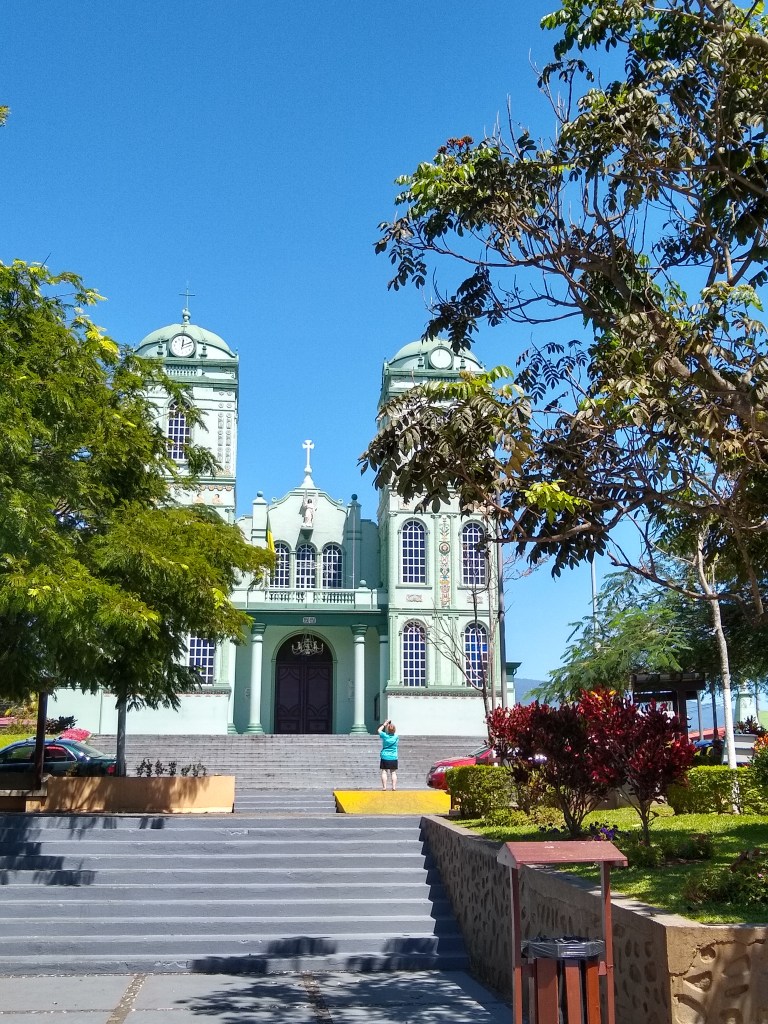
Parish Church at Sarchi
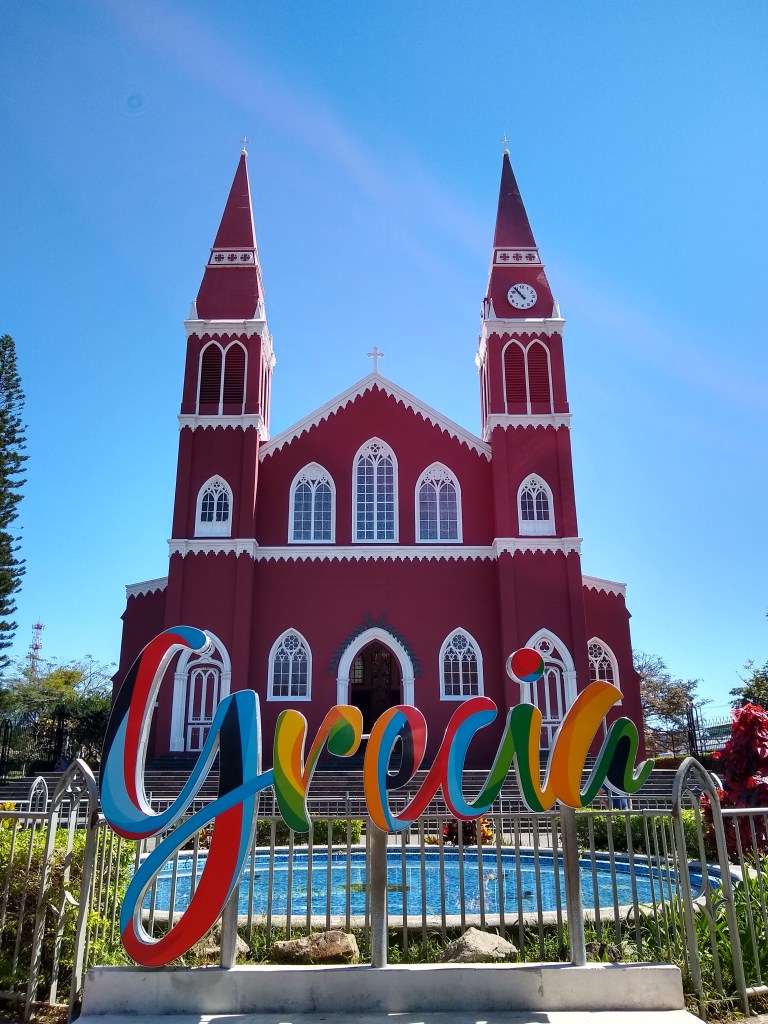
Parish Church in Grecia
Clouds Above Montezuma Beach
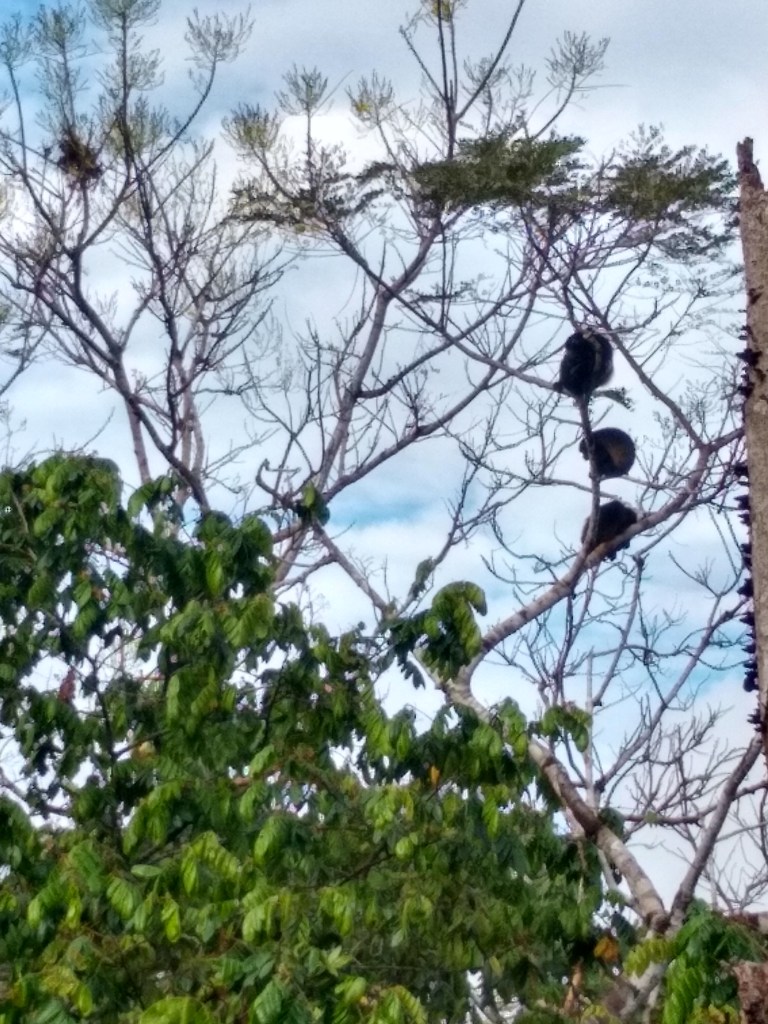
Howler Monkeys Demonstrate Why They Are Considered The Laziest Primate.
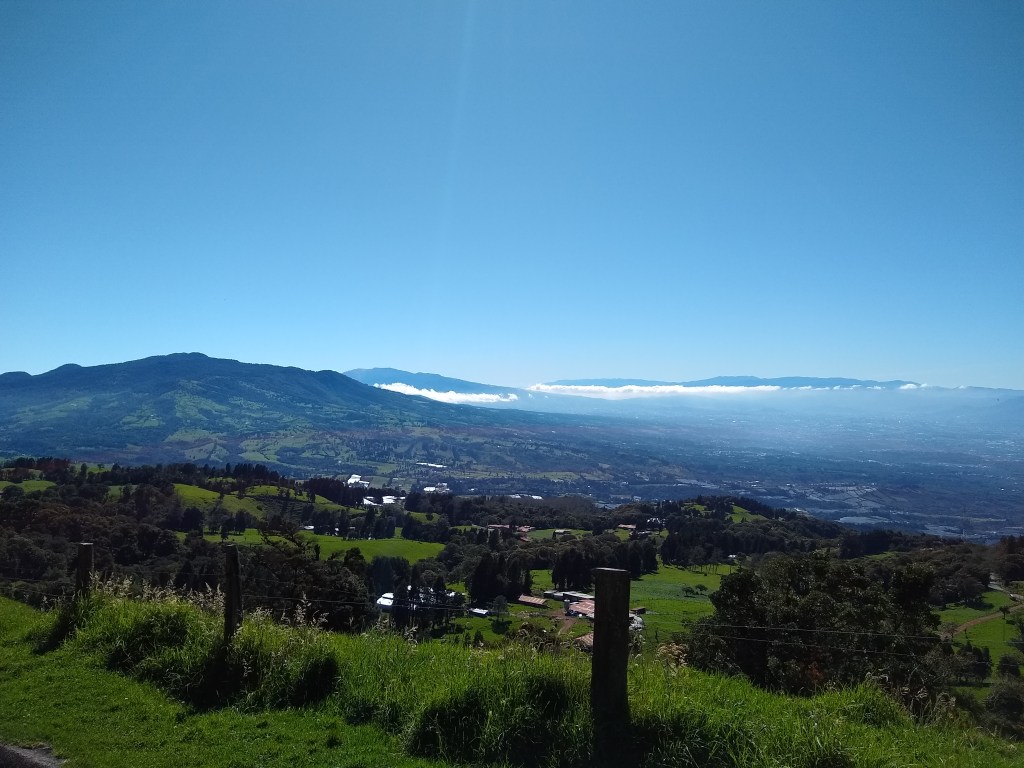
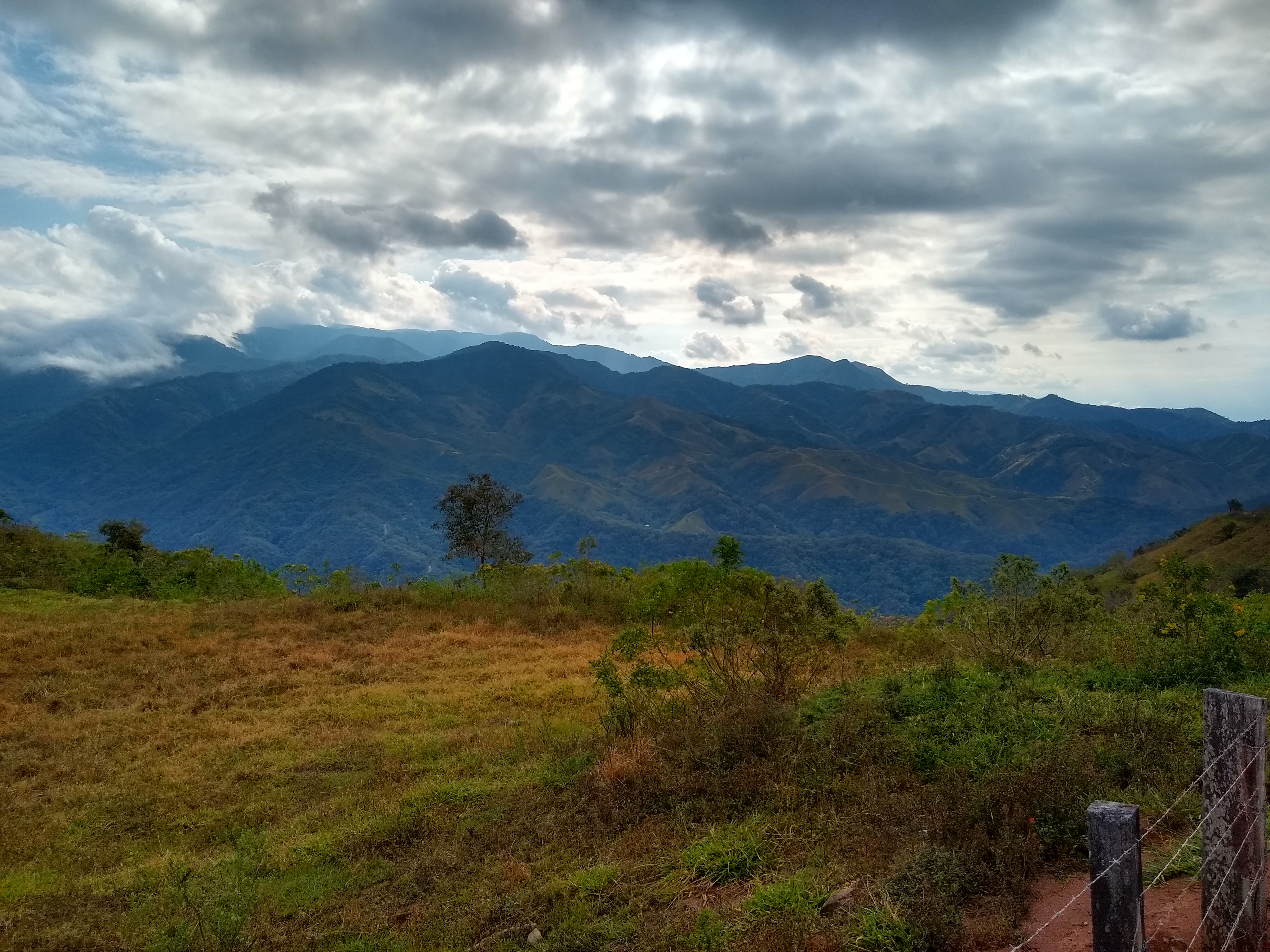
On the Road from Volcan Poas
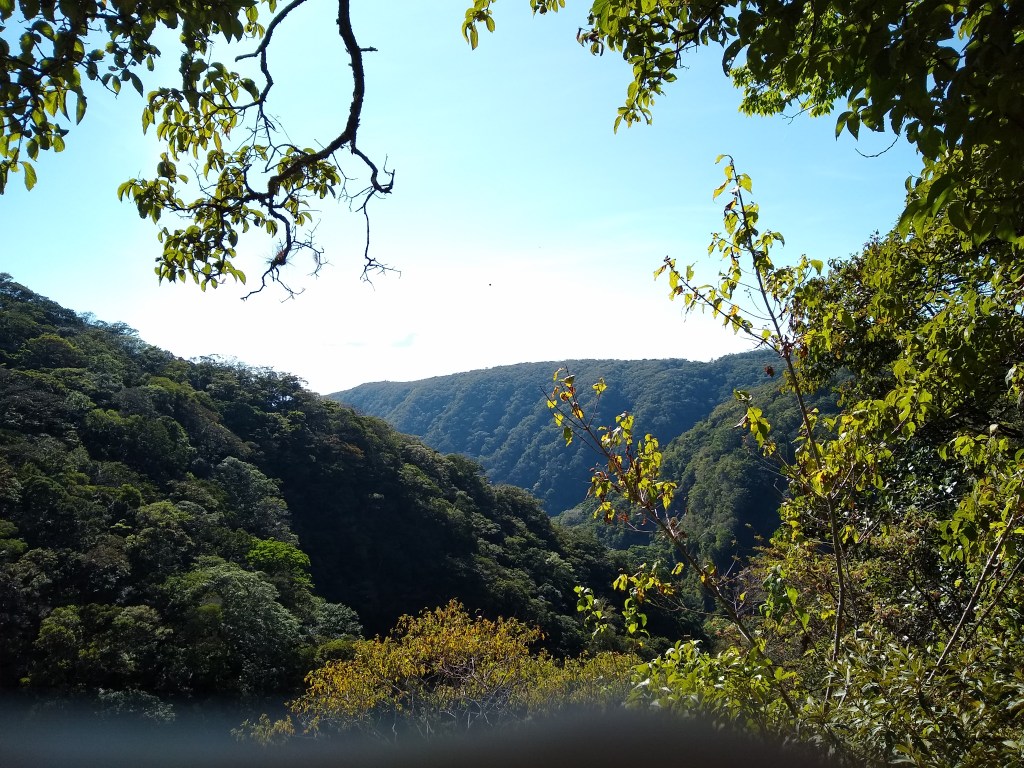
Within Valle Escondido, near Monteverde
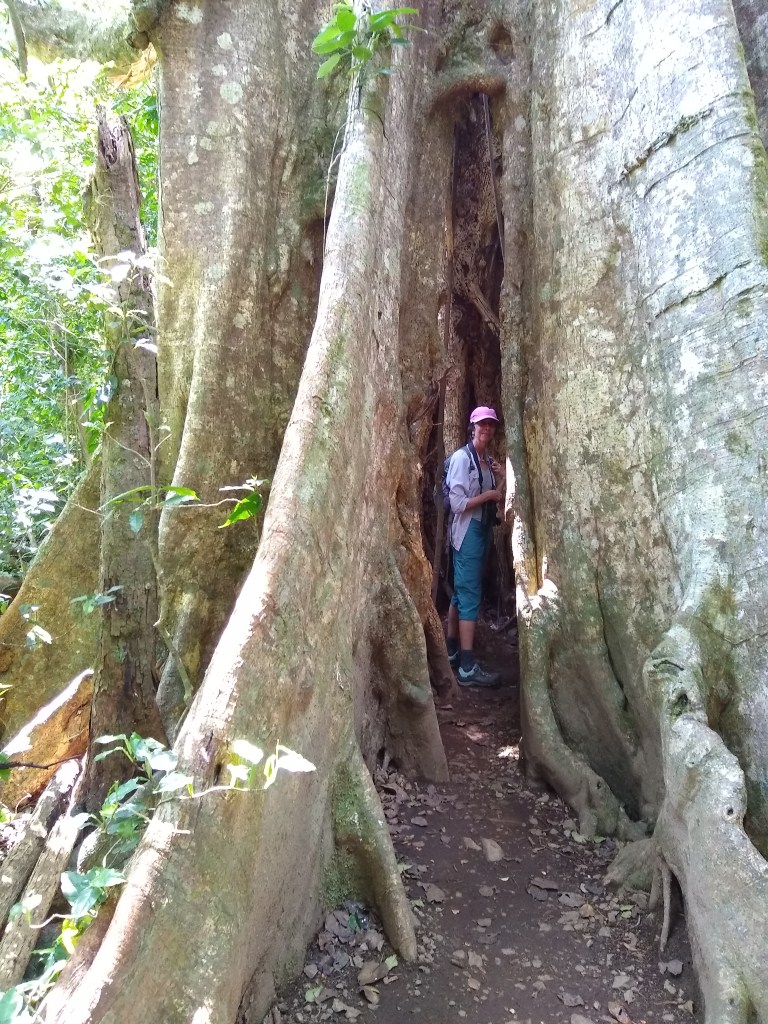
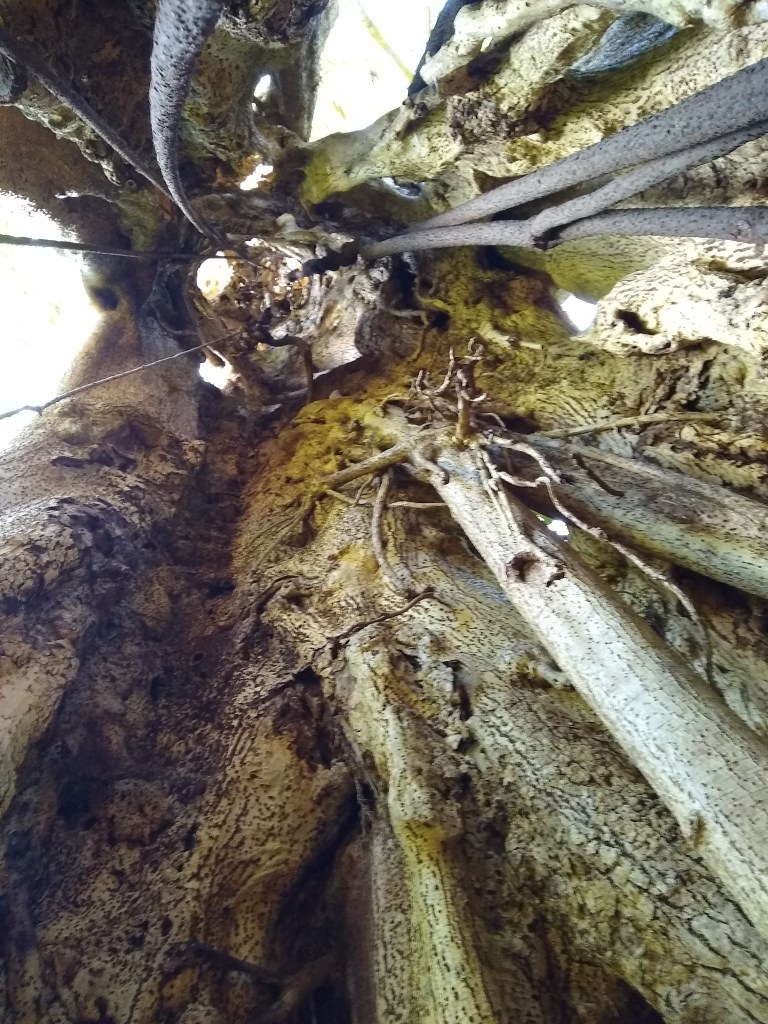
Paula Being Eaten by a Ficus
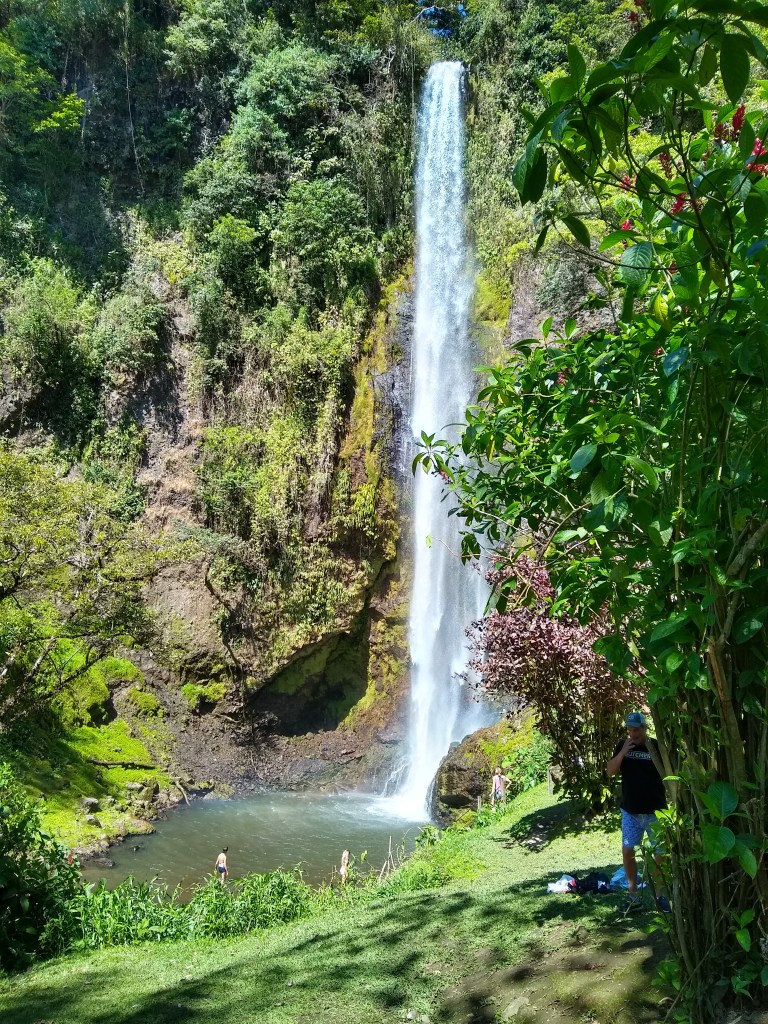
Rainbow Falls in Cataratas Viento Fresco
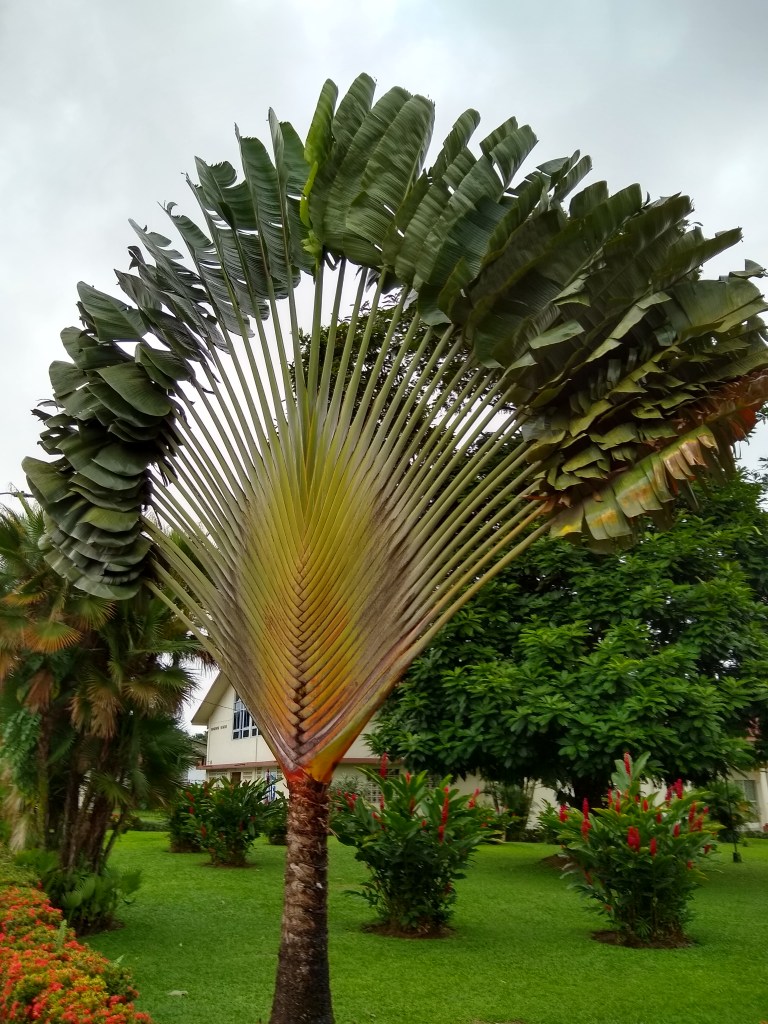
Garden in La Fortuna
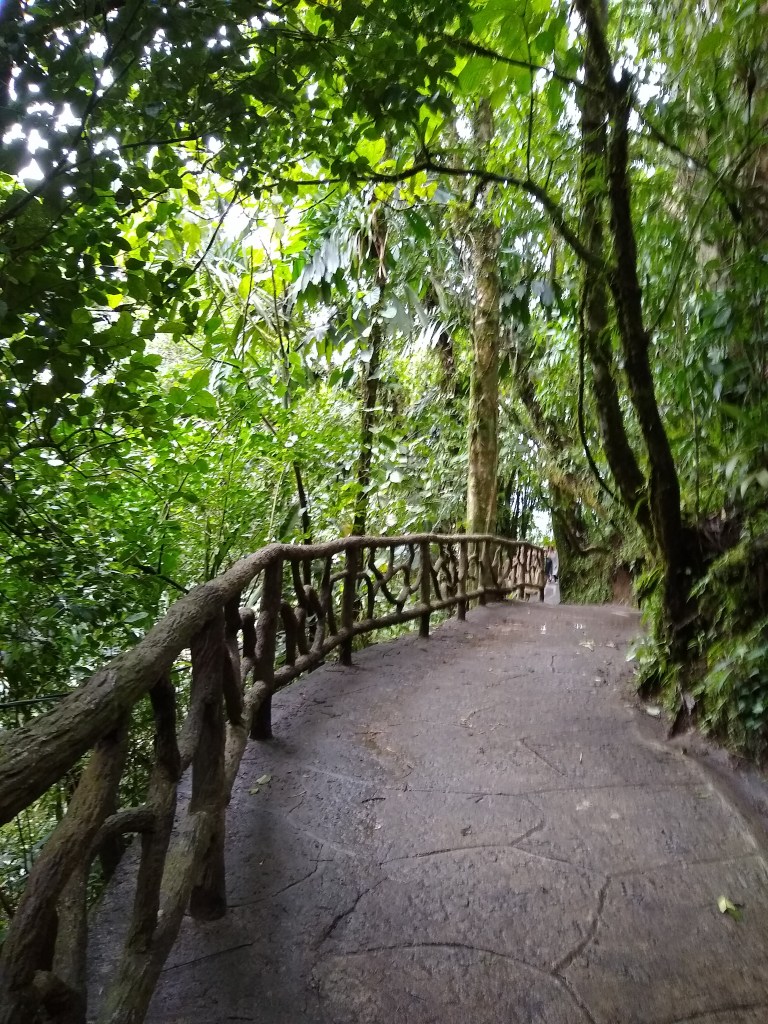
Trail at Hanging Bridges (Mistico)
I love how these leaves look against the sky.
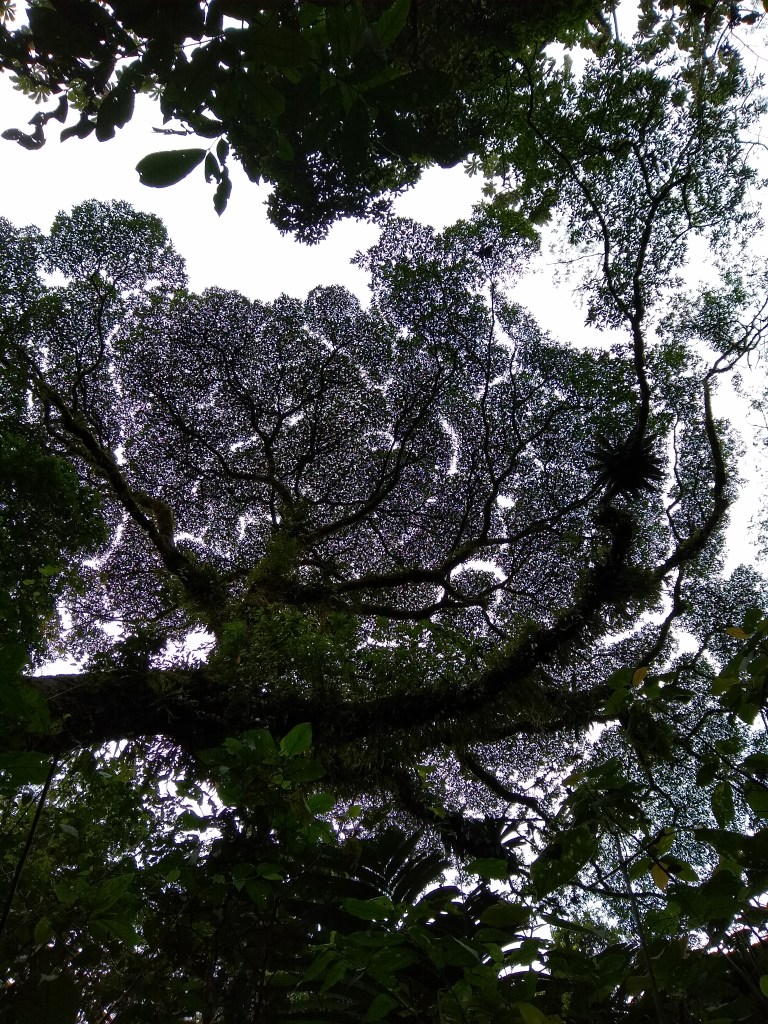
View of Ficus from Inside.

What, exactly, did I mean by that?

Paula has been keeping up with the blog postings for the last few days. Rather than admit to a basic level of laziness on my part, let’s just say that we were in beach country, which is Paula’ bailiwick. I figured that she would have more to say than I, but then, it’s beach country and Paula has a single minded focus when it comes to being in or around water, which is being in and around water. So we have both been silent for a few days, which leaves me in something of a quandary. How do I put my best foot forward when my best foot is still resting in the hammock?

Paula reminds me that I left something of an accusation at the end of my last post. I questioned how it is that GT, the worlds most renowned climate change activist, hates Ticos. I’ve been keeping one eye on developments in the political sphere while on vacation, and I happened to read portions of GT’s rant at the Davos gathering last week. In that speech she had wise words such as demanding that becoming carbon neutral is insufficient actions to curb climate change, and that we can not wait until there are technologies available to replace our current reliance on fossil fuels: only the immediate cessation of all carbon based fuel is an adequate response to the challenge. It must have been wise comments, since any adult who questioned the wisdom of her statements was accused of all sorts of crimes, including child abuse.
Costa Rica has based its economic development on two main industries. One is exportation of agricultural products: sugar, fruit, coffee, cocoa, etc. Another is tourism. Nearly half of all employment in the tourism industry. You can’t put your finger on the map without touching a national park, a nature preserve, private reserve or eco-resort. People come from around the world to fork over Dollars, Euros, Yen and Colones to experience the playland Costa Rica has become.
There is a large investment in alternative energy sources: wind, hydro, solar. Although I haven’t seen any electric cars, I’ve been seeing charging stations in some parking areas. I read last week that the country expects to be “carbon neutral” within 5 years, which will be a challenge given the number of internal combustion vehicles on the road. We were informed that reforestation is one of the major initiatives to achieve that end.

But Greta demands that this effort be cast aside. What we should do, instead, is let the economy of this country crumble. There should be no ships to move produce to markets. Airplanes should be grounded and the tourism trade should be abandoned. No more rental cars, airplane flights, motor boats, etc.

Let the Tico’s eat the papaya, piña, coconut and mangos. Let them drink the coffee and cocoa. They can live in the abandoned resorts and hotels. Just don’t let them have anything more than a subsistence level economy. It’s something they must do so that privileged children in the developed world can indulge their catastrophic visions.

Perhaps we should not pay so much attention to children until they have learned a bit more about the world and have something valuable to say.

Whoa. I didn’t mean to get all heated up like that. I think I will end this post, have another guaro and fruit juice, chill out and post again when I’ve calmed down a bit.

As the rain came tumbling down

Our host at the apartment we have rented in Montezuma, Costa Rica, told us this afternoon that it will not rain until may. It is now about 9PM and the sound of the rain on the roof is almost loud enough to obscure the calls of the howler monkeys in the jungle outside. Here is a photo to show how close we are to the jungle:

Paula relaxes on the patio

It was a nice drive from Monteverde to Montezuma. It took about three hours and included a steep downhill drive from the mountains to the coast at Punta Arenas.

From the road to Punta Arenas
Another view from the road

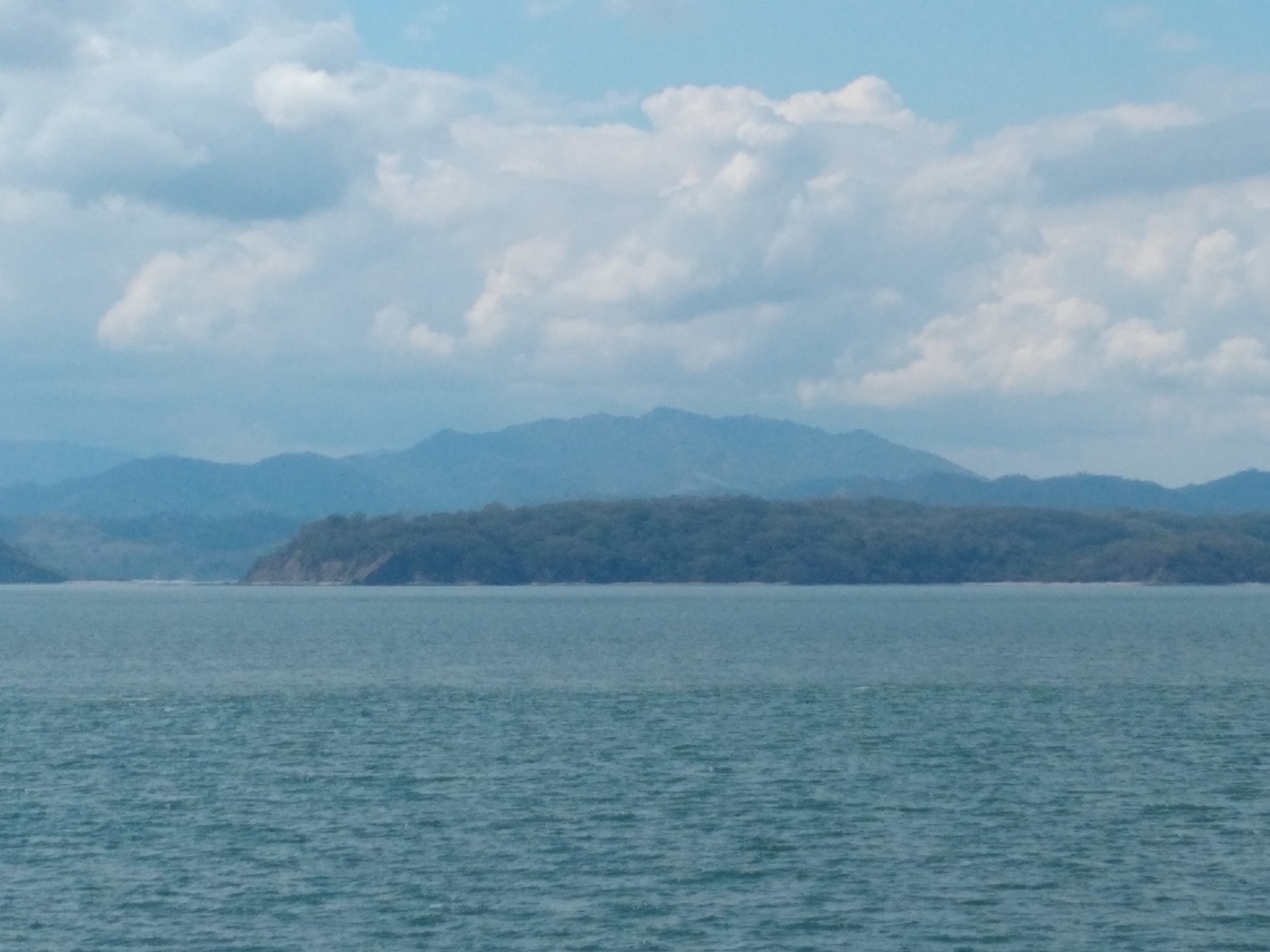
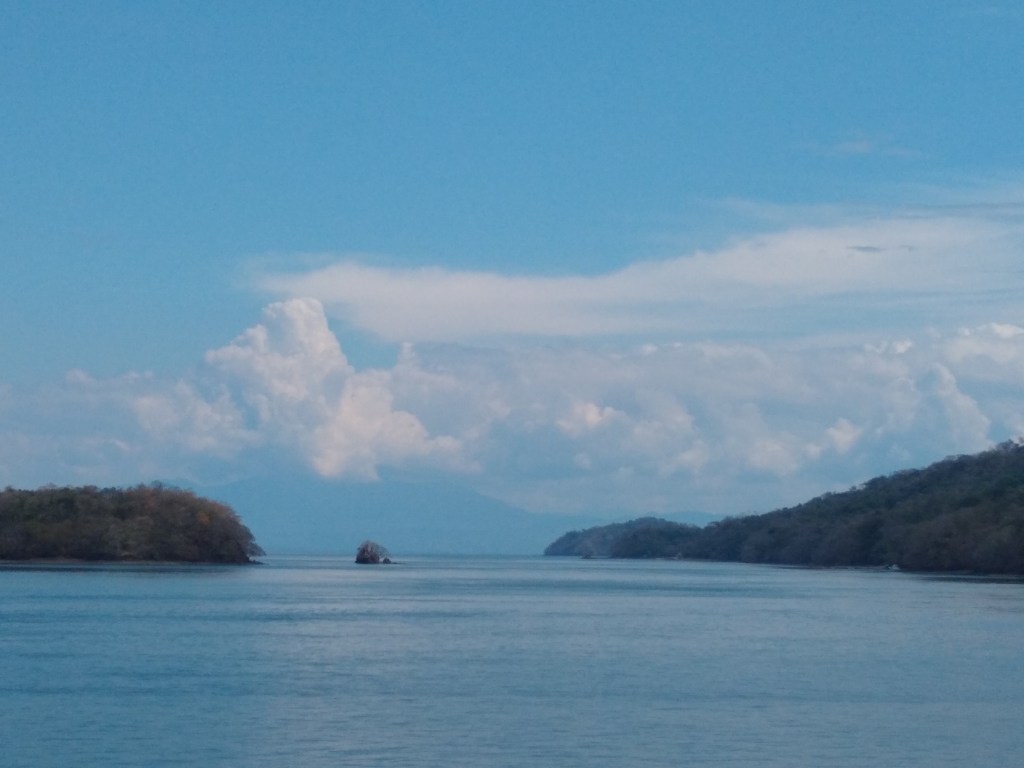
In Punta Arenas we caught a ferry to Paquera, crossing the Golfo de Nicoya to the southern end of the Nicoya peninsula. about half way across the gulf we passed the Isla San Lucas, which was abandoned as a penal colony in 1991. We wrote last week about an exhibit at the Museo de Arte Costaricanse in San Jose, that included images from an archeological study of the penal colony on San Lucas. Here is what we could see from the ferry:

Isla San Lucas
A view from the ferry

The road from Paquera to Cóbana is paved, sometimes with new asphalt, and at times with edge to edge potholes.  After leaving the port area we had to pass a number of large trucks that could barely make 10 kph up the hills.  But after that we did quite well.  At Cóbana we headed south along a gravel roads to our little apartment nears Montezuma. Dr. Google engaged in a bit of malpractice on this part of the trip, sending us down roads that had been washed out years ago, and circling around our final destination. A phone call to our host ended a significant frustration.

Montezuma is something of a hippie beach town, and is a twenty minute walk from out apartment, down a steep paved road. Our host advised us we should drive the first time we went to Montezuma to gauge whether we would feel comfortable walking up the hill. We, being good walkers, sneered at the notion and treked off blissfully unaware that he knew that of which he spoke. It wasn’t the steepest hill I’ve been on, nor the longest, but probably takes the prize for the longest steepest road I can recall.

Here are a few photos of what we saw in Montezuma:

Entrance to Montezuma
Montezuma Beach
The coast at Montezuma

After a grueling climb back up the hill, we sat on the patio, watching spider monkeys play in the woods and enjoying the sunset.

A spider monkey jumps between branches
There are two monkeys in this photo. Can you see them?

The rain is abating and the howler monkeys are howling again. It’s time for bed.

More later. Maybe I’ll get around to demonstrating why Greta Thornberg seems to hate ticos.

Sunshine, finally.

Paula is currently typing out a post about the last two days here in Nuevo Arenal. It has been really nice since the rain abated. Yesterday was not exactly sunny, but we spent a lot of time outdoors and did not have to dodge raindrops for more than a few minutes. Today we went on a forest hike and emerged from the jungle to our first experience of of bright sun since we have been in this part of the country. After a couple hours in the sun, I decided my new political slogan will be “Make America Sweat Again.”

Tonight I’ll mostly post photos without too much narrative. I’ve come to find that noone really appreciates my outstanding wit as much as I, so there will be no more of that.

Yesterday spent so much time out and about that neither of us had much energy to summarize the day. We started with another walk in the local forest, and I began composing my thoughts about another gray day of clouds and rain. Knowing it would be wet, we drove to a private reserve called Mistico which has a very well developed trail with a number of suspension bridges, some of which were above the forest canopy. We sprung a few bucks extra for a guided tour, which we were told would be in a group of ten people. However, after we arrived at the park we found that the group had already been filled so we were assigned a private guide, Alonzo.

Alonzo is a young man who has been working as a tour guide for thirteen years, and is currently a backup guide at the Mistico park. He was an impressive guide who was able to explain the habits of the forests creatures, the role of various plants in the ecosystem, and the evolutionary pressures affecting both plants and wildlife. He was able to show us spider monkeys, howler monkeys, several bird species, nesting bats and owls, snakes, various ants, bees, and the like. He used Paula’s camera to take some great photographs through the telescope he carried on the entire walk.

There were a few times, however, that I think he was exaggerating. For instance, when we mentioned that we had heard the howler monkey will throw feces at people who got to close, he agreed, and elaborated that several monkeys would do that, including the Foostiner monkey, whose poop supposedly has magical qualities, according to folklore, and being hit by their feces is considered auspicious. That is why most Costa Ricans understand that ………!

“But you promised!”, I hear you say. I’m not sympathetic, since you know I can’t be trusted.

Here are a few photographs from the park:

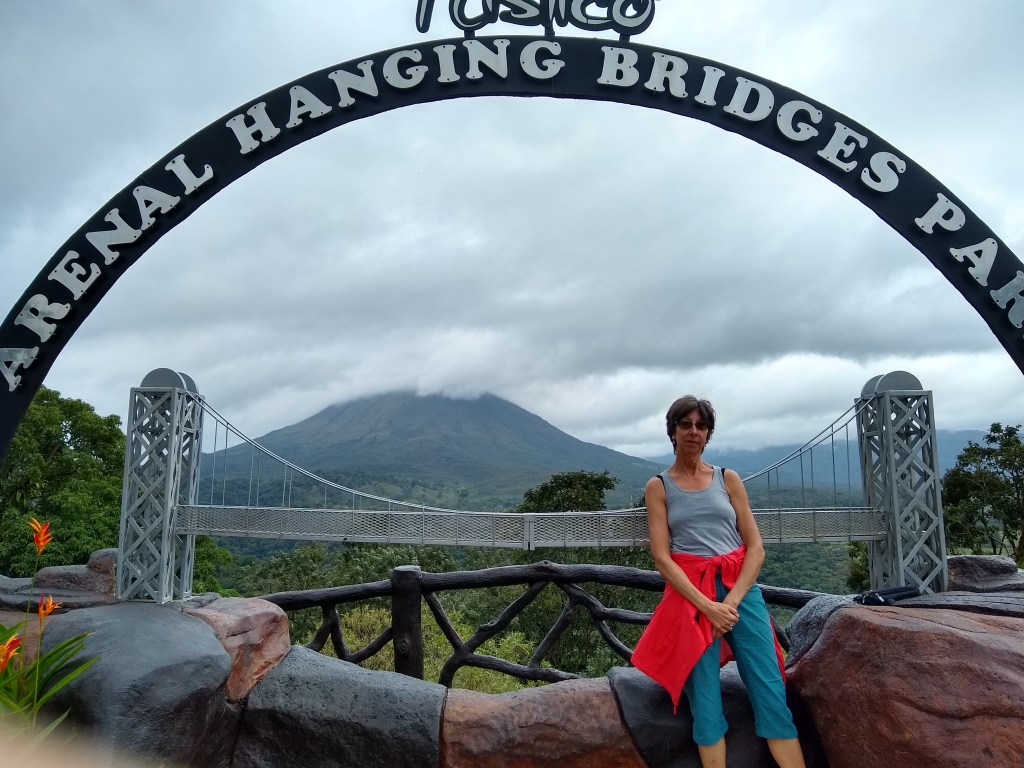
The optical illusion of Volcan Arenal behind Paula at the entrace
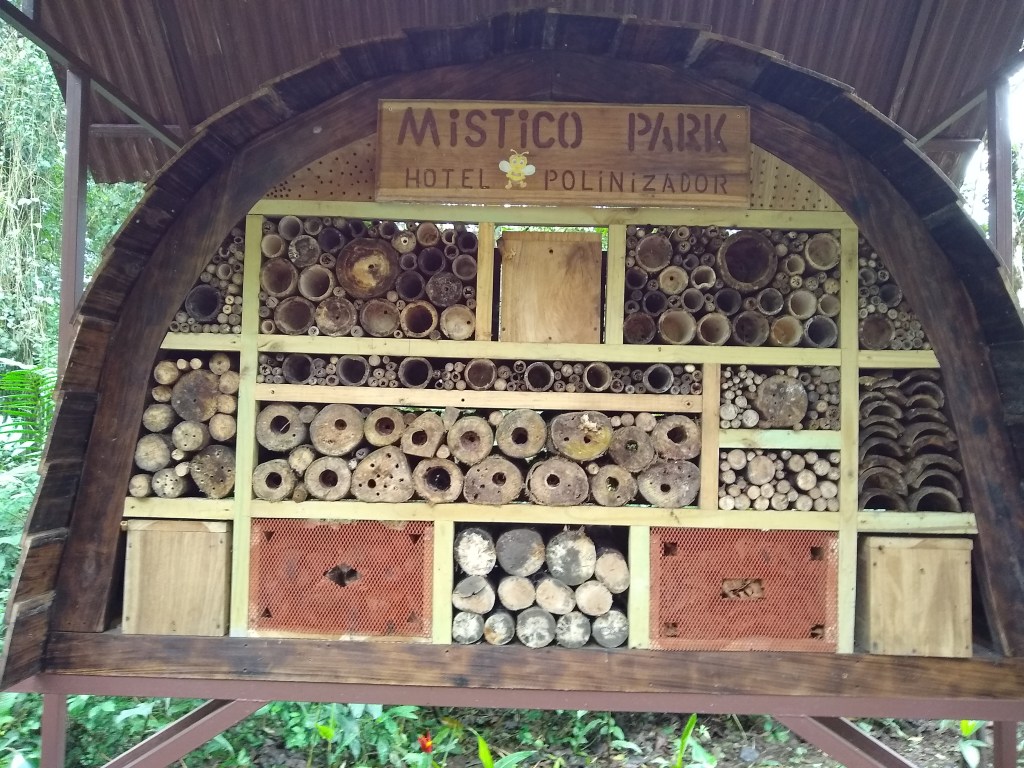
An Bee Hotel
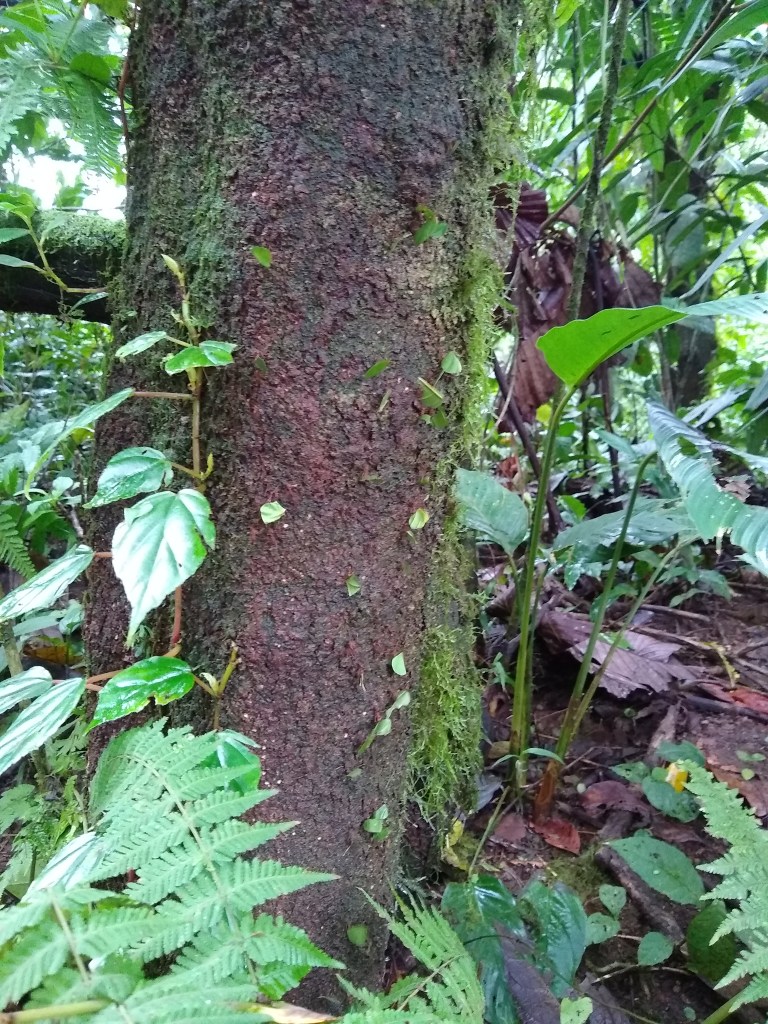
Leaf Cutter Ants at Work

Leaf Cutter Ants are not grouped in army’s, but in Corps of Engineers. They bring the cuttings from the upper leaves of palm trees into their nest, where the leaves are coated with excrement and saliva to generate fungus that will feed the colony.

Looking up to the canopy of the “Broccoli Tree”
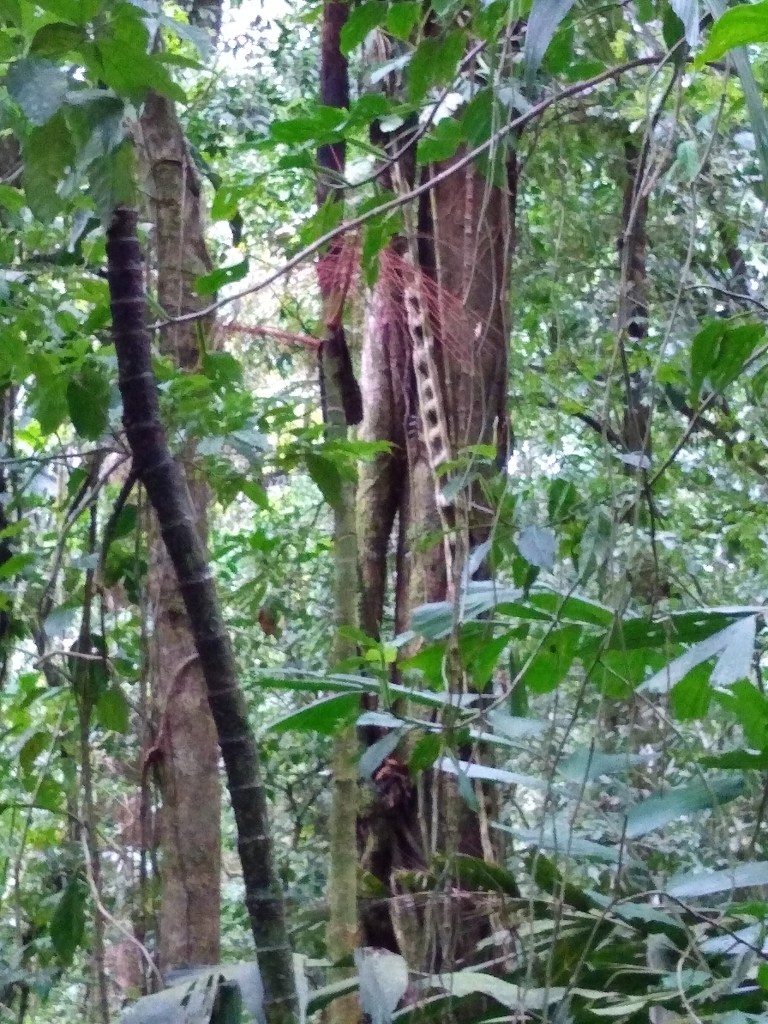
A ladder vine. Right I don’t believe it evolved to give monkeys a way to climb trees either.

I apparently forgot to take any photos of the suspended bridges. I trust Paula did, so check out her post (“two good days”).

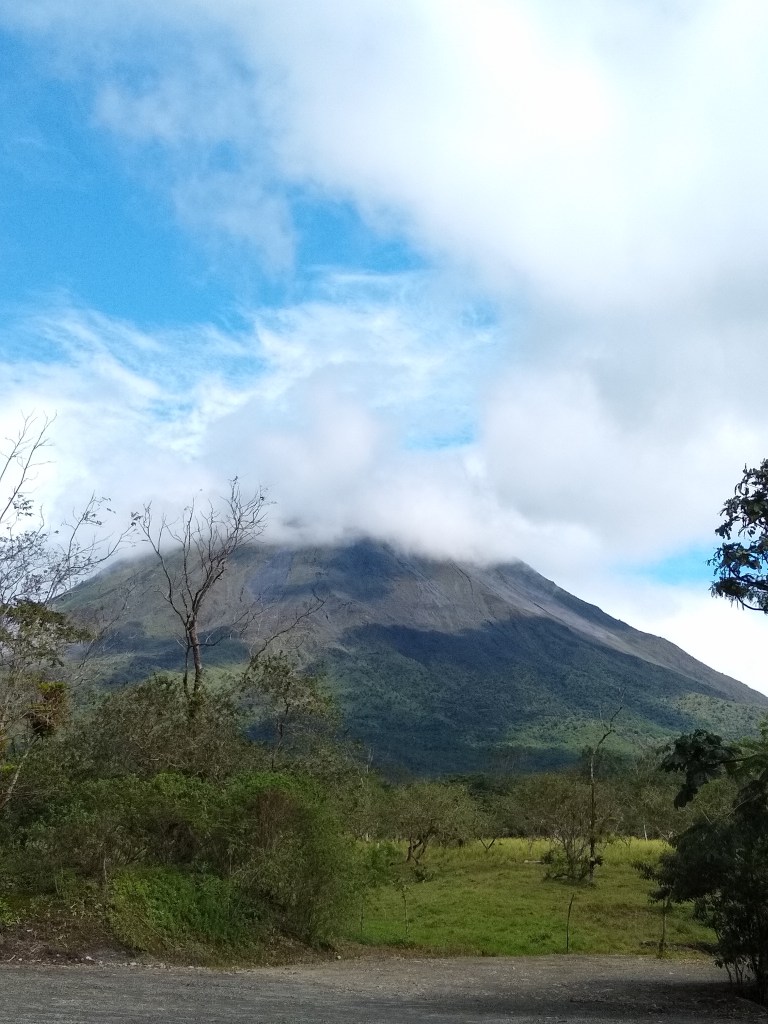
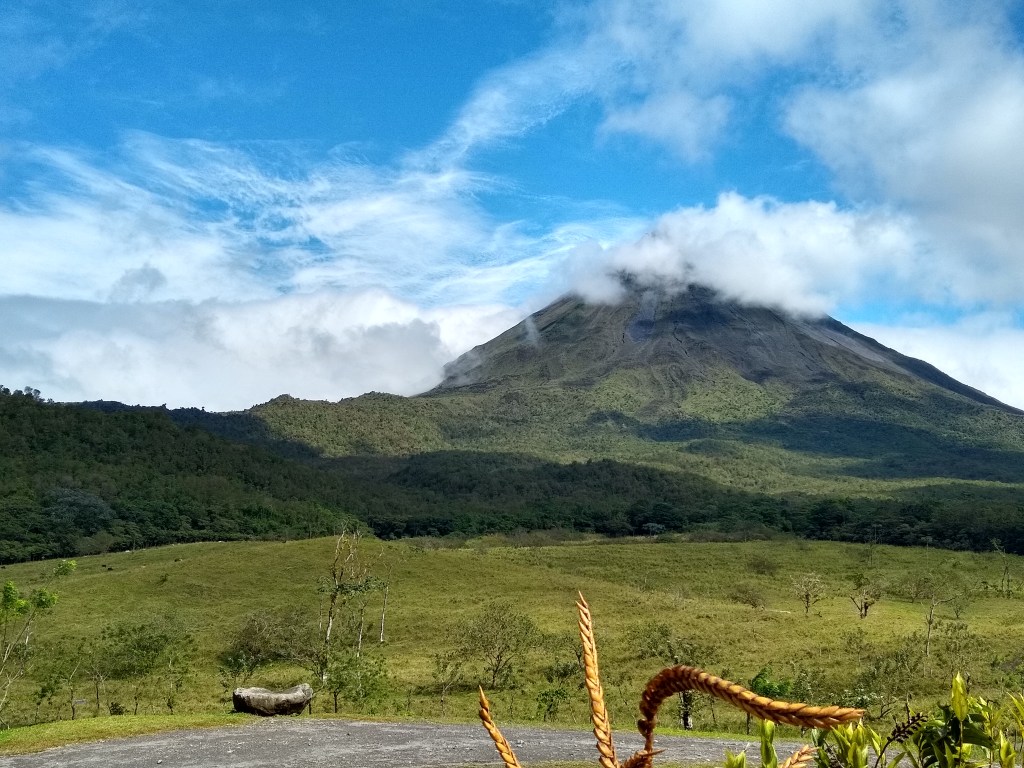
Today we went to the Arenal 1968 park that is adjacent to the Volcan Arenal National Park. This park is another private reserve that claims to allow visitors to get the closest view of the volcano since climbing in the national park is no longer allowed. The park is named for the 1968 eruption that destroyed a number of towns, including the original Arenal, the ruins of which are currently under the lake.

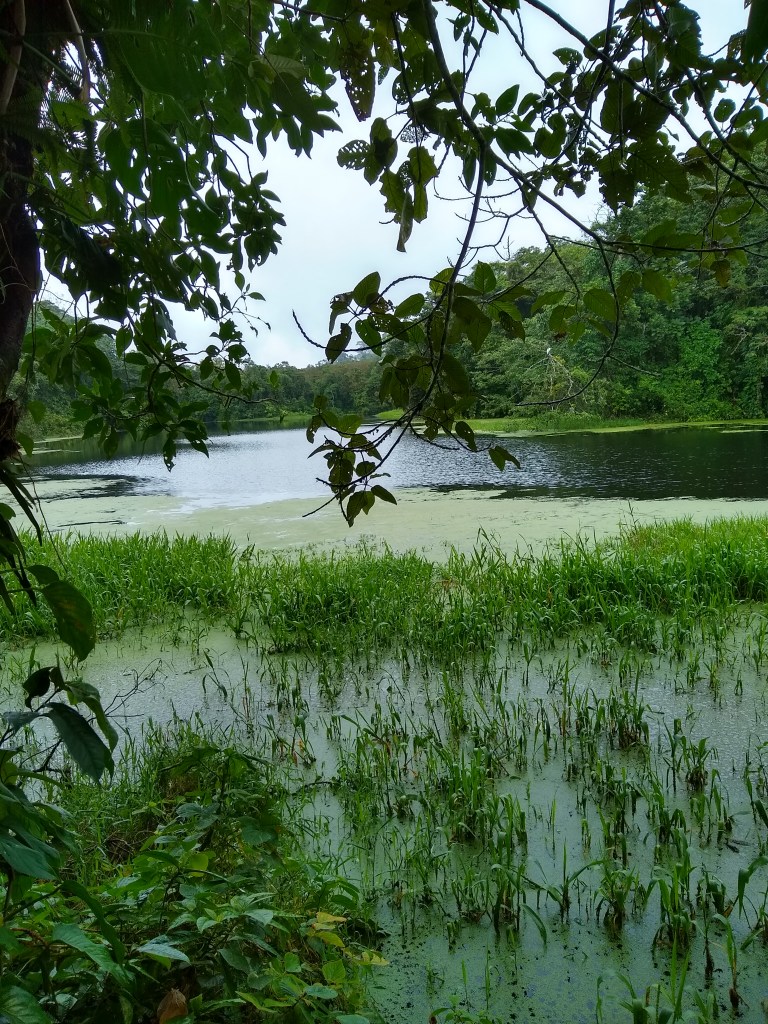
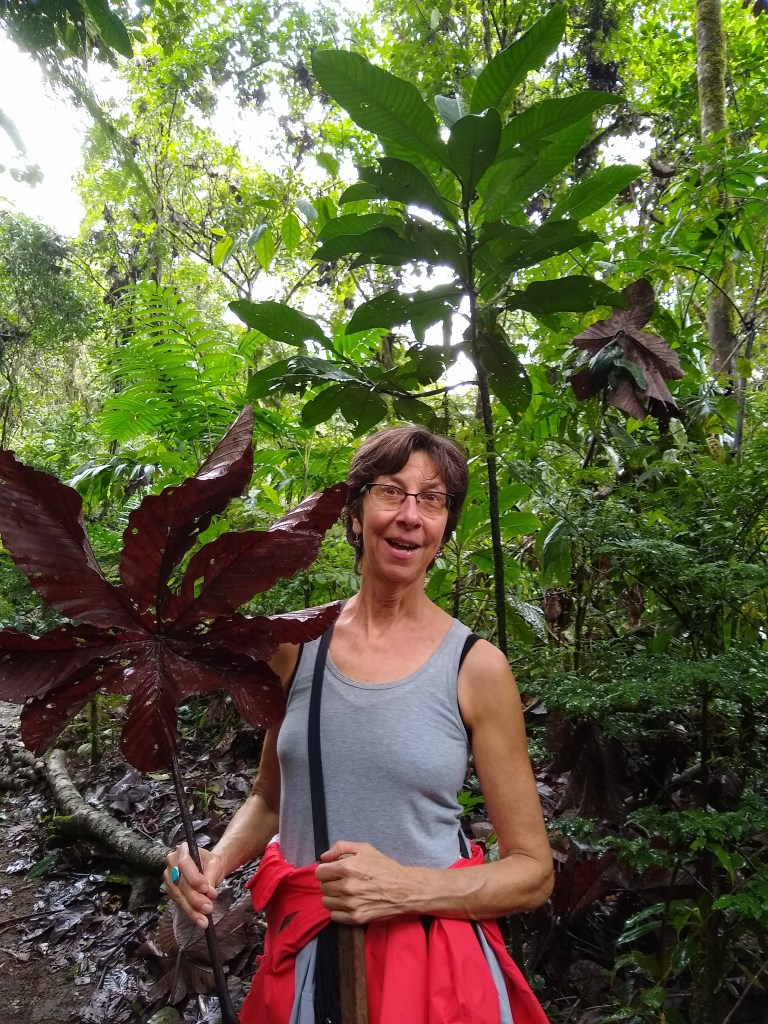
Visitors to this park can choose a trail over the lava field from the 1968 eruption, or take a forest trail that joins the lava field trail after a couple of kilometers. We did not see much wildlife, though we did hear some howler monkeys along the trail.

At the trail entrance
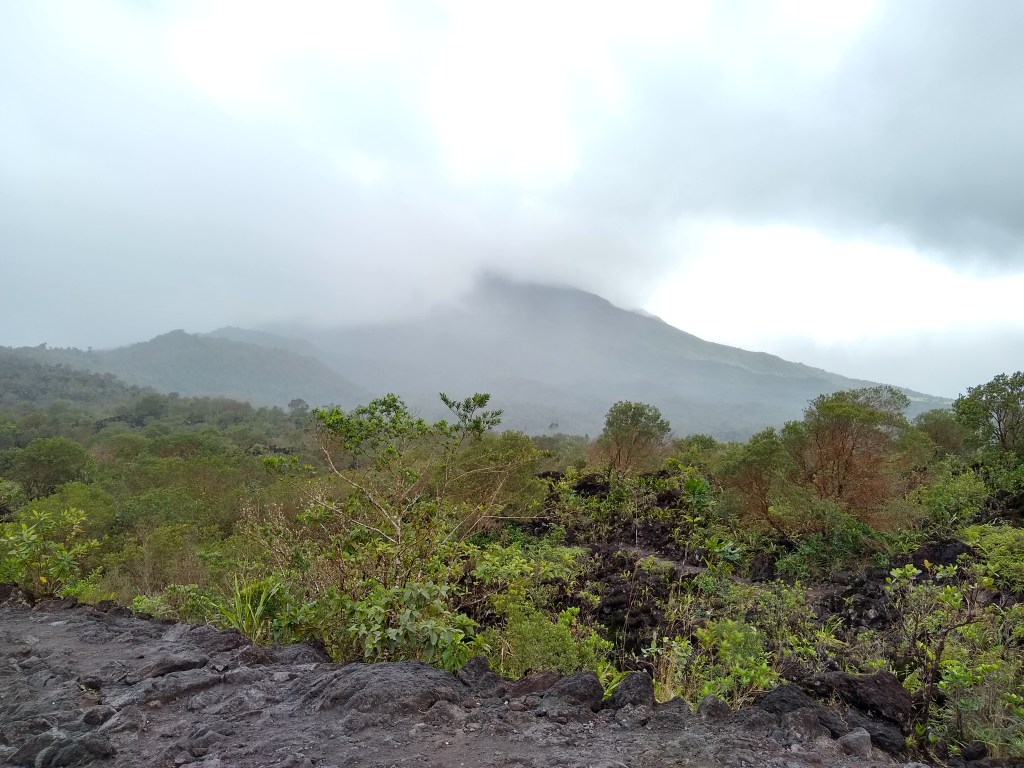
Volcan Arenal from the 1968 trail summit
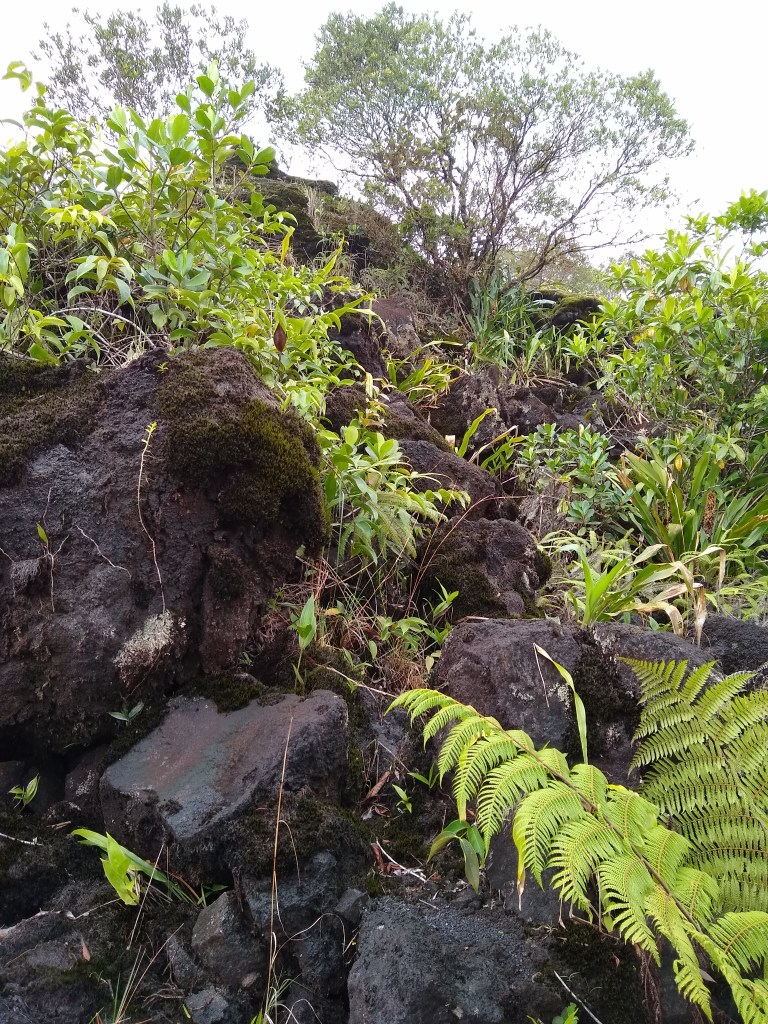
The lava field has become a quite healthy ecosystem
The clouds finally lift

After the hike was completed, Paula wanted to swim in the lake, so we headed to the boat dock and finally got to see the lake in full color.

It was a great day to be outside. It was a great day to be alive.

More later.